
There’s a class of twelve history students in an upper-level capstone class visiting the library. Many of them have been in a special collection or archive before, so the experience of stepping into a room full of old books isn’t as novel to them as it might be as a group of first years. Still, I do my best to wow them: a 1566 book on German history, written in Latin; a first edition of Virginia Woolf’s The Waves; a 1608 Vulgate Bible in French; The Girl’s Own Annual from the 1920s, with delightful anecdotes on the best way to prepare roast hare. These books feel appropriately historical, and they would make interesting capstone projects for the right student. While this is typically where I focus a library session on primary sources, during this class I decide to bring out a set of books owned by the university that aren’t, technically speaking, historical. But to my surprise, it is these books that have the students gasping in awe; many stay long after class is over to pore over the pages and ask questions.
On the table are the enormous volumes of The Saint John’s Bible Heritage Edition, a seven-volume facsimile version of the modern illuminated Bible. The Saint John’s Bible (SJB) is a project that began in 1998 and took fifteen years to complete. Commissioned by the Benedictine monks of Saint John’s Abbey in Collegeville, Minnesota, and directed by calligrapher Donald Jackson, the Bible was created with the intention of reviving an ancient tradition that has been nearly forgotten since Gutenberg’s invention of movable type. The original 1998 Bible was created using traditional quills from either turkeys, swans, or geese. The pages were prepared using calfskin vellum, and the illumination done with gold leaf and pigments. While the original remains in its home at Saint John’s Abbey, our copy of the Heritage Edition is just one of 299 identical reproductions (created under the guidance of Donald Jackson and his team) to ensure an accurate and faithful recreation of the original manuscript. Although it is a contemporary work, The Saint John’s Bible offers a powerful entry point for teaching book history, allowing students to explore medieval manuscript production, scribal practices, and the material experience of reading through an object that remains accessible, touchable, and immediately legible to modern audiences.
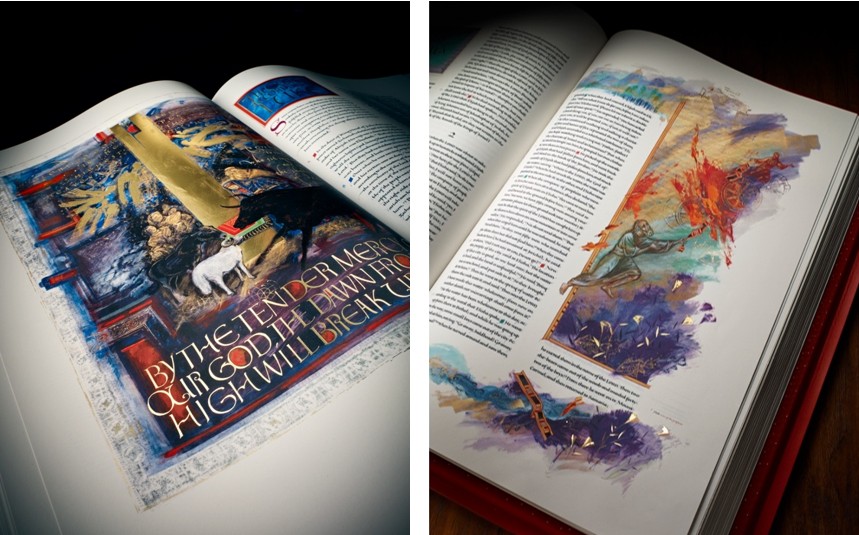
The importance of teaching with medieval manuscripts is well-studied, but The Saint John’s Bible is a bit of a phenomenon, and that means there haven’t been many (if any) discussions at all about the ways it can be used as a tool for teaching book history. The response from this class of history students suggests that it has great potential in a classroom setting, especially as an entry point for questions related to the history of the book and the comparison to medieval Bibles. Students asked several questions that spurred in-depth conversations amongst the class, such as:
- How long did it take for the scribe to complete one page?
- How is calfskin vellum made?
- What happens if a scribe made a mistake?
- Is gold leaf really made of gold?
- How were the pages laid out?
- How did the creative team decide what to illuminate?
- What is this Bible used for?
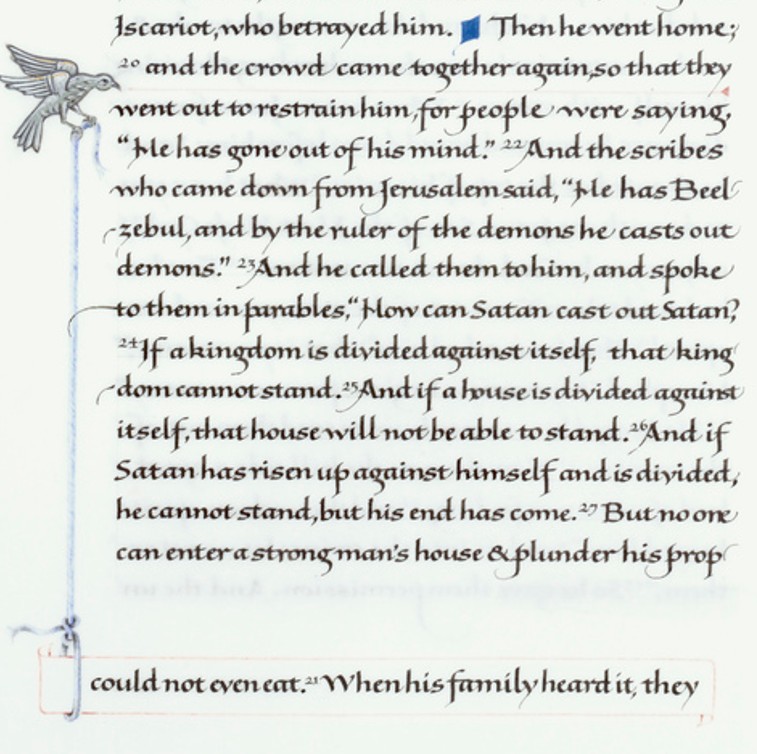
What originally began as a sneaky way to add more interesting materials to a library session turned into an in-depth study of The Saint John’s Bible and, resultingly, medieval book production. Take, for example, the question: “What happens if a scribe made a mistake?” As shown in Figure 3, “The Parable of the Sower and the Seed” in the New Testament’s Gospels and Acts, the original scribe forgot to insert one of the lines. Rewriting the entire page would equate to roughly twelve hours of wasted time (not to mention wasted vellum). Donald Jackson went to great lengths to ensure there was enough vellum to complete the project. There was no room for wasted pages, so the artistic team decided to transform the mistake into a moment of artistic creativity. In Figure 3, we can see the missing line at the bottom of the page being carried to the correct line by the pigeon, its beak pointing to the place where it should be. The medieval scribe would have encountered a similar dilemma. Medieval manuscripts are rife with examples of scribal errors: repeated lines, skipped words, or incorrect transcriptions. These skins wouldn’t have been wasted, but mistakes would be scraped off or reinvented. Using these two examples of the medieval and the modern was the perfect way for students to gain a better understanding of book history.
The illuminations also proved to be moments of great interest for the students. Not only were they fixated on the beauty of each illumination––the striking colours, the shining gold, and the mixture of modern and iconographic images––they were drawn to touching as well as looking at the images. As they flipped through the pages, I talked with them about medieval peoples’ experiences with book handling, particularly those worn places on old books that indicate repeated use––dirty pages from fingerprints or, in some cases, where people might have kissed the images.[1] In the age of artificial intelligence (AI), our eyes are no longer reliable judges of what is real and what is fabricated; touch, however, remains physical—it cannot be digitized or uploaded. As Nolan writes, “The human sense through which aura manifests itself is that of touch, because touch is the most intimate human sensation as well as the most destructive.”[2] While the initial reaction from students to seeing a rare book is that it cannot be touched, the creators of the SJB encouraged touch, and so do I. The students are drawn to the gold, and we discuss the way in which the SJB team used gold to signal the divine; the medieval illuminator, too, would know that these manuscripts were “already sacred objects channelling the hallowed word of God, but the gold added a further layer of spiritual connection, with the dazzling shine distilling the wisdom of the holy words into the reader.”[3]
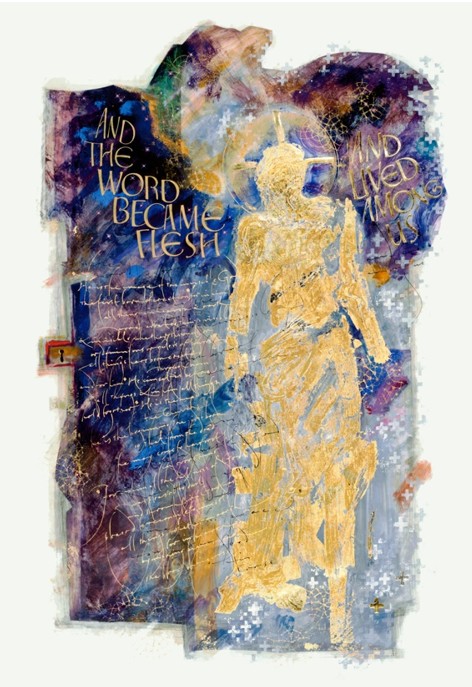
These are just two examples of the different discussions that took place during this library session. Teaching with The Saint John’s Bible allows students to experience what an illuminated manuscript would have looked like for a medieval monk, the nobleman, or king when the book was newly produced––the striking illuminations in brilliant gold leaf, those little mistakes and places of humanness which make them compelling to the modern reader. Being in proximity to a five-hundred-year-old book, while awe-inspiring, can feel almost difficult to comprehend. It’s hard to imagine the medieval monk writing with a quill in a scriptorium for hours, or the medieval hands that would have turned each page, but it’s very possible to imagine a team of modern scribes, calligraphers, printers, and illuminators coming together to plan this massive creative project. It’s almost incomprehensible in an age of AI, digital writing tools, and the onslaught of fast-paced, micro-forms of information that someone could spend countless hours writing and make a mistake … a mistake that cannot be easily corrected.
The Saint John’s Bible offers students a rare opportunity to encounter the processes, labour, and imperfections that shaped manuscript culture. By connecting a contemporary manuscript project to medieval bookmaking traditions, it renders visible the human choices, mistakes, and acts of creativity that are often hidden behind the finished page. As a teaching tool, it can create a deeper understanding of bookmaking and emphasize the humanness of their creation.
Image Credits: Figures 1–4 are reproduced from The Saint John’s Bible Heritage Edition (Collegeville, MN: Hill Museum & Manuscript Library, 2007). Images courtesy of The Saint John’s Bible.
[1] Kathryn M. Rudy, “Dirty Books: Quantifying Patterns of Use in Medieval Manuscripts Using a Densitometer,” Journal of Historians of Netherlandish Art 2, nos. 1–2 (2010), para. 1, https://doi.org/10.5092/jhna.2010.2.1.1.
[2] Maura Nolan, “Medieval Habit, Modern Sensation: Reading Manuscripts in the Digital Age,” The Chaucer Review 47, no. 4 (2013): 471, https://doi.org/10.5325/chaucerrev.47.4.0465.
[3] Sara J. Charles, The Medieval Scriptorium: Making Books in the Middle Ages (Reaktion Books, 2024), 195.