
Martin Paul Eve. Theses on the Metaphors of Digital-Textual History.
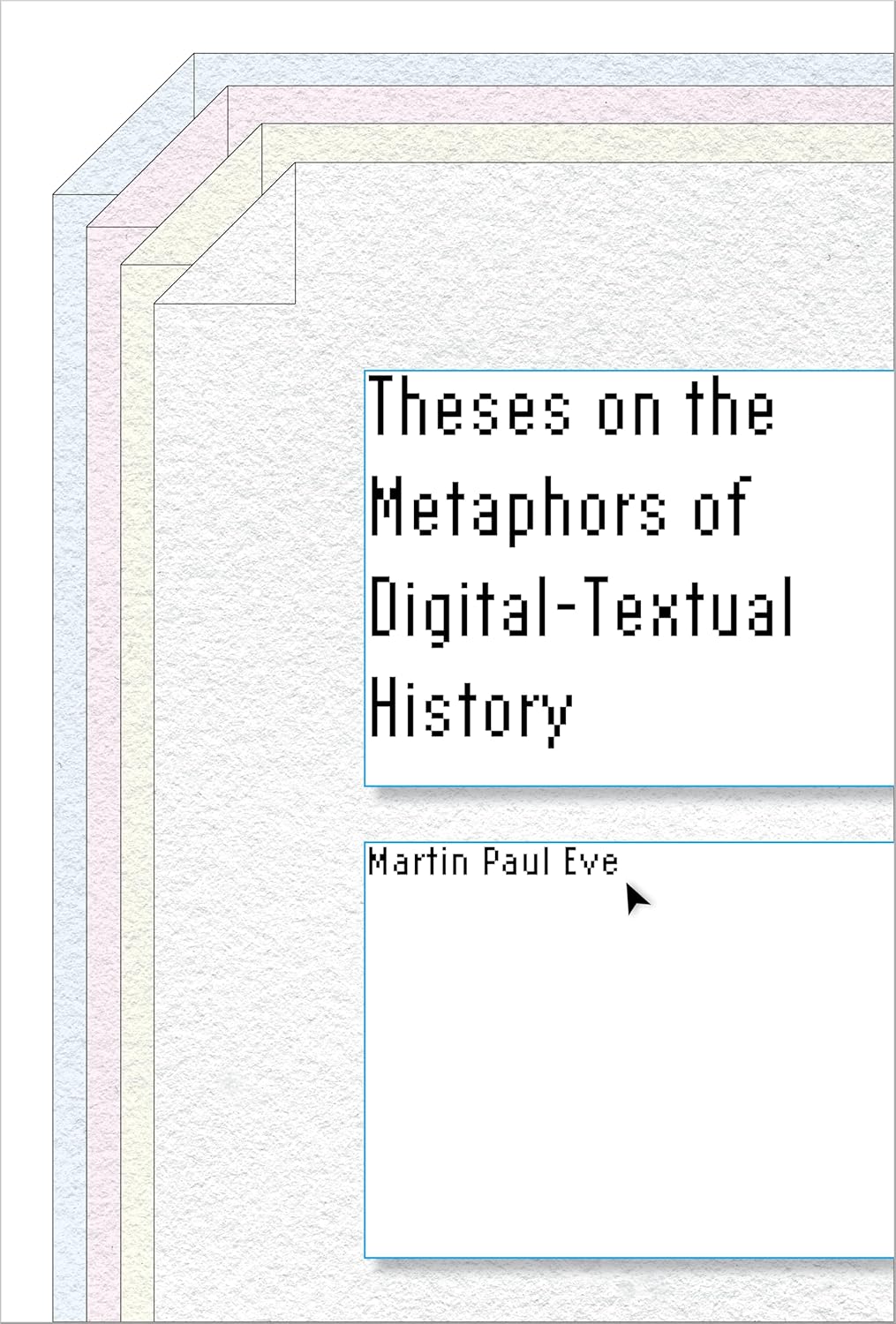
Martin Paul Eve. Theses on the Metaphors of Digital-Textual History. Redwood City: Stanford University Press, 2024. 436 pages. ISBN 9781503614888. US $35.00 (paperback).
To proclaim “theses” is to strike a decidedly ambivalent pose. It suggests the fearful responsibility of a theologian, philosopher, or mathematician tilting against tradition to establish a radical new school—yet tempers that ambition with a modesty regarding the completeness or cohesion of the work, which must be forgiven any gaps for the sake of its boldness. Fortunately, Martin Paul Eve’s Theses on the Metaphors of Digital-Textual History requires no forgiveness, as Eve deftly bridges the gulf between these disparate scopes of authorial aspiration with an overarching critique of the stubbornly encrusted terms used to label digital technologies of textual production, thereby delimiting their possible uses. His wide range of examples (including archives, viruses, copyright, cryptography, character sets, accessibility guidelines, large language models, and word processors) gives the reader an impression of breadth and comprehensiveness. Though conceptually ambitious in his argument that metaphor itself is the common problem uniting a number of challenges that frustrate digital text creators and readers, Eve scrupulously avoids overstating the political effectiveness of his theses, positioning his method of deconstructing metaphors as a diagnostic tool that illuminates “the conditions under which all contemporary writing is produced, erased, and edited” (p. 27). A champion of open-access scholarship and prolific writer in book history and digital humanities, Eve supports his grand scope with his enviably broad knowledge of the subject and relays it approachably to book history scholars, regardless of their training in computational history.
For Eve, the need to bridge gaps between ambition and coverage, proclamation and execution, is precisely the point. Such gaps typify his topic: “the messy digital-linguistic frames that condition our current reading and writing practices” (p. 5). Our techno-linguistic norms—pervasive yet unnoticed language patterns surrounding the tools, software, and processes of digital textuality—revolve around “metaphors for digital text creation [that] are not very good” (p. 295). Figurations that originally served as useful heuristics (such as the page, the library, and the window) have lost their descriptive accuracy over time, becoming maladaptive and entailing repercussions for digital authoring practices. This systemic misalignment between vehicle and tenor (the two components of figurative language) disrupts the function of metaphor: deploying the familiar to illuminate the unknown or introducing the unexpected to dislodge the ossified. Although a metaphor comes into circulation by virtue of its ability to “impute a materiality to the simulated interaction with the machine” (p. 8), once the metaphor degrades, it is vitally necessary “to understand the impact of the disjunct between the virtual’s surface effect and its true nature on contemporary textual production” (p. 9).
Despite this focus on the figurative, Eve does not position metaphors as independent agents. Instead, he opens with “the basic premise of digital textuality: that text and numbers are indistinguishable from one another” and obliges his reader to “understand the technical components that sit beneath [digital texts] and the computer-scientific principles that have conditioned that development” (p. 4). Like the founders of semiotics and poststructuralism, Eve premises his argument on the slipperiness of signifiers, which allows tenors to migrate away from their vehicles, but he cautions that technological metaphors’ possession of “a prescriptive power of their own” is cause for scholarly concern once “textual softwares become locked into paradigms that no longer make sense” (p. 6). Adopting Steven Connor’s cultural phenomenology to very good effect, Eve conjures a riotous, inconsistent system of overabundant metaphors that persist despite their contingent origins.
The book’s body chapters are devoted to understanding the histories and dangers of seven such maladaptive metaphors: the virtual page, whitespace, decentralization, reading, the window, the library, and the virus. Each chapter unravels a network of conceptual, political, and technological premises smuggled in by metaphors “when they no longer seem to function as we might expect” (p. 6), transitioning “from partial mimesis to disconnected symbolism” (p. 23). Explaining why he organizes chapters around software or technological conditions rather than individual literary texts, Eve coins the term “para-apparatuses,” an “expanded scope of metadata” that includes “actual technologies and their implementations,” as well as the metaphors sutured to them (p. 7). This choice may puzzle or irk data scientists or librarians who need interoperable standards for metadata, but adopting the coinage is not necessary for heeding Eve’s call for a “digital-material textual studies” that acknowledges the physicality of computation (p. 18), or for appreciating his wide-ranging catalogue of digital writing practices. This wide-ranging catalogue of contested sites of digital textual production balances the monograph’s technical abstractions and allows the book a second function as a compressed history of digital textual production.
Rather than speculate upon the ontological ramifications of technological metaphor, Eve proceeds with dispatch to his seven figures after using chapter 1 (the introduction) to bring the knowledge of a literary critic and linguist to bear upon metaphor as a rhetorical and aesthetic figure. Digital humanists will appreciate this effort, and technology/media theorists would do well to read chapter 1 carefully. In chapters 2 and 3, Eve reveals the contingency of the virtual “page” metaphor and the surprising musical origins of the “whitespace” metaphor, suggesting that the history of print is not as powerful an influence on digital textuality as SHARPists might assume (or hope). Puncturing idealized, technocratic metaphors about web standards, chapter 4 reconstructs how character sets like Unicode are “based, materially, on centralized structures that look quite a lot like nationalisms” (p. 137), and chapter 5 exposes how browsers and apps like Internet Explorer and WordPress implemented “bad readership” practices for “much of the web’s life” (p. 148). Chapters 6 and 7 dismantle the liberal claims to freedom, individuality, and disinterested public utility made by interface and programming infrastructures, which make use of “window” and “library” metaphors. Chapter 6 shows that the window metaphor creates a false impression that all software interactions are transparent and identical for every user, occluding the fact “that people interact in diverse ways with software and digital text, based on a diversity of body types, abilities, and impairments” (p. 210). Meanwhile, chapter 7 deconstructs the library metaphor, which suggests information can be shared through public libraries, including data and code, by examining the contested terrains of cryptographic and machine learning libraries. Eve’s condemnation of inadequate international legal standards for maintaining access to webtexts renders chapter 8 a must-read for SHARPists, who will undoubtedly receive his interrogation of key principles of preservation with interest.
Eve is an excellent explainer with an effortlessly authoritative voice and a deft hand for details. Digital media specialists may find many of the component claims and historical touchstones familiar, but the book’s overarching narrative of obsolescing metaphors recontextualizes these elements into a compelling new whole that should be required reading for all doctoral candidates in literature. Eve’s personal moral and aesthetic sensibilities infuse the text; chapters conclude with predictions or recommendations that resonate with deeply held moral positions about the responsibilities of technology developers, users, and scholars alike to create and maintain digital texts that are open, free, and accessible. These positions derive equally from his values and his knowledge, but, as a structural force, they sometimes propel examples hastily toward definitive conclusions that depart from the nuanced, complex agnosticism with which he handles his broader claims. Such risks fundamental to the genre Eve inherits from another Martin proclaiming urgent truths five centuries ago, and in an ever-changing landscape of digital textual production, it is an undoubted comfort to have his guidance.
Shawna Ross, Texas A&M University