
Daniel Matore. The Graphics of Verse: Experimental Typography in Twentieth-Century Poetry.
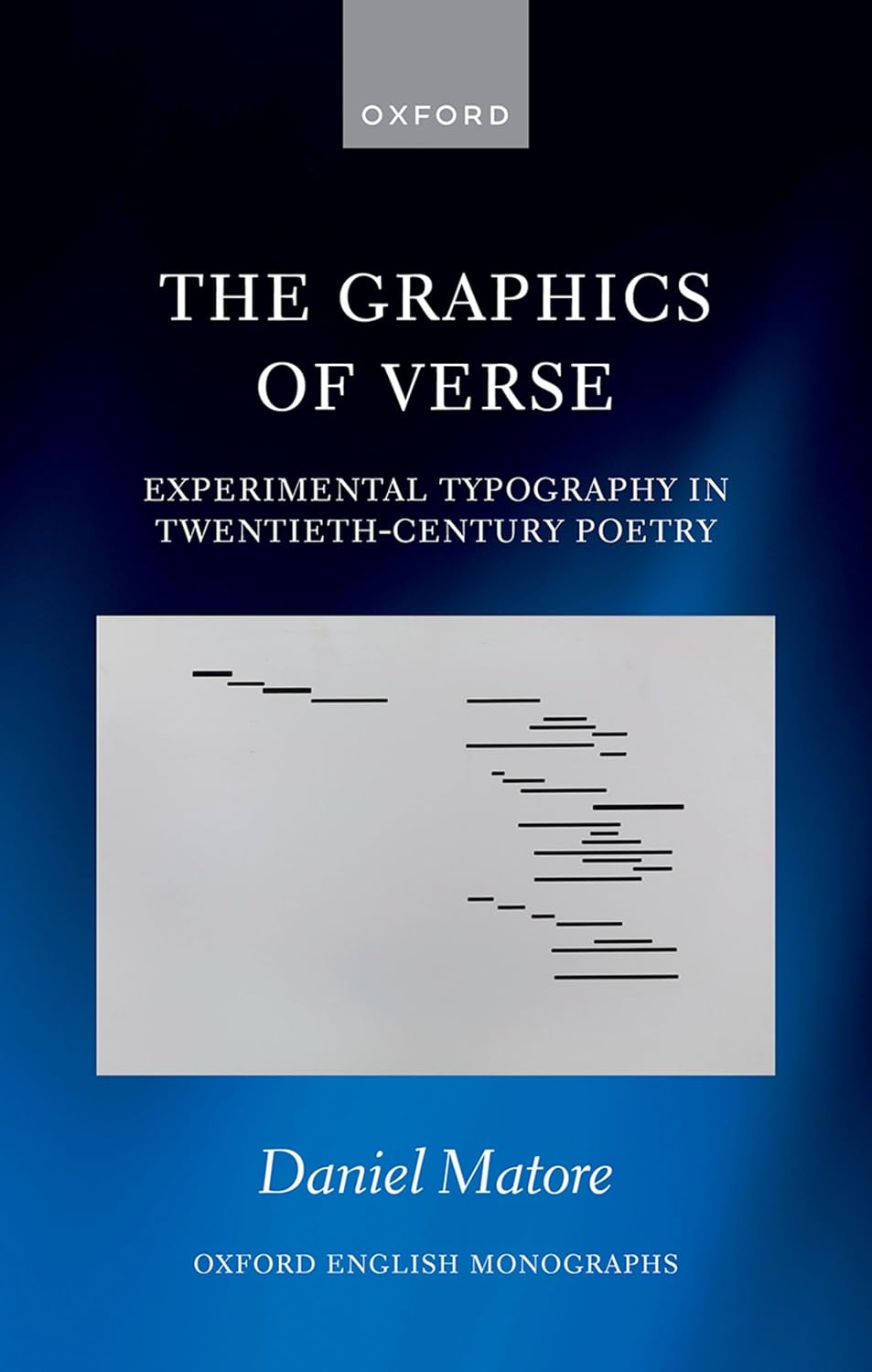
Daniel Matore. The Graphics of Verse: Experimental Typography in Twentieth-Century Poetry. Oxford: Oxford University Press, 2023. 252 pages. ISBN 9780192857217. £60.00 (hardcover).
Daniel Matore’s book, The Graphics of Verse: Experimental Typography in Twentieth-Century Poetry, is the first systematic study of typographical experimentation in twentieth-century poetry. The book contributes to the field by highlighting the often overlooked role of typography in shaping poetic meaning and form. It provides an in-depth study of how modernist poets used visual elements to enhance their artistic expression and how their typographical choices amplified the meaning and impact of their works.
Matore’s introduction claims that “typographical experiment is bound up with the preoccupations of modernist poetics” (p. 4). He provides an insightful study of the relationship between typography and modernist poetry, centering on the pivotal influence of Stéphane Mallarmé. Matore argues that Mallarmé’s experimental typographical choices, seen in works such as “Un coup de dés,” forge a significant link between visual form and poetic meaning. Critiquing the limitations of terms like “concrete poetry,” Matore advocates for a broader understanding of typographical experimentation that includes poets such as Ezra Pound and William Carlos Williams. His examination of varied approaches to page layout reveals how typographical decisions reflect deeper aesthetic and philosophical ambitions.
Chapter one examines Ezra Pound’s engagement with typography, challenging the traditional view of him as a poet primarily focused on sound. Matore argues that Pound’s concerns with typography reflect his anxieties about how visual elements shape meaning, noting that “Pound’s attempts to exempt himself from the contemporary strains of visual experimentation merit scepticism” (p. 35). Matore reviews how Pound’s dissatisfaction with conventional print arose from its failure to convey poetry’s rhythm and emotional depth—a frustration linked to technological advancements. As Matore writes, in Pound’s estimation “the rhythmical and tonal precisions of modern poetry…are not communicable through conventional typography” (p. 58). Typography, central to Pound’s poetic practice, evidences a tension between his innovation and the desire to control interpretation. However, despite these anxieties, Pound experimented with typography in works such as Guido Cavalcanti’s “Donna mi prega” to enhance his poetic form. This endeavour, according to Matore, illustrates Pound’s deliberate effort to achieve comprehensive bibliographical control. It exemplifies typographical innovation within the framework of another poet’s oeuvre, thereby enhancing the intricacy of his methodology and echoing the wider experimentation in his practices.
In chapter two, Matore discusses E.E. Cummings’s use of the typewriter as a medium for typographic expression, asserting that the typewriter enabled Cummings to manifest his artistic vision against the constraints of mass production imposed by the linotype machine. Matore’s analysis of Cummings’s work illuminates the poet’s complex relationship between expressive freedom and mechanical constraint, challenging Martin Heidegger’s reductive view of the typewriter as merely producing machinic texts. Instead, Matore contends that Cummings saw the typewriter as a mechanical aid but also as a liberating tool capable of simultaneously conveying both precision and unpredictability. He supports his argument by referencing Cummings’s letter to his aunt, in which the poet describes the linotype machine as a “gadget” that “inflicts a preestablished whole” on the text (p. 94), and proposes “an ingrained and unique typographical thinking in the works of Cummings” (p. 103).
Matore’s analysis of Charles Olson’s poetics in chapter three calls into question the prevailing notion that Olson’s work is primarily concerned with aurality and the primacy of the ear. Instead, he maintains that Olson’s poetry deeply engages with the visual and material aspects of language, particularly through typography. Examining Olson’s essay “Projective Verse,” which advocates for ear-centered poetics, Matore claims that Olson’s later work, particularly The Maximus Poems, shows a shift toward integrating sound and sight in poetry. This is evident in Olson’s use of typography to create a “graphical landscape” that interacts with and shapes the poem’s soundscape (p. 149). Olson’s revisions to “Conqueror,” in which adjustments to line spacing and layout demonstrate visual awareness, further support Matore’s argument that “graphics” were integral to Olson’s work (p. 155). This attention to visual detail is also portrayed in Olson’s frequent use of letters as a model for poems, blurring the lines between poetry and correspondence. Matore redefines the understanding of Olson’s poetics by foregrounding their often bypassed visual and material dimensions.
The final chapter sees Matore return to his high-level overview of the subject to consider the broader implications of experimental typography in modernist poetry. Matore explores the views of influential typographers such as Stanley Morison and Eric Gill, who contributed to typographic innovation but resisted the idea of typography as a medium for radical experimentation. For Morison, “print is inhospitable to experiment” because typography’s core purpose lies in mass replication, which relies on public acceptance (p. 209). Matore contrasts this statement with modernist poets’ departures from traditional norms, claiming that these poets, “unschooled in such traditions” and “liberated from the conservatism of print,” prioritised expressive design over typographic standards (p. 213). As a result, modernist poets produced visually unconventional layouts, not bound by tradition but serving as vehicles for formal and visual disruption. Matore probes how these poets reframed concepts of legibility and illegibility, with typography becoming a visual extension of poetic thought, transforming print into a medium for expressive experimentation.
A lecturer in Modern, American and Comparative Literature at the University of York, Matore’s expertise in modernist literature and visual culture is evident throughout The Graphics of Verse. Drawing on diverse sources, including primary texts, critical essays, and archival materials, his research is meticulously documented and deeply engaging.
However, questions arise about the representativeness of the study, particularly in terms of the periods covered and the place of female poets in his analysis. Despite the book’s blurb inviting readers to explore why British and American poets, from the early twentieth century “right up to the present day” (emphasis mine), experiment with the design and layout of the printed page, the analysis remains largely confined to early- to mid-twentieth-century poets. Matore’s predominant focus on canonical male modernist poets leaves less room for an expansive discussion of the women poets he mentions, including Marianne Moore, Frances Motz Boldereff, Hope Mirrlees, and Denise Levertov. Considering their significance, a more detailed analysis of these figures would have provided an interesting counterbalance to the in-depth discussions of Pound, Cummings, and Olson.
These limitations notwithstanding, Matore’s study provides valuable insights into the relationship between visual form and poetic meaning, making it significant to modernist studies, and enhancing our understanding of typography’s potential in poetic expression.
Adeola Eze, Coventry University