
Adam Smyth, ed. The Oxford Handbook of the History of the Book in Early Modern England.
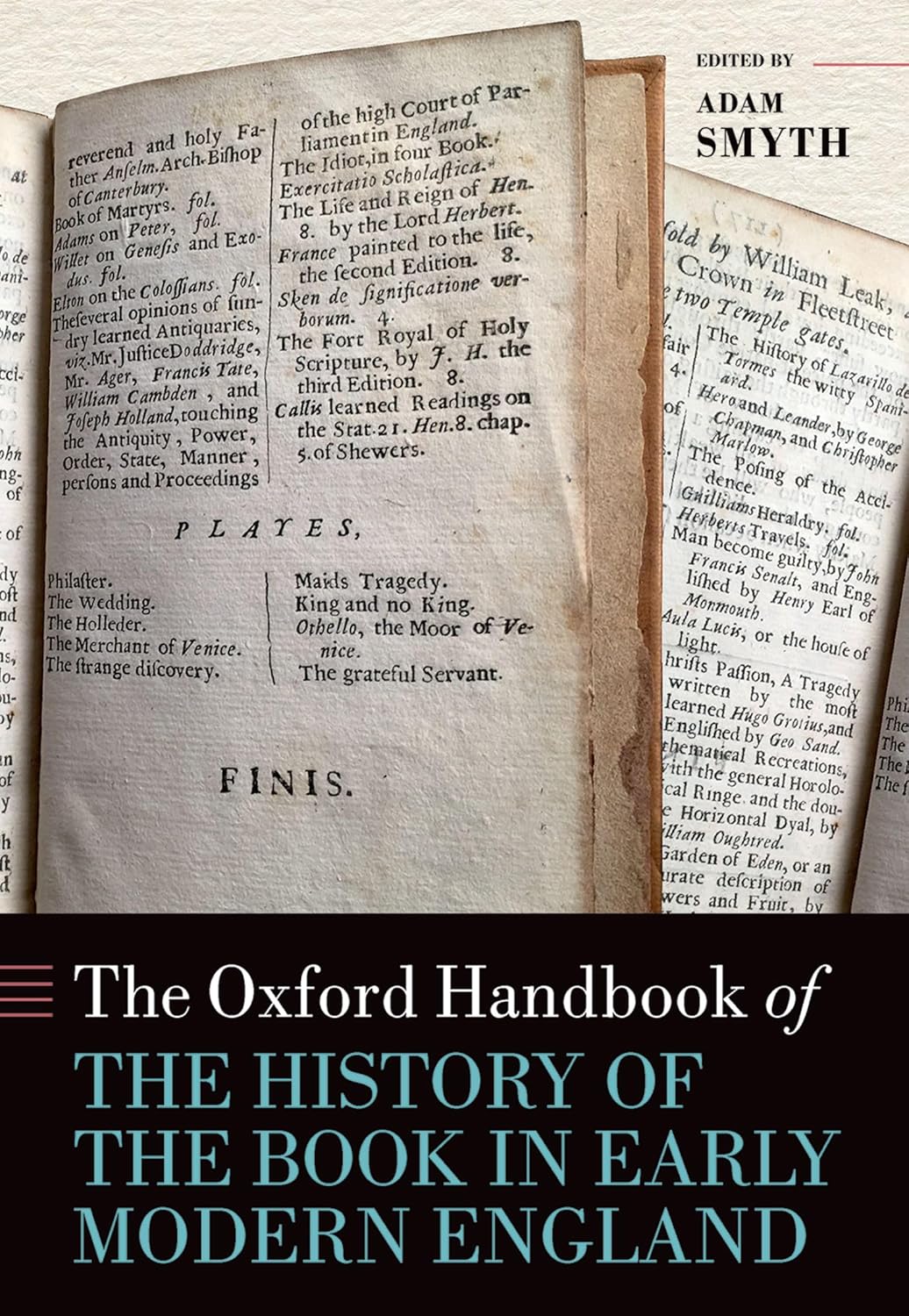
Adam Smyth, ed. The Oxford Handbook of the History of the Book in Early Modern England. Oxford: Oxford University Press, 2023. xxii, 739 pages. ISBN 9780198846239. £120 (hardcover).
At first glance, the title of this volume may elicit the question: “Why?” It recalls the magisterial Cambridge History of the Book in Britain, volume 4: 1557-1695 (CHBB4; 2002), covering the same period and a similar geographical area, and providing, like CHBB4, a broad overview of book-related activity. Is Oxford attempting to rival or belatedly to oust Cambridge?
The answer: certainly not. CHBB4 is now twenty-three years old, and relevant scholarship has developed rapidly. Except for Adrian Johns, the contributors to The Oxford Handbook of the History of the Book in Early Modern England (OH), many of whom are extremely eminent, differ from the equally eminent contributors to CHBB4. The predominance of material published after 2002 in the chapter bibliographies suffice to indicate just how much has been written since CHBB4. Editor Adam Smyth explains the two fundamental aims of OH, running through all the chapters, as being “to analyse in a lively manner the nature and role of the book in early modern England,” and “to consider critically how we talk about the history of” the book (p. 15): “content” and “approaches” respectively. The materiality of the book is important throughout.
Chapters consciously avoid repeating material in earlier publications and focus on new, “critical-analytical perspectives of topics” (p. 15). OH achieves this with full coverage; there is no sense of a chapter wanting. Just one chapter, “‘A Gifte of good Moment’: A New History of the Stationers’ Benevolence to the Bodleian Library, 1610 to 1616,” sits awkwardly in the volume. Its exploration of archives to amend our notions of the relationship between the Stationers’ Company and the Bodleian Library in the second decade of the seventeenth century is excellent, but the specificity of topic would have made it more appropriate for a book history journal.
Many chapters present a great deal of solid fact, among them Brian Cummings’s “Religion and the History of the Book,” Jason Scott-Warren’s “Monuments and Trifles” (about what happened in, and emerged from, the printing shop, from folios to jobbing printing and pamphlets), Michael Hunter’s “Illustrated Books,” and Hanna de Lange and Andrew Pettegree’s “Internationalism and the English Book Trade.” They combine well-known information with new research. See, for example, Paul Nash’s chapter on the print shop, which adds to earlier expositions by Philip Gaskell and others lively detail about the health risks incurred thereby, and compares the theory presented by Joseph Moxon’s Mechanick Exercises with practice. All these chapters are eminently readable. They rise on occasion to be positively thrilling:
The authorities are at the door. They’ve come to confiscate your property. Quick: what’s the first thing that you hide? For the printer Robert Waldegrave, it was some “lettres in a boxe”—not letters of correspondence, but letters of the alphabet, equipment used to print illegal pamphlets (hence the raid). (p. 311, James Mission, “Typography”)
A trend towards literary critical argument in book history also emerges clearly in this work. Alongside the fact-driven chapters are others that theorise, most saliently Jeff Dolven’s “The Early Modern Book as Metaphor,” which uses Edmund Spenser and Ben Jonson to discuss the book as prop, blind, memory, prophecy, commodity, food, building, self, friend and child. Emma Smith’s “Self-Reading Books: Marginalia, Prosopopoeia, and Book History” urges us to think of books as biographical subjects, not objects, and Kathryn James’s “Provenance Narratives in the Twenty-First Century” locates the dissolution of the monasteries at the beginning of English literary studies as it discusses the recovery of the past through the cataloguing and piecing together of manuscript fragments, are also on the literary side.
Some changes between the OH and earlier histories are primarily lexical, but redress former value judgements, such as the progression from “provincial” to “regional” printing. Maureen Bell had already considered women printers in CHBB4, and the role of women both in the book trade and as readers has enjoyed a fair amount of attention since. OH increases the focus to discuss two early twentieth-century women scholars in Shakespearean studies, Alice Walker and Henrietta Bartlett, in Claire Bourne’s chapter, “The Handmaids’ Tale: Book History, Shakespeare, and Women’s Textual Labour.” Concern for ethnicity and diversity emerges especially in Brandi K. Adams’s “‘Inlaid with inkie spots of jet’: Early Modern Book History and Premodern Critical Race Studies,” which looks at the portrayal of people of color in illustrations and at the terminology around blackness, such as “printer’s devils.”
We never forget our own century. “Printing and Book History” by Alexandra Franklin and Richard Lawrence is a fascinating chapter on learning through practical printing. Several chapters exhort us to discard our twenty-first-century views, such as Bruce R. Smith’s “Early Modern Books and Phonography,” which discusses how different types of books lend themselves to being read aloud, and David Pearson’s “Owning, Preserving, and Transmitting the Text,” which reminds us not to equate book ownership with book collecting. Chapters rooted especially firmly in the current century provide an overview of digital projects by Whitney Trettien and a juxtaposition of the early modern book with modern artists’ books by Sujata Iyengar. Two welcome chapters bring together academics with other professionals who work on early printed books. “Broken Books and Fragile Print” by conservator Nikki Tomkins discusses the tension between retaining evidence of a book’s former materiality and preserving it for the future. “Past, Present and Future” by curator and librarian Caroline Duroselle-Melish describes comprehensively how library professionals work with rare books in various capacities and how these roles have developed.
Most chapters are clearly and elegantly written. The book’s illustrations are relevant, helpful, and clear. Some factual and typographical errors, however, have crept in. A collational formula is formatted incorrectly (p. 6; presumably a printing mistake); border appears as “boarder” (p. 7), “Holinshed” is spelled “Hollinshed” in ch. 13 (but correctly in ch. 16); the claim that there “there are few standard guidelines for…cataloguing multilingual texts” (p. 448) is misguided; the Geneva Bible first appeared in quarto, not octavo (p. 513); “a Sammelbände” appears for “a Sammelband” (p. 635); John Selden’s books are at the Bodleian Library, not at Cambridge (p. 635); EEBO is described as a “catalogue” (p. 713). These do not detract from the overall quality of a worthy and impressive volume, an indispensable addition to institutional libraries with any stake in book history or English literature.
Karen Attar, University of London