
Rhae Lynn Barnes and Glenda Goodman, eds. American Contact: Objects of Intercultural Encounters and the Boundaries of Book History.
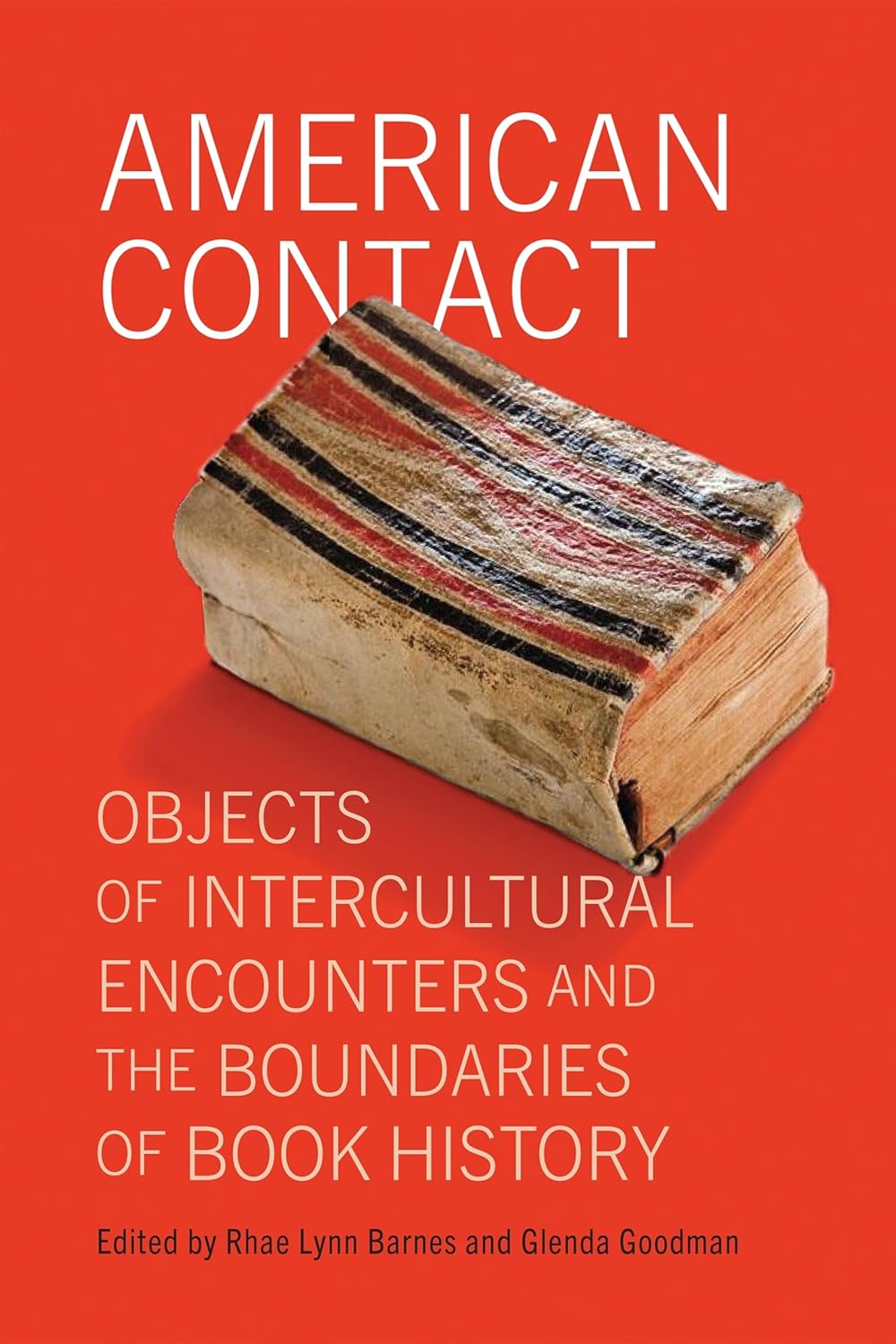
Rhae Lynn Barnes and Glenda Goodman, eds. American Contact: Objects of Intercultural Encounters and the Boundaries of Book History. Philadelphia: University of Pennsylvania Press, 2024. 456 pages. ISBN 9781512825770. $74.95 (hardcover).
American Contact begins its exploration of American book history by pressure testing its disciplinary boundaries. A field at once material and textual, empirical and deeply interpretive, book historical scholarship can still struggle to outrun its associations with bibliographic scorekeeping and Euro-American print circulation. But for Rhae Lynn Barnes and Glenda Goodman, along with the more than fifty scholars who contributed to this superbly useful volume, the field works best when its key terms—American, book, and history—are defined as expansively as possible.
This is why the editors introduce the volume not with a text, but with a textile: the crazy quilt of Hawai’i’s last monarch, Queen Lili’uokalani, who stitched an archive of her life while imprisoned in her own room in the ‘Iolani Palace. Produced at the edges of America’s growing imperial imagination, before the US annexation of Hawai’i in 1898, this object is part of a historical moment in which Americanness, textuality, and historical memory were being contested and remade. The quilt is a patchwork of conquest, a monument to a dying monarchy, an assertion of sovereignty, an assemblage of national and regional memory, a personal testimony, and an act of resistance. Its politics are self-contradicting; its motifs and techniques borrow from Hawai’ian and Euro-American traditions, and its relationship to textuality and to narrative is uneasy. But book historians have long been in the business of reading objects as texts and texts as objects, and the editors of this volume offer a fascinating, deeply researched, and provocative analysis of this object, setting the stage for a collection of essays that “pushes the boundaries of the history of the book” toward more inclusive and imaginative scholarly domains (p. 8).
Though there are too many essays to summarize adequately here, what unites them is a commitment to what the editors call “layered legibilities” (p. 1). These are the proliferating and mutually enriching meanings that textual objects accrue—first as they pass through moments of intercultural encounter, and later as they are digested by the makers of historical and critical memory. Chadwick Allen’s essay on Serpent Mound, an effigy mound in southeastern Ohio, is a particularly telling starting point. Allen notes that historians still struggle to date the original creation of the mound, but that it is likely the earliest “object” referenced in the volume. And as Allen observes, its status as an object is unsettled: it is a landform, a cultural production, and a living site of historical, political, and spiritual reinterpretation. Allen reads the mound itself, the maps that nineteenth-century historians drew to represent it, twentieth-century scholarship that relitigates the claims of those maps, and the affective experience of viewing the mound from different vantage points. Reflecting on his visit to Serpent Mound, Allen illuminates how the site both clarifies and frustrates the scholarly hunger for scriptedness, for syntax, and for linear, legible meaning-making. He reminds us that the mound, as old as it is, is epistemologically alive.
At its simplest, American Contact is a collection of object biographies that takes seriously the epistemological aliveness of its subjects. Chapters on the Maya Stela, the Tlaquimilolli, Alonso de Molina’s grammar book, the Frankland family’s receipt book, and Yun Ch’i-ho’s diary all consider understudied dimensions of their own historical moments, but they also offer contemporary scholars new points of entry into conversations that might otherwise have come to feel settled. Chris Suh, for instance, reads a diary of Yun Ch’i-ho, a Korean student at what is now Emory University, to investigate what life was like for international students at American universities at the end of the nineteenth century. The diary is not only a chronicle of intercultural encounter, Suh notes, but it also reveals how scholarship itself can struggle to make sense of the dissonances of the moments it aims to study. Where previous scholars have wanted Yun Ch’i-ho’s observations about anti-Black racism in the US South to evolve into full-throated critiques, Suh shows they instead resolve into observations, apologies, or indifference. How do we interpret such a document in light of Yun’s demonstrated interest in remediating inequality? For Suh, it is a matter of understanding and accepting the flawed, personal, and idiosyncratic nature of material texts, even as we can also use them as a window into a time, place, and cultural milieu that is otherwise inaccessible.
Often, the key to unlocking the complexity of the objects and documents featured in this collection is rigorous attention to their materiality. As Don James McLaughlin notes in a brilliant essay on the queer possibilities of comic valentines, the “affective pandemonium” invited by consumer ephemera creates openings for unexpected material attachment (p. 241). McLaughlin’s attention to the nineteenth-century practice of wrapping a letter in its own sheets, so to speak, offers a model for how scholars can think about the material conditions of textual transmission as metaphors for analyzing the forms of connection that such texts attempt to engender. How a text came to its first readers, and how it comes to us now, are vitally important to the authors of this volume’s essays.
The ways in which this volume eludes summary testify to its strengths. It is its own crazy quilt of methods, histories, and scholarly commitments, yet it also reads like a mission statement for the field. American Contact is both a bird’s-eye view and a richly textured portrait of book historical scholarship as it exists today: a field in which disciplinary boundaries are continually being redrawn, in which assumptions are challenged and historical actors are treated with generous critical rigor, and in which gathering vast and nuanced stores of material data have become shared values.
Most of the essays resist—to varying degrees—arguments or conclusions, which might strike some readers as a limitation. Yet the chapters are all richly infused with readerly interpretation. The only weak points of the volume appear when the mood of productive unsettling is overtaken by a teleological formula of historical suppression and contemporary recovery. But taken together, these essays offer a feast for the book historian and the generalist alike. While it will be profoundly useful to scholars, this volume has the potential to be completely transformative for students trying to orient themselves within the intersecting fields of book history, material culture studies, and American studies. Students who read this book will learn to write about textual objects with heart and equanimity, to use reading as a way into understanding, and to draw lines between the past and the present with creativity and care.
Emily Gowen, Harvard University