
Samuel V. Lemley, ed. The Four Shakespeare Folios, 1623-2023: Copy, Print, Paper, Type.
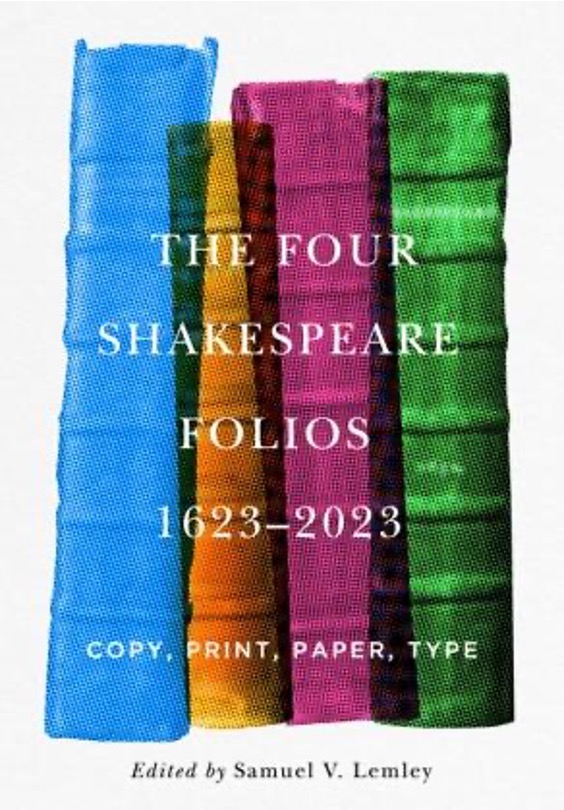
Samuel V. Lemley, ed. The Four Shakespeare Folios, 1623-2023: Copy, Print, Paper, Type. University Park, PA: Penn State University Press, 2024. 161 pages. ISBN: 9780271097329. US $64.95 (cloth).
As the quadricentennial of the publication of the First Folio, 2023 was a hallmark year for both Shakespeare and book history studies, and many celebrations, conferences, and publications marked the date. The Four Shakespeare Folios, 1623-2023 makes no secret that it is one of this number; editor Samuel V. Lemley notes in his introduction that it arose from “two exhibitions held to mark the quatercentenary of the First Folio” (p. 7). However, the book owes its existence to more than just this anniversary. A foreword by Keith Webster, Dean of Carnegie Mellon University’s Libraries, extols the virtues of academic libraries, in particular special collections. Though indisputable, Webster’s claims may seem incongruous until the reader continues through the book: (almost) every chapter makes use of the archives of only one library. In a way, therefore, this book analyzes different libraries’ collections as much as it analyzes the compilations we know as the Folios. The Four Shakespeare Folios presents a fascinating case for examining a specific library’s collections to see how that library presents a version of a rare book. As Lemley points out in his introduction, “there is no ‘the’ First Folio” (p. 7); equally, there is no “the” special collections.
Most of the chapters are devoted to specific aspects of the Folios’ material form. Erin C. Blake, for instance, extrapolates a case for Shakespeare’s inclusion in the literary canon from the minutiae of the Droeshout portrait and the Folios’ title pages—a convincing angle that responds to long-existing grievances regarding that portrait’s quality. Elsewhere, Tara L. Lyons argues that the printers of the Folios made formatting innovations in order to maximize profits when producing the books themselves.
While concentrating on these physical qualities, the contributors also bring modern methods of analysis to bear in their studies. Samuel V. Lemley et al.’s final chapter models the possibilities of a digital update of Hinman’s twentieth-century collator. With the help of a digital toolset, his team compares individual pieces of type from the Fourth Folio in order to identify its printers. Where Lemley et al. opt for depth regarding their particular inquiry, Zachary Lesser’s chapter offers breadth in drawing interpretive conclusions from a specific digital humanities project (Lesser’s, with Adam G. Hooks, eminently useful Shakespeare Census). This chapter’s wide range of topics demonstrates how such a digital project can develop many different avenues of scholarly approaches and would be especially instructive for students unsure how to use such a database. Its focus, though, is a bit disjointed, reading less like an argument and more like a scholarly sampler platter.
The origins of the physical copies of the Folios are not neglected in this volume. The focus of Andrew Murphy’s chapter on the publication of the Folios presents a refreshingly clear look at a history which has been examined so frequently that in other places it has appeared muddled. As with Lesser’s, Murphy’s chapter seems primed for classroom use, and would serve as an excellent introduction to students of the topic. Claire M. L. Bourne’s chapter considers the material concerns of the print shops involved in the creation of the First Folio, as its section titles underscore: materials and labor, design, accidents. In doing so, Bourne turns from Murphy’s concentration on such well-known figures as William and Isaac Jaggard and Edward Blount to the unknown compositors and rag pickers who facilitated the collection’s physical creation: a needed disruption from many of the previous chapters’ concentration on those big names to bring often ignored (and still unknown and unnamed) contributors to the forefront. Murphy’s and Bourne’s chapters thus demonstrate either end of the spectrum considering study of the folios: a well-worn history and a consideration of things we still do not know.
As Lyons writes in her chapter, “[c]elebrating the anniversary of a book [like Shakespeare’s Folios] is an invitation to recalibrate our sense of the value that this supersized authorial figure bears in our own [time]” (p. 94). The double meaning inherent in her choice of the word “authorial,” referring to both author and authority (as Jeffrey Masten and Sonia Massai among others have argued), is palpable and her caution is fitting. At the 400th anniversary of the First Folio, what does it mean to add yet another book to the multitudes on Shakespeare? Can such a book do anything markedly different or present anything new that the previous centuries of scholarship have not? Perhaps not. Perhaps such a collection merely furthers in the making of this most outsized of dramatists. But requesting readers to self-interrogate in the middle of such a book as this—a book which on first glance seems a straightforward tribute to the best-known English writer—complicates this position. The Four Shakespeare Folios is not simply a study of Shakespeare; it’s a study of how these books have alternatively created, represented, or preserved a version of Shakespeare.
The virtue of a collection such as this one lies in its variety. Its chapters seem capable of appealing to a broad range of readers, from beginners in the fields of Shakespearean and/or book history studies to specialists seeking new explanations to long-lasting mysteries. That the book’s authors include some of the most distinguished scholars in these fields examining the smallest of details (such as broken type or individual lines of engraving), while still being comprehensible to novices, supports this book becoming invaluable to those interested in the topics of Shakespeare, printing history, or the Folios more generally. Its method of making use of one library’s collections to examine a book or an author is a fruitful one, which should also be considered for future scholarly imitation.
Lindsey L. Jones, Texas A&M University