
Passports as Books and Books as Passports

Even though there is, of course, no easy definition of what a book is exactly, a passport is an object that is very much like a book, without being usually considered to be one. Indeed, depending on the issuing country and some other factors, a passport is a small booklet (e.g. about 90×130 cm) of about 32 pages, saddle stitched with a semi-flexible, gold-embossed cover and very elaborated printing and fabrication techniques such as laser perforations and engravings, microprinting, UV inks, holograms, kinegrams, latent images and ghost images[1]. Modern passports also contain electronic components like a microchip and an antenna. Different countries have different ‘editions’ of this ‘book’, and each copy is personalised with a photograph and details about the person it was made for.
What I intend to point out with this description is that, materially, passports are very much like fancy tiny books. However, the functions and significance carried by this material form are quite different from those of a normal book. For the purposes of this reflection, some main dimensions of a passport’s significance can be highlighted. First, a passport exists in order to identify its holder by describing an individual through bodily features and biometrics. Through the stamps and visa accumulated within it, a passport may also tell a story about that individual’s life and travels: when have they crossed which border, how long did they spend in each place? Second, passports represent not only the individuals carrying them, but also the nation they were issued by. They define who and what is part of that nation, and they serve an emblematic function.
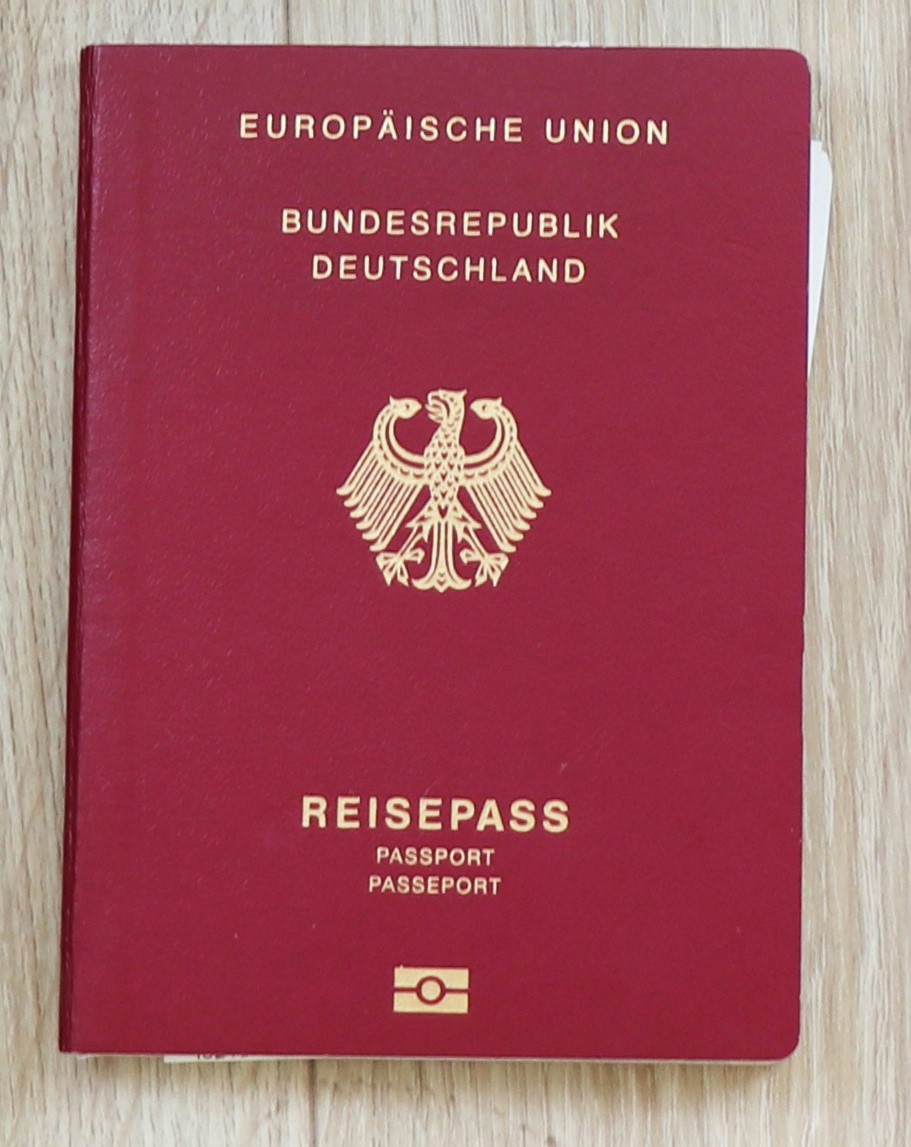
1. Deutscher Reisepass. Barbara Maiser/Unsplash
This is achieved most clearly by the state’s emblems on the front cover, but also often on the inner pages, which represent geographical features, the national anthem, famous monuments, persons, works of art and/or quotes that are deemed representative of the nation. In more than one way, passports create borders, defining what is ‘here’ and what is ‘there’. Of course, and this is the third dimension I would like to explore, the most evident function of a passport and often the reason why one owns one, is to cross borders and to travel safely. Thus, and fourthly, the passport bestows on its owner the agency to move around freely—a freedom at the same time severely limited for those who do not own a passport or one that is unable to grant this agency.
All these dimensions of the passport are inscribed into its materiality. They are particularly evidenced by the many safety features of a passport such as the sophisticated paper and printing techniques, but also by size, format, illustrations, text, and all other aspects of a passport’s materiality. As Mahmud Keshavarz argues in his monograph The Design Politics of the Passport,
[…] we tend to see design as a neutral and passive instrument that can be the carrier of ‘good’ or ‘bad’ ideologies and intentions. However […], I argue the opposite: that because design always entails an imagination of certain persons, ideologies, arguments, positions, and privileges being realized in the materiality of the world, design inevitably produces specific politics of life and living.[2]
In other words, passports frame our understanding of politics and mobility. As we will see, features of this design can be and have been appropriated by artists, authors, and publishers in the making of books.
I will focus this analysis of the passport as a book(ish object) on a small collection of different passport-like books or booklets that I acquired over the past two years. Due to my own geographic location and the fact that I did not constitute this collection systematically, it is necessarily Eurocentric. Examples from other regions of the world might bring to light different aspects of the bookishness of passports (and the passport-ness of some books). In the following, I will propose an exploration of these ‘bookish passports’ along three of the dimensions outlined above: Passport and nation; passports and travel; passport and agency. The dimension of identity is only marginally present in books that imitate passports since they are not generally personalised.
Passport and Nation
Passports play a part in constructing and perpetuating the imagined communities which, as Benedict Anderson argues[3], first emerged through print capitalism: nations. Indeed, Jouni Häkli describes the passport as a device that, historically, played a role in “naturalizing the idea of borders and territorial belonging.”[4] Both the book and the passport are everyday objects that create a sense of belonging shared by large, anonymous groups of people.
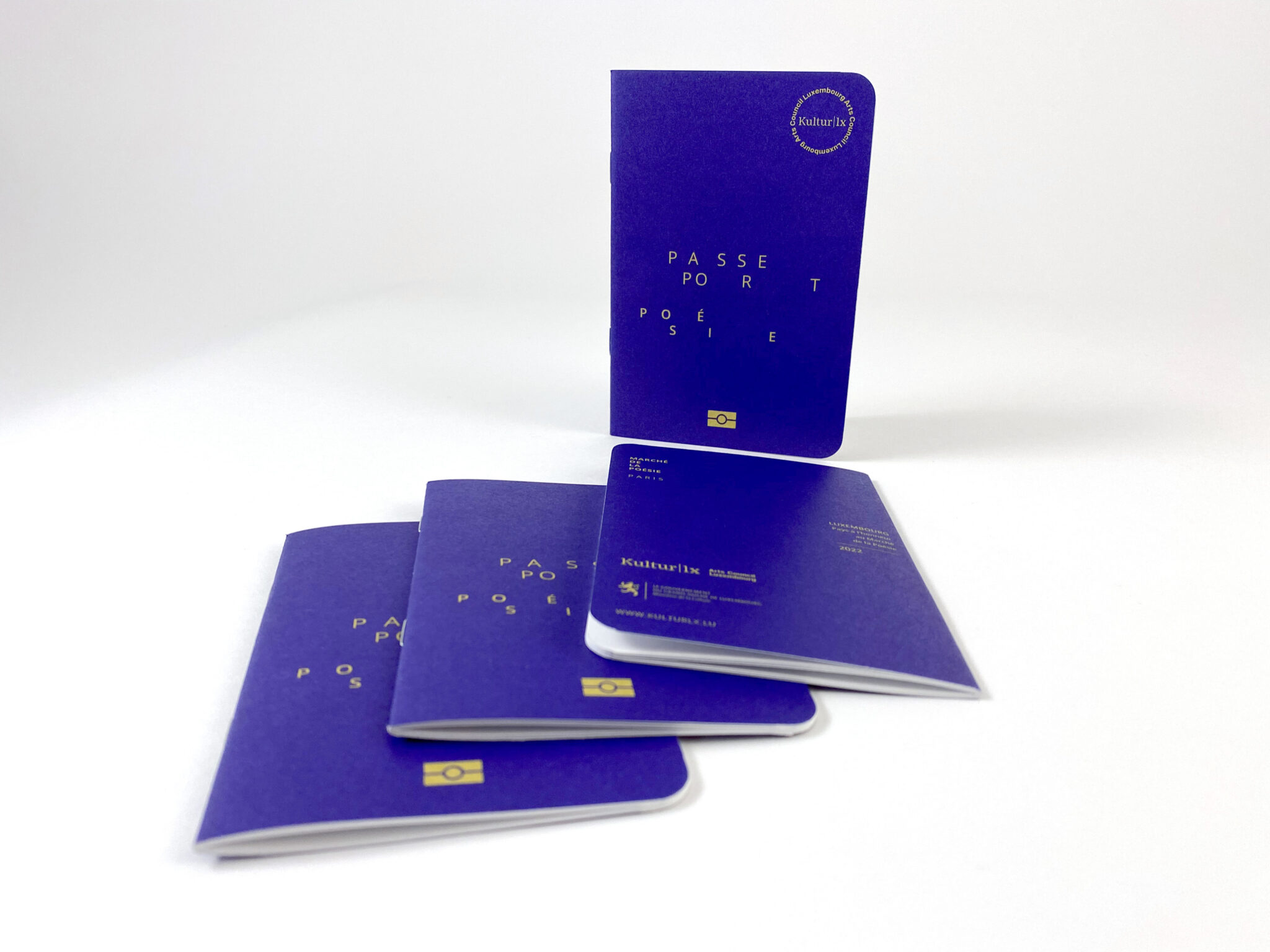
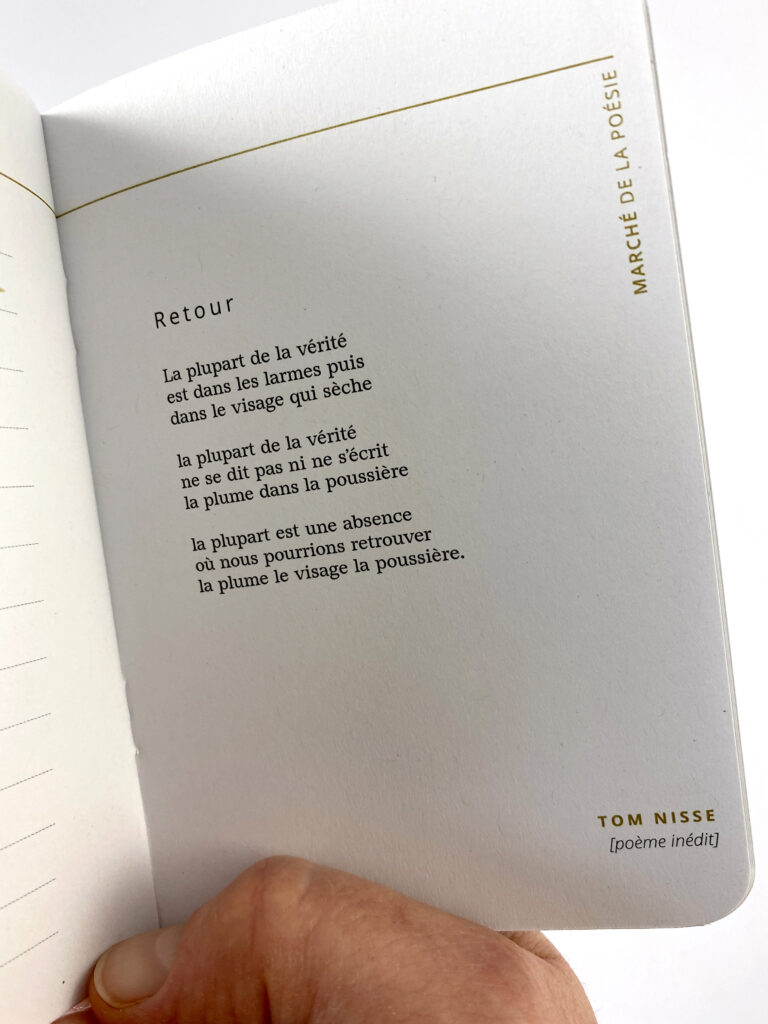
Some of the bookish passports in my collection copy that emblematic function. The object that started my collection was not commercialised as a book, but it is still a book-adjacent object in the double sense that it is a small-format poetry collection, and that it was conceived as a tool to direct attention towards Luxembourgish poets. The Luxembourg Arts Council Kultur|lx has produced these little brochures in a format reminiscent of a passport and featuring a collection of ten French-language poems by Luxembourgish poets. The publication, titled Passeport Poésie[5], was distributed for free at the occasion of Luxembourg’s Guest of Honour presence at the Marché de la poésie in Paris in 2022. The publication bears the logo of Kultur|lx, which is a state-funded organisation, and of the Luxembourgish ministry of culture. Being published by a state authority, the Passeport Poésie mimics the emblematic function of a passport by presenting the qualities of Luxembourgish poetry to the world.
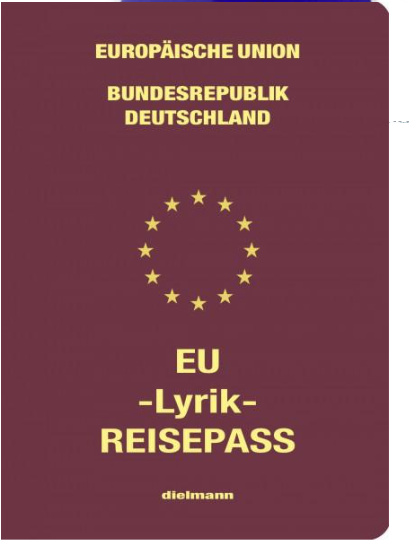
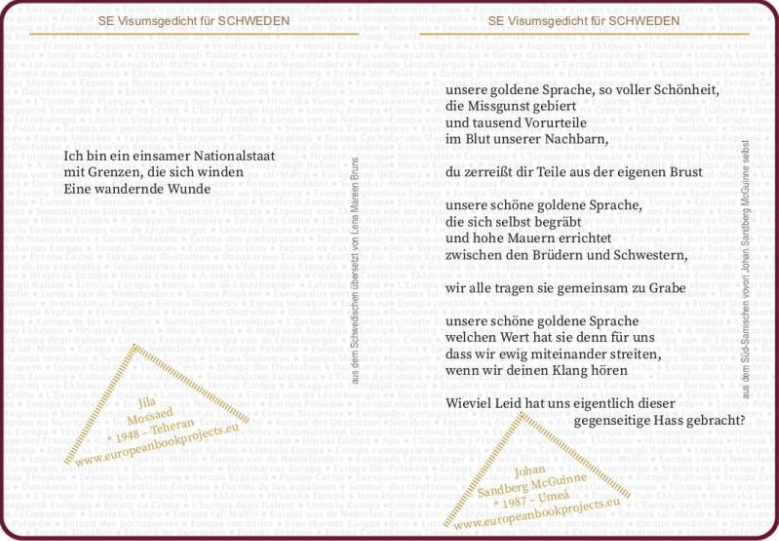
3. EU-Lyrik-Reisepass: Dielmann Verlag. http://www.dielmann-verlag.de/de/content/europeanbooks-sample-passport/~nm.67~nc.165/EU-Lyrik-Passport.html#x
My second bookish passport was directly inspired by the Luxembourgish Passeport Poésie, which German publisher Axel Dielmann stumbled upon at Frankfurt Book Fair 2021.[6] Dielmann’s EU-Lyrik-Reisepass[7] features a double page for every EU member state, with two poems representing each country, all translated into German. The size is similar to that of a passport, the cover reproduces the red colour of EU passports and the golden stars of the EU flag. The poems are designated as “Visa poems” for every country. This creates an ambivalence between the EU as a nation that the passport seeks to represent, and the EU member states as destinations that the poems will allow the reader to travel to. We will come back to the latter aspect below. Ideas of nationality and European unity thus compete in this publication.
https://www.facebook.com/@La5eCouche/
Other publications also reproduce the representational function of the passport, but from a more critical perspective. Passeport by Sébastien Conard, published by La 5e Couche in Belgium[8], is an almost accurate copy of the authentic Belgian passport, which features silhouettes of famous Belgian comic characters. The rather pastel tones of the actual passport were changed into bright neon colours, but otherwise the images correspond completely. In texts announcing the publication, the publisher and the author call it a “misappropriation of a misappropriation”[9], questioning the state’s legitimacy to use comic artist’s work for representative purposes. All of these bookish passports play with the fact that passports are portable nation-ness[10] and that they reproduce the border far from the border[11], be it through mimicking, extending, reappropriating or critiquing this function of a passport.
These first three bookish passports are explicitly tied to the countries where they were conceived: Luxembourg, Germany, and Belgium. They represent a nation or create a feeling of national belonging through literature, or on the contrary question the ways in which this is done by the state.
Passports and Travel
The primary aim of a passport, however, is to cross borders and to travel. This dimension is also materially addressed by the bookish passports on various levels. A mere book does not a priori have the power to allow an individual to cross a national border. Books are, however, well suited as travel devices for texts and ideas. In their foreword to the EU-Lyrik-Reisepass, the editors Dielmann and Schöttler insist on translation as a border-crossing practice: “Über die Grenzen hinweg, seien sie nun aus Draht oder sonstigem harten Zeug oder schon ganz aufgelöst, gehen die Übersetzer am freudvollsten” (“Across borders, may they be made of wire and or other hard stuff or already quite dissipated, the translators walk most joyously”[12]). The idea is that, through literature which ‘travels’ to us via translation, we can mentally ‘travel’ to where it came from. The literary texts thus enable border crossing. Luxembourg’s Passeport Poésie also plays with the idea of travelling, since this theme is frequently present in the poems it contains. Through the poems as well as by using the material form of the passport, the publication presents Luxembourg as inherently cosmopolitan.
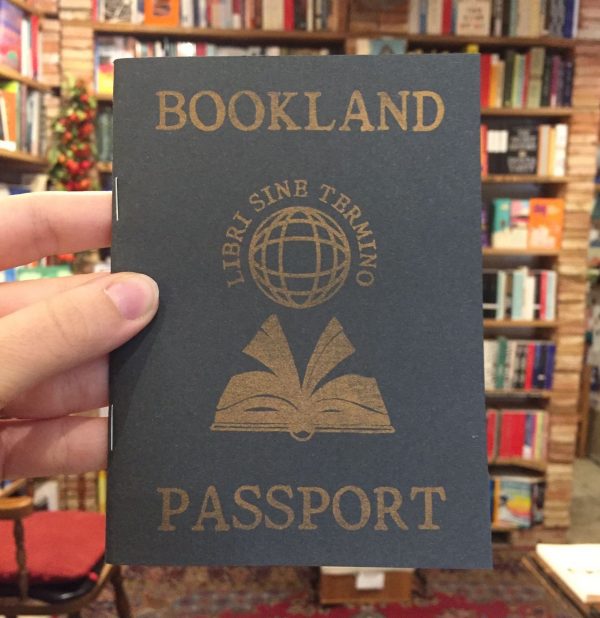
https://desperateliterature.com/product/bookland-passport
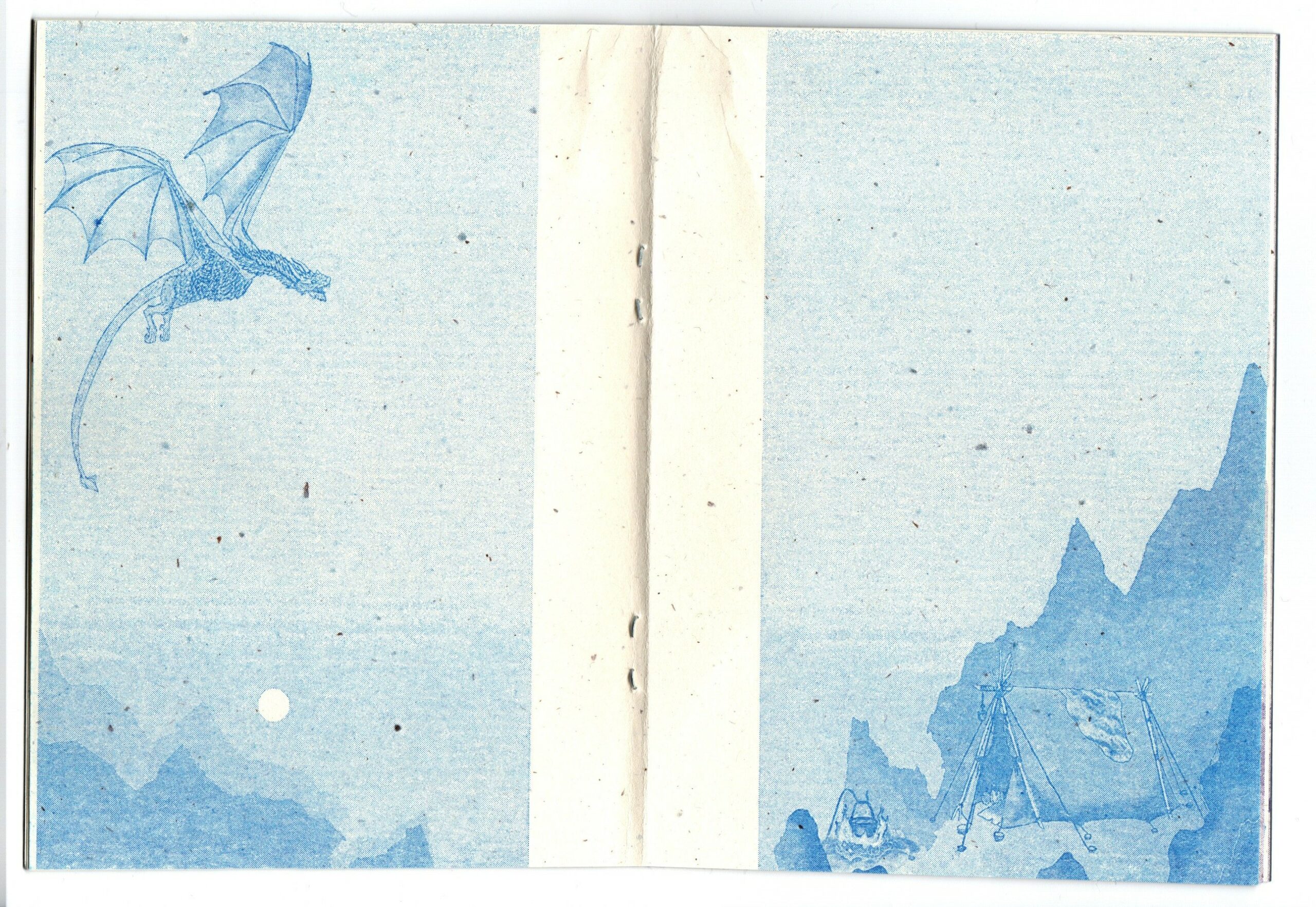
In another sense, literature can let us travel into imaginary worlds. This is the idea that the Bookland Passport[13] plays with. This small volume contains mostly illustrations that evoke more or less imaginary worlds that we might ‘travel’ to through books, such as a cozy café, or wild mountains with a dragon.
However, not everyone has a passport and not every passport enables border crossing, at least not at any border. They are supposed to keep an individual safe outside of its own nation state, as Susan Harban Page recounts: “How many times I placed these pieces of paper, this tiny book with stamps, and my photo, securely in my pocket or backpack, counting on them to keep me safe.”[14] But passports also keep states ‘safe’ from unwanted individuals. Artists, authors and publishers have appropriated elements of passports’ materiality to reflect upon and criticise the unequal distribution of privilege through passports. Page is an American artist and scholar who has gold-leafed her old passport as a reflection on the privilege it represents, reinterpreting the American passport as a “golden ticket”[15] that lets you travel anywhere. I mention this project here although it is not a book publication but an individual work of art, because it highlights another way in which the materiality and specifically the bookishness of the passport can be appropriated. In the quote above, she calls the passport a “tiny book”. Further, she describes the gold leafing as reminiscent of illuminations in ancient manuscripts[16], attributing another kind of value to the passport than the political power it initially held. The fact that the passport, as a portable paper object, resembles a book, makes this reinterpretation of its value possible.
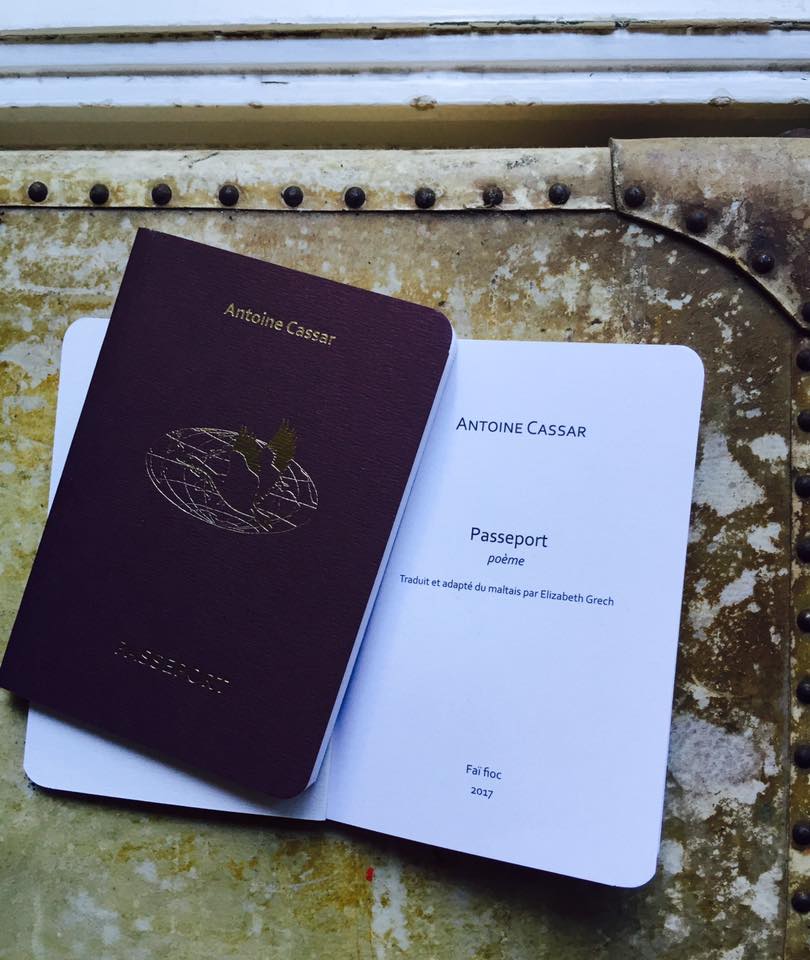
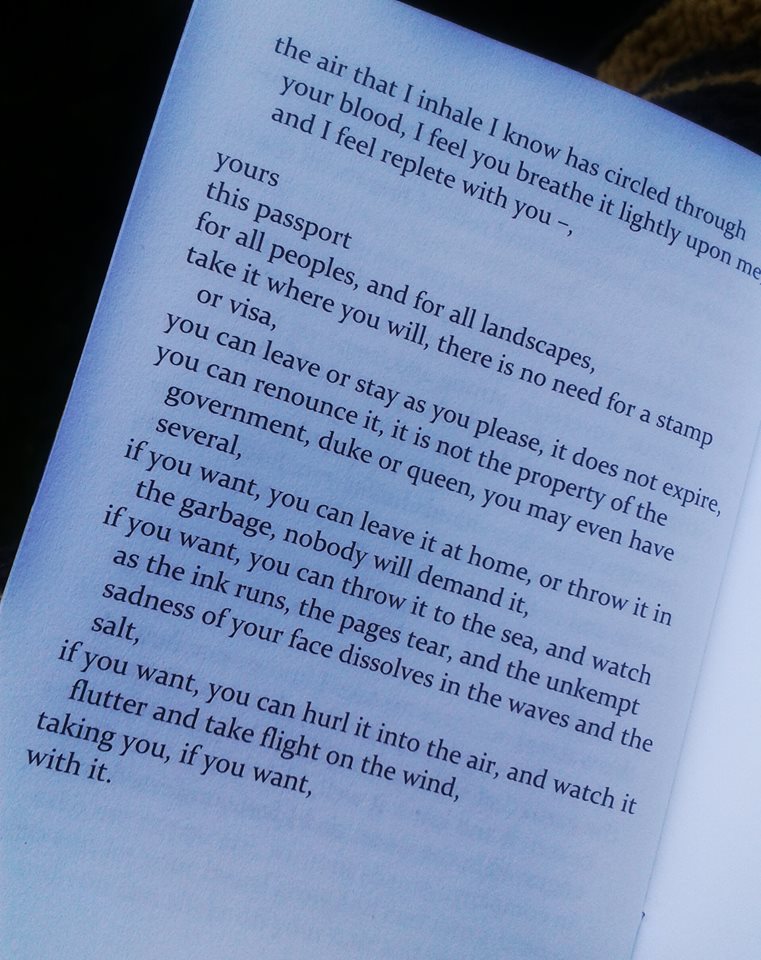
On the contrary, Antoine Cassar’s Passaport[17] is an actual book and has been available in many different languages.[18] Initially written in Maltese and conceived as part of a greater political and artistic project, it contains one long poem that denounces the denying of fundamental rights to people on the grounds of the passports or ID papers they do or do not own. It presents itself as a consolation of sorts to those who have no valid passport and suffer extreme violence at borders, repeating that it, the book, is now their passport and that it will protect them, as if to repair the violence inherent in a passport. The book indeed presents itself as a passport on the outside, with a dark red/brown colour, a size similar to most passports, and an emblem, which is gold embossed or printed in yellow depending on the edition. The emblem represents a goose freely travelling the globe. While the poem is also performed live across the world, the passport-like material form of the book edition is necessary for the assertion that it can replace actual passports and remedy their violence to make sense.
As Häkli evidences[19], passports serve the regulation of physical bodies at physical borders. Books, however, transport intangible things and can thus question bordering practices. By appropriating material features of a passport, they symbolically distribute equal rights to readers regardless of their origin.
Reappropriating Agency
By letting possessors of certain passports cross borders and others not, passports allocate agency to certain bodies. But the issuing states can just as easily revoke that agency.[20] Indeed, a valid passport is always the state’s property, not the individual’s. Artists and authors symbolically reappropriate that agency over our bodies. In another register, this is also what forgers do, since forgery is a technique used by those to whom passports are otherwise inaccessible. Keshavarz states that “Forgery as an act of redesigning passports and the relations and situations they produce, through recognizing the very artificiality of those relations, is also an inevitable element of the passport.”[21]
This practice is invoked by the publisher of Conard’s Passeport in the publication’s imprint. In lieu of the usual phrase in a book’s imprint warning against piracy, it reads: “La loi punit cruellement le contrefacteur de travaux forcés à perpétuité, pas nous. Il ne manquerait plus que cela.” (“The law cruelly punishes the counterfeiter with a life sentence of forced labour, not us. That would be the last straw.”)[22] This remark mocks the repression the state exerts against forgery, bootlegging and copyright infringements, while at the same time copying original artwork to decorate its passport. The parallel made between passport forgery and book piracy, and the laws prohibiting both, is interesting: while a bootlegged book ‘liberates’ its content, a forged passport ‘liberates’ its holder.
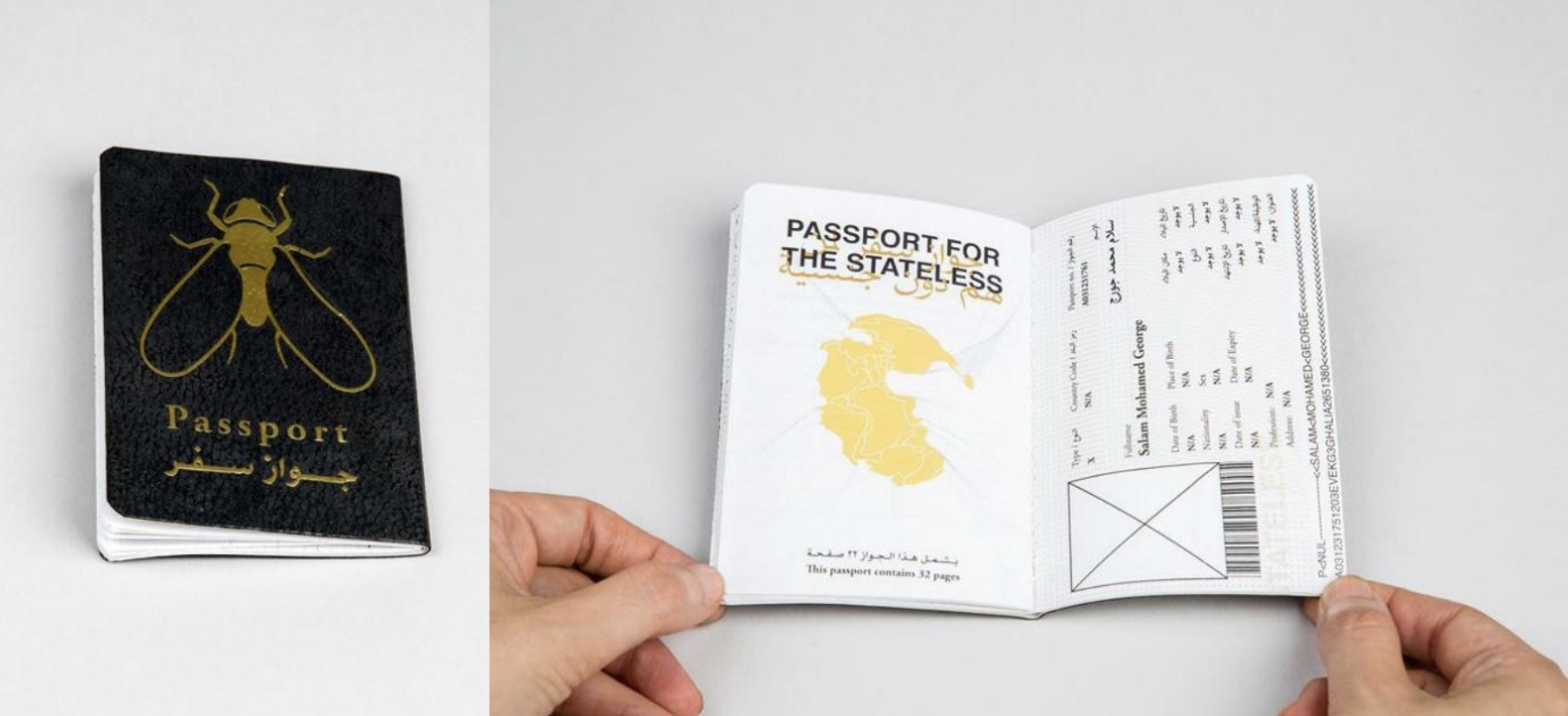
Ahmad Hammoud’s Passport for the stateless[23], while not edited as a book, follows a similar logic to Antoine Cassar’s poem-passport: symbolically redirecting violence, consoling, and repairing. Indeed, the “Passport for the stateless” reproduces not only the size and typical gold-embossed cover of most passports, it also contains an ID page, complicated printed patterns and other features typical of a passport. So much so that this artwork was considered by border agents as menace to sovereignty and destroyed to reinstate order.[24] Artistic reappropriations of a passport’s material features appear to have some actual potential of destabilising the power relations inherent in a passport.
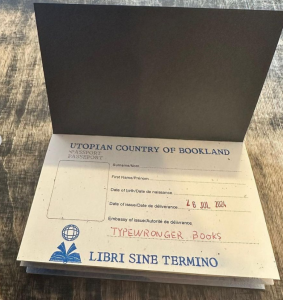
However, a more concrete possibility for books to challenge passports’ discriminating functions is through creating alternative imagined communities. This is what Antoine Cassar’s Passaporte project and the EU-Lyrik-Reisepass attempt to do. Via translation, they extend the potential readership of the texts beyond any national border. The Bookland Passport, on the other hand, explicitly instates bookishness as an identity and as a form of belonging to a world-wide utopian community. This is evidenced by the first page, which, like a passport’s ID-page, leaves space to fill in a photo, name, and date of birth of the owner as well as the date and authority of issue, meaning the bookshop where the Bookland Passport was acquired. The last page, titled “The Great and Noble History of the Country of Bookland”, explains that
Bookland is a country you reach through reading, through talking about books with your friends, and through hanging out at your local bookshop. Though we issue passports for Bookland, the territory it encompasses spans the entire known world, plus quite a few as yet unknown dimensions […]
and, in the end: “Citizens of Bookland don’t need documentation to prove their status… but it sure is fun!” Reading and discussing books is articulated as a system of belonging accessible to anyone, thereby abolishing borders and the inequalities they create and enforce.
Conclusion
To repeat Keshavarz’ statement:
because design always entails an imagination of certain persons, ideologies, arguments, positions, and privileges being realized in the materiality of the world, design inevitably produces specific politics of life and living.[25]
This holds true for books, too: through their materiality and design, they produce different realities of identity and belonging. By reappropriating some of the passport’s material features, books can reproduce, deconstruct, and redirect the ways in which passports design our relations to the state, the border, and each other. The principle of mimicry or imitation that is common to the passport-books I analysed here serves different purposes and the resulting books are more or less critical toward what a passport does and represents. While most of them do not, contrary to actual passports, have an individualised page identifying the owner, they do raise questions as to how and to which extent books generally can serve to affirm identity and belonging. This small power to at least symbolically resist state authorities on the issue of belonging and travelling appears like a beacon of humanity to hold on to in the face if increasingly arbitrary and violent politics of identity and migration.
[1] See for example: Bundesministerium des Innern und für Heimat [sic]: Die aktuelle Reisepass-Generation für die Bundesrepublik Deutschland, Stand Mai 2024; New design of the Belgian passport, 27.1.2022 [URL: https://youtu.be/XiexwlLvvyk]; Announcing the new Canadian passport design!, 10.5.2023 [URL: https://youtu.be/GvoD0i-SoDs]
[2] Mahmoud Keshavarz: The Design Politics of the Passport. Materiality, Immobility, and Dissent, Bloomsbury Publishing USA, 2018, p. 5
[3] Cf.: Benedict Anderson: Imagined Communities. Reflections on the Origin and Spread of Nationalism, Verso, London 1983.
[4] Cf.: Jouni Häkli: “The Border in the Pocket: The Passport as a Boundary Object”, in: Amilhat-Szary, A., and F. Giraut: Borderities and the Politics of Contemporary Mobile Borders, Palgrave Macmillan UK, 2015, pp. 85-99, p. 90.
[5] Kutlur|lx – Arts Council Luxembourg (ed.): Passeport poésie. Ca. 2021.
[6] The editors Axel Dielmann and Stefan Schöttler relate this encounter in their introduction within the publication.
[7] Axel Dielmann, Stefan Schöttler (ed.): EU-Lyrik-Reisepass, Dielmann Verlag, Frankfurt am Main 2022.
For more information, see https://www.europeanbookprojects.eu/
[8] Sébastien Conard: Passeport. 5c éditions, Brussels 2023.
[9] Facebook-event “Lancement de Passeport, de Sébastien Conard”, planned for May 26, 2023, published by La 5e Couche (5c), Judith Forest and Sébastien Conard. URL: https://www.facebook.com/events/3384014345187398/
[10] Cf. Susan Harban Page: “My Gold-Leafed Passport”, in: Geopolitics 2023, Vol. 28, pp. 904-918. https://doi.org/10.1080/14650045.2021.1963707
[11] Cf. Keshavarz 2018.
[12] My translation.
[13] T.S.J. Hodges, Corin Wong, Elsa van der Wal: Bookland Passport,2024.
[14] Page 2023, p. 908.
[15] Page 2023, p. 917.
[16] Page 2023, p. 908.
[17] Antoine Cassar: Passeport. French translation by Elizabeth Grech, Faï Fioc, Montpellier 2017. Initially selfpublished in Maltese, 2009. Project website: http://www.passaportproject.org
[18] The project’s website states that only the Maltese edition is available anymore, though I still acquired a French edition in late 2024.
[19] Cf. Häkli 2015, p. 88.
[20] Häkli recounts the example of Edward Snowden, whose US passport was revoked while he was travelling through Moscow in 2013, effectively stranding him there. Cf. Häkli 2015, p. 85 f.
[21] Keshavarz 2018, p. 18.
[22] Sébastien Conard, Passeport, imprint. My translation.
[23] Ahmad Hammoud: Nationality n/a: Passport for the Stateless, 2015. URL: https://hammoud3000.com/Nationality-n-a-Passport-for-the-Stateless
[24] Cf. Description on Hammoud’s website, 2023.
[25] Keshavarz 2018, p.5