
SHARP Grant Report 2024

Long before I became an academic, I set up an online magazine to champion British and South Asian literature. It was 2007 and I was a bored stay-at-home mum with little connection to the outside world except for online forums. With two children – five and under – I was desperate to reconnect with my childhood dream of becoming an author, and setting up The Asian Writer to inspire the next generation of writers was a way of finding myself and my artistic voice. I interviewed authors, attended festivals, reviewed books. Three years later, I set up a publishing press to amplify voices like mine that had been, and still are, largely ignored by the mainstream. I was keen to champion regional and diverse voices.
Over the years, I travelled up and down the country – going as far as Newcastle where I had the pleasure of interviewing Mohsin Hamid in London’s Mayfair at the Nehru Centre, and launched a collection of short stories with new and relatively unheard voices. I took my work seriously. And although I didn’t claim to know everything, I certainly thought I knew the basics. The founding fathers of British Asian literature were obviously the likes of Hanif Kureishi and Salman Rushdie, two literary giants that had oft been mentioned and cited. I had read neither of them. I was much more interested by the here and now: Like Mohsin Hamid and Kamila Shamsie. Nadeem Aslam. Nikesh Shukla. And, closer to home, Bali Rai. Some might have said they were up-and-coming back then, rather than the established names they’ve gone on to become.
In 20212, when I launched The Asian Writer Short Story Prize I met writer Jocelyn Watson, who told me about The Asian Women Writer’s Collective that had formed in the 1970s as a way of supporting the literary ambitions of a group of primarily South Asian women. I felt sad that I hadn’t heard of them before because I wondered what I might have learnt about what it means to provide a space for marginalised communities. Watson told me that the group had formally disbanded but had many notable names such as Tanika Gupta that had gone on to achieve mainstream success.
It wasn’t until 2022 when the Jubilee Reads was announced that I bemusedly scanned the list – hoping to see at least a handful of writers of colour – that I came across the writer Attia Hosain. Who was this woman who had written and published in the UK as early as the 1950s and why was I only just hearing about one of the most influential Indian writers of the twentieth century now?
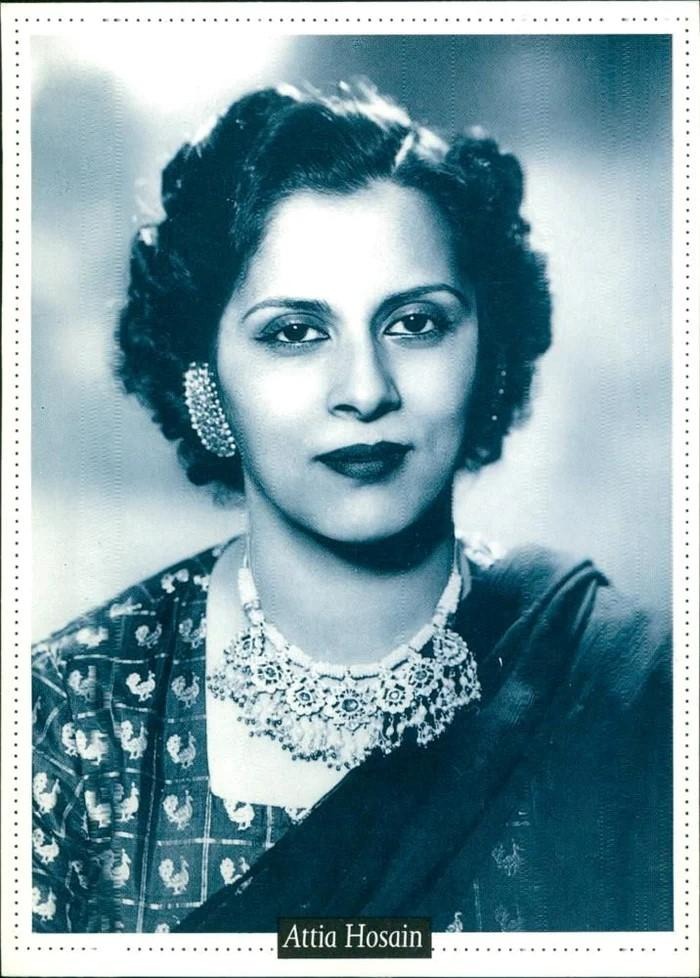
Securing the Research Development BIPOC Scholar Grant to explore Attia Hosain’s life was a fantastic opportunity to learn more. My research plan was to use my funding to visit two archives: the South Asian Diaspora Archives in Birmingham and Special Collections in Reading, which housed the Chatto and Windus archives (Attia Hosain’s publisher). Having never carried out archival work before I was unsure of the processes, so my first port of call was to visit both websites.
I learned that the Birmingham Museum and Gallery was closed until October so I wouldn’t be able to physically visit the archives, but a large number of documents, photographs and papers were made available online instead. This desk research was a fantastic foregrounding into understanding more about Attia Hosain and the network she was part of. I learned that she was part of the Progressive Writers Association and she would attend meetings regularly. I was surprised that such material was made completely accessible – from deeply personal photographs of her as a newlywed to a chronology of her publications.
Attia Hosain began her career as a journalist in India by writing for newspapers such as The Statesman and The Pioneer in Calcutta. She also published various short stories in periodicals in India. It was after moving to England in 1947, however, that she began to write professionally and published two books with Chatto and Windus: the collection of short stories Phoenix Fled (1953) and the novel Sunlight on a Broken Column (1961).
Series notes, accompanying the Attia Hosain archives held at South Asian Diaspora Arts Archive, Birmingham Museum and Art Gallery
The archive gave me some insights, but as a creative writer it was hard not to let my imagination run away…
I forced myself to remember that Hosain wasn’t a character, she was a person, who had walked the planet. She had published two books of fiction. More online visits to the archives made me desperate to learn more about her personality and test my hypotheses. Were the impressions I had formed correct? I couldn’t help but make a leap: a connection between she and I, especially given her connections to other marginalised voices of her time and her socialist values.
Archive work is not as quick, it cannot be rushed. It is slow, thoughtful.
Shaikh, F. Abandoned note found in notebook (circa late 2024)
I remembered a piece I read in Prospect magazine written by the author Kamila Shamsie some time before in which she mentioned her great aunt Attia Hosain. I revisited it to learn more about their connection, how Hosain had regrets of giving up on writing. I wondered if they were close, as she mentioned the advice she had given her. This reminded me that long ago I was in touch with Muneeza Shamsie, Kamila Shamsie’s mother on Facebook, so I sent her a message to ask if she would agree to be interviewed, fill in some gaps, go where the archive could not.
Muneeza Shamsie, herself an acclaimed writer based in Pakistan, agreed to meet on Zoom. She remembered her ‘Aunty B’ vividly having visited her when she was nine years old. She recalled Hosain rehearsing for the BBC, holding gatherings with ‘terribly important people, literary friends,’ at her home near Sloane Square. I was grateful Shamsie was able to go where the archives could not: deep into her own memories, retelling family history, helping me to form early impressions of Hosain grounded in truth. Back home, the idea of Hosain living in England, raising two children, working at the BBC and writing wasn’t seen out of the ordinary or revolutionary. Hosain’s mother had been widowed, so ‘women doing things were not unusual… not uncommon in her family of strong, pioneering women.’ I learned about Hosain’s early life and her career – how she published a hugely successful cookery book – something that the digital archives had neglected to mention. How well she was received in Pakistan and India (‘Everybody knew her,’), compared to how little attention she received in England upon publication (‘Nobody was interested.’). Even so, among her own the sentiment that “desis shouldn’t write to convey good ideas to the English,” was rife.
Shamsie confessed she didn’t know her aunt all that well really and her memories were limited to her childhood. She recommended that I speak to the writer Aamer Hussein whom, while no relation, knew Hosain intimately much more so than her daughter Kamila.
Aamer Hussein knew of Attia Hosain since he was a child. Had seen her around at family gatherings and social events. He had no idea she was a writer until one day, aged 15, he stumbled on a book in the library with her photo on the back.
Setting up an interview with Hussein was rather straightforward as many years ago we had become Facebook friends. I sent him a short note. He wrote back immediately. We arranged to meet in mid-September at a cafe near Hussein’s home in Maida Vale.
Hussein help me to fill in some gaps, contradictions that had become apparent between the desk research and Shamsie’s account of her aunt. I’m not sure why but learning that Hosain had written a cookery book and that she also met up with other writers at a restaurant in London left me thinking she might be – like me – a massive foodie. Hussein put that to an end almost immediately. He looked bemused by my enthusiasm. ‘She could barely cook,’ he told me.
He took what I was doing with absolute seriousness. This wasn’t a time to discuss food. Although it was lunch time and we were sitting in the most gorgeous café. I had sneakily eaten a falafel wrap before our meeting! Hussein described his wonderful friend Attia Hosain as hailing from an idealist generation, concerned with exile and partition, displacement, being a Muslim in Britain at a time when the religion was unfairly criticised.
He sipped his coffee and told me about how incredibly loving she was. How she treated him like a son, telling him to write from the heart. While she didn’t act as a writing mentor, offering to read and give feedback on his work, she provided pastoral care with her abundance of curiosity and care.
I asked him why Hosain stopped writing. He talked about Hosain’s struggles, her homesickness. The pains of survival, making it on your own, describing her as a single, working mother, who regretted putting her children in boarding school – which was odds to the 1960s housewife impression I had gotten from Shamsie.
‘Gaps of silence and pain prevented her from writing,’ Hussein said, talking at length about her losing the muscle for writing. Despite this, even until the end, Hosain was writing. She kept telling him about a novel she was writing. She told him to carry on, saying ‘Aamer will complete the work I’ve left behind.’ Hussein would go on to publish the novel posthumously as The Distant Traveller.
Hussein left me with a lead to follow. There was an extensive interview of Attia Hosain online on a site called Harappa.com, did I know it? It hadn’t come up in my initial search. I was intrigued… but I was overwhelmed; I didn’t quite know how to sit with this personal detail, with the different versions of Attia. Which was true? I left my notes, abandoning my notebook after writing ‘Archive work offers an opportunity access multiple versions of the truth.’ Perhaps I would learn the real truth when I visited Special Collections in Reading.
Today I will be travelling to Reading to visit the archives. I’m excited but nervous to find out, as I’m not exactly sure what this process will involve. Undoubtedly, I think there will be things I must be curious to know and understand about the lives of those remarkable people who are hidden from view when it’s convenient and thrust in the spotlight, but are otherwise ignored if we are not exceptional, or even when we are exceptional. Do we care to appease the master or desire that sort of limelight or approval? Whose approval do we seek?
Shaikh, F. 15th February 2025, journal entry
In Reading I was anxious about the systems and processes of the archives. The need to email in advance. Bring ID. I was worried that I wouldn’t be allowed in. That somehow I wouldn’t pass. As a writer of colour who is still relatively new to academia my imposter syndrome was hard to contain. For those of us who have been historically excluded from such circles, the rules and processes can feel exclusionary – an additional barrier that we must ‘learn’ in order to be granted access. Reflecting on this now, I wonder if the ‘rules’ around the archives should themselves be decolonised to support those new to them.
The sun is shining and its warm and it feels joyful and odd to think that a shift in the weather can bring with it such hope, can lift my mood and carry with it a spirit of optimism and hope. I feel hopeful for no particular reason, but I also feel like a time traveller. I must remember that archives are available to access – that this information – is free at the point of access and despite the measure and procedures you need to follow it is entirely legitimate and right to seek such access. Perhaps it is something to do with permission. Who is and who isn’t given permission, I wonder and why must there be such form-filling? Is it entirely necessary to prove oneself with photographic identity, to say ‘Yes, I too am legitimate,. These places also demand silence, steeped in a history that is by its nature exclusionary.
Shaikh, F. 15th February 2025, journal entry
In any case, on arrival I was greeted with a smile and shown to my table where I was presented with three large, dusty books. Books so big and heavy I had never seen anything like them before. It was hard not to feel just a bit silly, unsure what to do next. The books were stock books and ad books and while they were in themselves relics of the past, an insight into the processes of publishers in their 50s heyday, I felt I wanted to start off with something smaller.
Seated at Table 1, I tackled the files in a brown box. They seemed a lot less intimidating. I was being presented with artwork and production cards. The original artwork of Phoenix Fled, Attia Hosain’s first publication (a collection of short stories) was being preserved in a beige folder and wrapped in a thick acetate-like plastic. I had not seen this artwork before, since the front cover of Virago’s version, rather than Hogarth Press’s original is frequently returned when searching for first editions of the book. This facsimile proof was on pink layers and cited ‘as supplied’, containing three floral doodles, two of which were crossed out. The paper quality was the highest, a thick art paper. Although I’m no expert in visual rhetoric analysis, I have been looking at covers as part of my academic research more widely and considering how the visual language speaks to inferences made about the author. Here, it is not surprising that we see the depiction of an Indian woman, with a scarf wrapped loosely around her head, hair up in a bun, standing with her arms crossed, adorned with necklace and earrings, and bangles on her arms from which lines indicating the wings of a hint at flight. I wonder what this says about the positioning of the author – a Pakistani woman heralding from a landowning family – and how the work was ultimately received and indeed, marketed by its publishers.
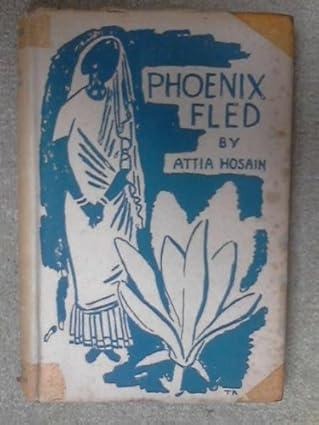
The production cards provided me with an insight into the production process: How many copies were printed, and details of any print-runs. The initial print run for Phoenix Fled was 2000 copies. The ad book provided insights into how the book was marketed to readers – through advertisements placed in The Sunday Times, Times Literary Supplement and so forth. Although there were only a handful of advertisements placed, the reviews themselves were telling, with mentions of “brilliant little”, “unusual distinction,” “delicate,” “about simple people face with personal problems,” while contemporaries were promoted as having “rare excellence,”, being “vividly interesting”, and an oft-used publisher’s favourite: “exciting”. And while too much ought not to be read into this, of course, the lack of advertisements compared and contrasted with Hosain’s contemporaries was glaring. Phoenix Fled was also priced at 12s 6d. net, far cheaper than other books released and advertised at the same time.
I’ve woken up with lots of feelings about my visit to the archives. Much of it is tied up with where I left my thinking yesterday, in particular, my thoughts on how you keep going in light of not having a great deal of attention on you and you work, the impact of not being widely marketed – there were notable exclusion from say The Bookseller, not being one of 4 Best Books (the damage of lists?), who gets talked about and where, and what they say sticks. It forms opinion. I do not know enough about 1950s literary society but I imagine it to be stiffer, posher and whiter than it ever has been. An exclusive club. I did not see other brown or black people published in the production cards.
Shaikh, F. 19th February 2025, journal entry
As fascinating as this was, I was at a loss to where the personal documents were. Had I not requested those? I checked my emails and the numbers against the materials that were sitting at the desk. Yes, it all did seem to be there but I vaguely remembered seeing some personal letters in my initial search. I queried at the desk to understand if they had anything else, only to be told to search the online catalogue again. I went back to my emails to see there was some discrepancies between the lists. What I had told was all there was, wasn’t quite true. But my time was running out. The archive would be closing soon. I enquired again at the front desk and was told, this other list was not visible to the archivist as it needed further permissions to view. More files? Secret documents? What was being hidden from view that even the archivist didn’t know about it? Or did she know, and she didn’t want to supply it? I tried to settle my writer nerves and my imagination from running away from me. It was a process matter. I would need to write to the publisher. Would the permissions come back before tomorrow? I hoped they would. The archivist smiled at me. They might do, she nodded. I think we both knew I was asking for the impossible.
It took several emails and several weeks of patience to hear back from the Attia Hosain Literary Estate to give me permission to view the additional materials. One morning, I received a short email from Waris Habibullah (Attia Hosain’s son and executor of the estate) containing a few lines saying I had his permission to research all archives relevant to his mother. The last line, a polite ‘Best wishes in your research,’ filled me with joy and an increasing sense of imposter syndrome that I wasn’t a proper researcher. If I had been, I wouldn’t have messed this up so badly.
In any case, I would now need to organise a further trip down to Reading so I wrote to Special Collections once again, setting out a date for my visit, and forwarding the permission email. I had read and re-read it several times by that point to make sure it wasn’t a hoax. I had no idea who and how my message had even reached them, as I had not written to them directly. Although I had not received any response from Victoria Hobbs at AM Health Literary Agency, I suspected it may have come via them (I imagined emails flying about with ‘There’s someone asking questions about your mother.’) In any case, so grateful to receive this email was I, that I forwarded it on, without further thought of how it came to be.
Since it was Ramadan and travelling was nigh impossible, I arranged a visit to the archives the following month. I couldn’t believe I would have to wait a further few weeks to read the correspondence relating to both of Hosain’s titles, Phoenix Fled and Sunlight on a Broken Column, letters to and from her literary agent and dear friend Joyce Weiner. While I didn’t want to wish the month away, the waiting made for an even longer fasting period than usual. By Eid, I had made my travel arrangements and packed my case.
There was much more correspondence than I was expecting. Letters from agent to publisher, from publisher to agent. From Hosain to her agent and so on and so forth. There were invitations to dinner parties that were never attended. Letters that were read or not read in time. There was even a gap in the correspondence where I suspected that something unpleasant may have gone on – a tense argument or exchange between agent and publisher. These letters were mentioned but were not in the file.
My notes lead me to think that reviewing this correspondence provided me with much more of an insight into 1950s – 1970s publishing than anything else. How the agent and publisher seem so much more aligned. How grotesque the obvious flattery, bordering on sycophantic levels. How the literary agent almost disappears after selling the book.
You are not imagining how it is. You are not feeling abandoned and alone because you’re an outsider or a single mother or because of any other reason but because it’s just you. You feel alone because you are left to it. They can be a blessing and a curse and we must not overlook this fact.
Shaikh, F. Note to Attia Hosain, journal entry 11th April 2025.
I’ve also added a note with some emphasis on the role of Indian publishers and filmmakers in helping Attia Hosain remain relevant – as there were long periods that moved from excitement to silence, revival to survival, and back to silence again. This time, I take photographs – an additional cost with no permission to reproduce the material except for my own record.
We could excuse the poor marketing effort when considering that PR and advertising wasn’t well established in the 1950s as it is today and marketing theory was still being shaped… but these publishers did understand something and this was supported by the literary establishment – the power of reviews, of word of mouth and looking through the advertisement book I can see that some names were frequent when turning the pages and while I don’t begrudge them of the recognition they received I can see at the same time how not being in that club of writers that were name checked at every turn meant that it was so much easier to forget or not become a name that sticks.
Shaikh, F. Note to Attia Hosain, journal entry 11th April 2025.
I made two last notes, one about how the letters move from exuberant flattery to ghosting, and who knows best – author? Agent? Or publisher? I also noted the last letter dated from 2nd September 1987 is about the contractual end – the reversion of rights. I’ve left myself a note to build a timeline of key events, mapping these letters against Hosain’s publication history. I am yet to begin.