
Patrick Spedding and Paul Tankard, eds. Marginal Notes: Social Reading and the Literal Margins.
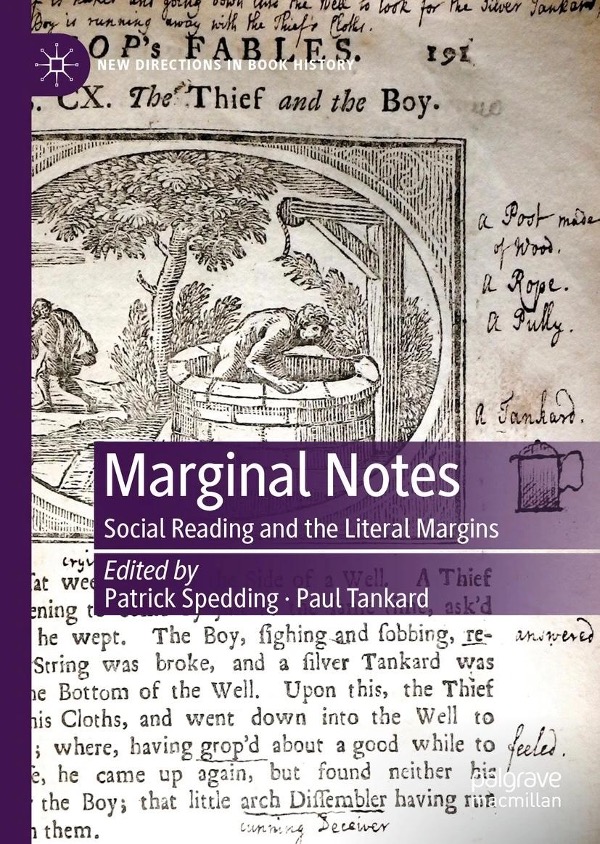
Patrick Spedding and Paul Tankard, eds. Marginal Notes: Social Reading and the Literal Margins. London: Palgrave Macmillan, 2021. 294 pages. ISBN 9783030563110. US $139.99 (hardcover).
The pun is “unavoidable,” as Patrick Buckridge says (p. 241) in his contribution to this excellent collection of ten essays on marginal notes, edited by Patrick Spedding and Paul Tankard. Is research in marginalia inevitably peripheral, dispensable, a marginal sort of project? “Among the multitude of things subject to academic attention,’” the editors write in their introduction, “the study of marginalia may appear to be—more obviously than most studies—fusty and dusty and pedantic and self-referential and … marginal” (p. 19). Those adjectives sound like an anxious defence, insisting upon the editors’ key claim in this collection that “the study of marginalia is far from marginal, but a route into all literate culture” (p. 1). In the margins of page one, on my second reading of this book, I found that I’d noted a personal reaction to the question of marginalia scholarship being marginal. Says the pencil: “Would it matter if it was?”
Mattering, of course, is a second unavoidable pun of book-historical research. The literal margins matter, in the sense of offering and taking up space, being made of the same medium as the printed page. The varied essays in Marginal Notes: Social Reading and the Literal Margins show how the material fact of pages having blank edges offers common ground for scholars with different expertise. For example, Yinzong Wei, in a chapter about the seventeenth-century Chinese scholar He Zhuo, notes that whereas English-language books often have ample room for annotations in the bottom and side margins, “in pre-modern Chinese books, the upper margin, or ‘heavenly head”’ (p. 42) was much larger and therefore used for manuscript notes. Throughout the collection, the formal features of the book as object and technology provide imaginative access to potentially unfamiliar reading contexts. Ranging across periods, languages, and geographical distances, these essays offer surprises and reveal that a shared interest in annotation makes for a kind of natural interdisciplinarity. We are all marginal to each other’s specialisms.
The book contains a rich diversity of topics. How did the English author Mary Astell use annotations to mount a counterattack to Pierre Bayle’s philosophical scepticism? How should we read Hester Piozzi’s manuscript additions to books, or Herman Melville’s, or those of a child in nineteenth-century Britain, or a student in twentieth-century Australia? Do we need to know who added anonymous comments to Sir Walter Scott? What about the signs of use in an Encyclopedia Britannica which once belonged to the Huon Mechanics’ Institute library in Franklin, Tasmania? The joy of a collection like Spedding and Tankard’s is the sense of unexpected opportunity: I would never have stumbled over any of these topics otherwise, and consequently appreciate the invitation and challenge to think about reading in connection with new contexts and cultures. As several of the writers note, it is difficult to reproduce, even difficult to read a text which is organised around another text: can one make sense of annotations on Pensées Diverses sur la Comète or The Antiquary except by also reading the original? The chapters of this book are, in part, experiments in answering this question, each scholar of marginalia acting as a guide to help the uninitiated understand new examples.
Where the book is most thought-provoking, for me, is in those moments that seem almost anxious about the weight and significance of marginalia. As is perhaps inevitable, the introduction makes bold claims for marginalia. “[W]e are offered a genuine glimpse into someone else’s privacy” (but what if some annotations are in some way a public performance?) (p. 3). “The annotator is a conscious being and is clearly making a range of claims” (but what if some annotator in particular is an idle being and clear about nothing?) (p. 11). Such hypotheses are put to the test by the succeeding chapters, which show the range and diversity of results yielded by different kinds of marginalia. “Annotation is like scholarship,” (p. 15) says the introduction, even though we will discover, reading on, that some annotation (like He Zhuo’s, or Mary Astell’s) explicitly is scholarship, whereas some, like the doodling in the Huon Mechanics’ Institute’s Encyclopedia Britannica, quite explicitly is not.
Perhaps there is something about the very miscellany and mixtures of marginalia which rewards our attention: if some manuscript notes seem “slight or trivial,” (p. 91) perhaps the opportunity for the researcher lies in drawing out what may be seen in the tiny details. Is slightness necessarily bad?, I find myself thinking, and noting in the margins. If annotation is sometimes scholarship, annotation is also, sometimes, a student writing against another student’s writing, “I don’t f***ing care! If you want to scribble all over the book—spend a quid and f***ing well photocopy it first” (p. 258). Perhaps one achievement of marginalia studies as a discipline is to show why we might f***ing care even about what is both slight and trivial. Paul Tankard, writing about a previously unexplored set of annotations by Hester Piozzi, apologetically discovers that “these marginalia afford us no astounding revelations” (p. 101). Meanwhile, Patrick Buckridge has mixed feelings about an encounter with his own former self, writing in a library book: “the annotations themselves are not as bad as they might have been” (p. 259). My conclusion on finishing this book is that I am actually less interested in astounding revelations than I am in annotations that are not as bad as they might have been. Most of our days are not astounding. To be interested in reading is to be interested in what is habitual and quotidian.
Lucy Sixsmith, St John’s College, University of Cambridge