
Margaret Morgan Grasselli and Elizabeth Savage, eds. Printing Colour 1700-1830: Histories, Techniques, Functions, and Receptions.
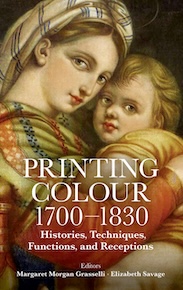
Margaret Morgan Grasselli and Elizabeth Savage, eds. Printing Colour 1700-1830: Histories, Techniques, Functions, and Receptions. Oxford: Oxford University Press for the British Academy, 2025. 439 pages. ISBN 9780197267530. US $148 (hardcover).
Before reading the first word, Printing Colour 1700-1830 shows the reader what eighteenth-century printers knew well: colour persuades. This volume, edited by Margaret Morgan Grasselli and Elizabeth Savage, is a large, beautifully produced book, printed on heavy paper with hundreds of colour illustrations that make it a pleasure to read and study. The material book thereby mirrors its own central argument: much like today, colour printing in the eighteenth century was never a marginal curiosity, but central to how Europeans imagined, displayed, and consumed the printed image.
This edited volume continues the story begun in Printing Colour, 1400-1700 (Brill 2015), bringing it into the late hand-press period. Its twenty-eight essays shed light on the techniques and trades that made colour printing both a technical challenge and a commercial success. The editors’ introduction—lucid, ambitious, and refreshingly concrete—sets the scene. It calls for a history of colour printing that moves beyond the more traditional “London-Paris axis”, and beyond the confines of art history, to include printed objects such as textiles, wallpaper, and ceramics alongside books and ephemera. By doing so, this volume is as much about the circulation of colour as it is about the mechanics of its production.
Part I, on materials and techniques, anchours the reader in the eighteenth-century workshop. Savage’s chapters on ink are particularly rich: she explains what colour printers were actually doing with their hands, rags, and rollers. The next sections move through various techniques, from letterpress, mezzotint, and aquatint, tracing the revival of older methods and the invention of new ones. Subsequent contributions further flesh this out: Ad Stijnman surveys colour letterpress, Simon Turner reconstructs Elisha Kirkall’s ambitions for printing in “natural colours”, and Christian Tico Seifert follows John Baptist Jackson’s international career across Paris, Venice, and London. Together, they show how much of the eighteenth century’s colour printing was experimental, collaborative, and unstable.
Several essays stand out for the way in which they link technical processes to their social and intellectual contexts. Julia Nurse’s “Colouring the Body”, looks at colour in medical illustrations as both aesthetic choice and epistemic claim. Karen Severud Cook’s contribution on à la poupée inking in natural-history illustrations reminds us how colour and credibility are almost always intertwined. Patricia F. Ferguson’s chapter on printed ceramics and Phillippa Mapes’s on wallpaper stretch the notion of “print” to its limits, but convincingly so: both argue that colour printing in these media shaped the look of everyday life. The editors have also been careful to include perspectives from conservation science as well as art history. “From Colour Theory to Colour Practice: Printmakers in Pursuit of the Ideal Pigments in 18th-Century Europe” by Dionysia Christoforou, Manon van der Mullen, and Victor Gonzalez, for example, connects the chemistry of eighteenth-century pigments with the problems of fading and change that curators encounter today. This mixture of the archival, technical, and analytical runs through this volume and is one of its strengths. The later chapters by Michael Phillips and Michael Twyman carry the story into the nineteenth century and the beginning of industrialised colour printing. Twyman’s two essays in particular draw on his lifelong research on lithography and chromolithography, placing the techniques of the earlier periods in a longer technological story.
Another welcome thread is the attention given to the role women played as printers, colourists, and consumers. Essays on Anne Allen and Jean Pillement’s workshop, on the Strickland sisters’ botanical prints, and on the gendered marketing of embroidery patterns and domestic ornamentation expand the field well beyond its usual male protagonists. These are not decorative anecdotes but reminders that colour printing was often women’s work, both literally and figuratively.
As with any large collaborative volume, the focus of the individual contributions varies. Some chapters are dense with technical detail, while others read more like exhibition essays. But the editors’ hands are firm, so that the book is focused throughout. The over four hundred illustrations are a very nice addition, with clear captions and consistent technical descriptions. It is not often that form and content of a scholarly book reinforce each other so well: to turn the pages is to see what the contributors discuss. The editors’ introduction alone could serve as a manifesto for a new kind of colour-aware book history. Their argument that colour printing was integral to the eighteenth-century media landscape, not an exotic byproduct, is persuasive. By placing ephemera, decorated paper, and printed ceramics in the same classification as fine prints, they dismantle the hierarchy that long kept colour printing in the margins of both art and bibliography. The result is a book that will interest not only print historians but any scholar working on material culture, the history of science, or the economics of early modern publishing.
Printing Colour, 1700-1830 is a substantial and carefully assembled volume that brings together a wide range of current research. Its generous illustrations and clear technical descriptions make it a useful reference work as well as an engaging read. For anyone who still thinks of colour printing as primarily a nineteenth-century development, this book offers a timely correction. It shows how, by the mid-eighteenth century, colour had already become an integral and familiar part of print culture, essential for scientific images, domestic ornament, commercial goods, and the more routine work of the press.
Trude Dijkstra, University of Amsterdam