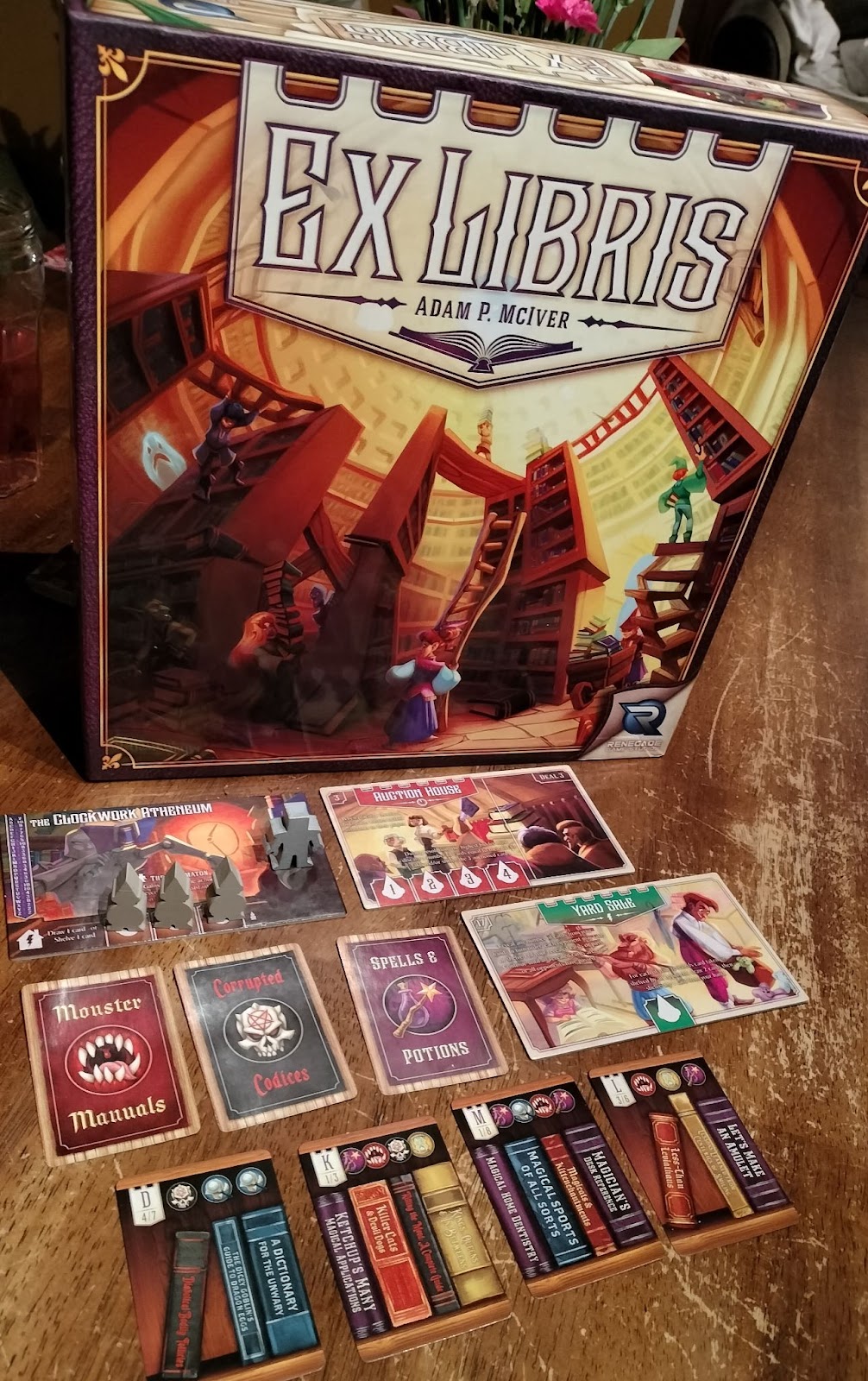
Ex Libris. Designed by Adam P. McIver with art by Jacqui Davis, Adam P. McIver, and Anita Osburn.
Ex Libris. Designed by Adam P. McIver with art by Jacqui Davis, Adam P. McIver, and Anita Osburn. Published by Renegade Game Studios, 2018.
Purchasing books isn’t part of my job as a curator, but playing Ex Libris gives me a taste of what I imagine it’s like to be in charge of a collection, if I lived in a fantasy world where I could collect books about manticores and tour the underworld. My family owns and has been playing Ex Libris for years (we are a big game playing family) so I’m familiar with it, but I played a special game of it with my husband as research for this review.
Ex Libris has a great name, but what is it? It’s a tabletop game for ages 10+ and 1-4 players (yes there is a solitaire option, although I have never played it). It’s not properly a board game, because there’s no board that you move pieces around on like Monopoly. Instead the game is played with cards and a number of different tiles, which I’ll describe in detail later in the review.
The story of Ex Libris is that the Mayor needs to assign a new Grand Librarian, and he’s invited all the town’s book collectors to be considered for the role. So you’re all preparing for the Mayor’s Official Inspector to come and judge your collection — the collector with the best collection (that is, with the most points at the end of the game) wins the job, and the game. In order to build their collections (and gain points) the players collect books following prompts set at the start of the game, and carefully shelve the books they collect over the course of the game.
The books are the best part of playing Ex Libris, in my opinion. There are six genres (which are called categories in the game): Historic Volumes, Reference Texts, Spells & Potions, Fantastical Fictions, Monster Manuals, and Corrupted Codices. Each genre gets its own card (category cards) and then there is a fat stack of cards (152 total) that represent the books on the shelf (book cards). I think of these as “shelf cards” because in fact each book card has three or four books on it, a variety of genres shelved next to each other, and — this is the best part — every book has a title: Unicorns: Narwhals on Land? (Monster Manual, obviously); The Witchelin Guide (Reference Text); Rotten Things to Do (Corrupted Codex); Five Hundred Fireball Spells (Spells & Potions). They aren’t all bangers but some of them are pretty amusing, and when we play there’s always a point where we pause to share our best titles.
At the start of the game, the six category cards are shuffled and randomly assigned: one to “Prominent Works,” one to “Banned Books,” and the others are distributed to the players as their “Library Focus” – the genre that you are secretly gathering to differentiate your library from the others. As you gather book cards over the course of the game, you need to keep your eye on the genres of books on your book cards – Banned Books will lose you points, and Prominent Works will get you more points. So will books of your Library Focus. Otherwise, books are worth one point each.

In order to collect books, of course, you need a collector, and a library for the books to go into. Ex Libris has twelve libraries and collectors to choose from. In addition to their amusing identities (which include “The Igloo of Information” represented by The Snowman, “The Clockwork Atheneum” represented by The Automaton, and “The Crypt of Accursed Knowledge,” represented by The Mummy), each library gives the player unique skills that will help them during game play. For example, the player represented by The Witch (who curates “The Swamp of Scholarship”) has this ability, which no other player will have: “When acquiring a banned book, reveal the top card of the deck. You may take it instead.” Since the unique traits of each of the 12 libraries are different, the combinations guarantee a different game every time, even if you’re always playing with four players. Collectors are represented in the game using little wooden pieces (“meeples”) — one for the collector themself and three others for the collector’s assistants — and Libraries are represented by large cardboard tiles.

We have books, and we have collectors and libraries. So how do we get the books into the libraries? Over a series of turns, new locations are revealed for buying, trading, or otherwise acquiring books. Locations, like Libraries, are represented by large cardboard tiles. Each location has a specific set of functions that allow players to collect book cards, either from the location itself or from the deck. There are 18 total locations, including the Diviner’s Hut, which is the only location that stays in play through the entire game.
A complication is that every location has only a certain number of spaces. The Diviner’s Hut, for example, has only one space, so only one player can play that location once per turn. So if you want to play a location, you need to make sure that you get there first or you might miss out. The locations aren’t quite as amusing as the book titles, but some of them might give you a smile — for example, “Garbage Dump” which enables you to search through the discard pile (only one spot!) and “Local Drafthouse” in which the first one there shows two book cards from their hand for every other player there, and they draw one at a time until the cards are all taken (the cards can immediately be shelved) — essentially, that player got drunk and shared all their secrets!
At the start of the game there’s only one location (the aforementioned Diviner’s Hut), but every round more locations are drawn — one for each player (so if you are playing with four players, you draw four location tiles). Location tiles are numbered; at the end of each round, the location tile with the lowest number stays out and the others go into the location discard pile. This means that every round has one more location available than the previous round. Some locations are only good for one round, however, so more locations doesn’t necessarily mean more options.

We’ve collected a good handful of book cards, and now it’s time to shelve them. It’s your shelved books that determine points, so shelving properly is important. Like the Location tiles, every card is both alphabetized and numbered, from A 1/7 (A has seven cards total) to Z 2/2. It’s rare that you get cards in your hand that are in exact sequential order, and book cards have to be shelved orthogonally (either side-by-side or over-and-under), so players need to make important decisions about which cards to shelve, and when. As in our world, books in Ex Libris should be stacked on top of each other in addition to being shelved next to each other (alphabetical ordering continues from one shelf to the next). This is where “shelf stability” comes in — another important part of the collection process which is judged at the end of the game — you earn an extra point for every card in this rectangle. (That is, you can shelve the cards however you want and you’ll get points for all those books, but you’ll get more points if your books are nice and neat and lined up. Just like real life!)

The last round begins when a player has shelved the number of book cards needed to trigger the end, which depends on the number of players: 16 cards for two players, 14 cards for three players, and 12 cards for four players.
Once the final round is over, everybody counts up their scores in the various areas, including extra points for “Prominent Works”, “Library Focus” and shelf stability, and subtracting points for any Banned Books in their shelves. The player with the most points wins!
As you can guess, Ex Libris is not a game that takes itself too seriously. The book titles are quite amusing and the instructions on the tiles are often witty. On top of that, it’s not designed to accurately reflect the book collection process. That said, I think the gameplay reflects the concerns that I see discussed when purchasing decisions are made in my department. Does this potential acquisition enhance our existing collection? Can we afford it, or would it make more sense to spend the same amount to purchase a few other items? Do we have space for these new books?
Another concern is that this game is pretty complicated; there’s just a lot going on, with different tiles and cards, lots of instructions written in different places, details to remember. We play a lot of games in our house, and we’ve played Ex Libris before, but we were still reaching for the Rules of Play every few minutes to check on minutiae. Luckily the instructions are clearly written. I recommend Ex Libris if you have a penchant for numbers and sorting, and you have experience playing complex tabletop games, or you have the time and patience to try.
Published in 2018, Ex Libris might be difficult to find. At the moment, on the BoardGameGeek website, there is a new copy available for $125 and used copies from $25-$65. You might be able to get a special order from your local games store, but you probably won’t find it in Target.