
“Now I’ve read all the books beside your bed:” Books, Literature, and Taylor Swift

It’s no secret that the cultural zeitgeist is currently saturated with Taylor Swift, from her massively successful Eras Tour to her relationship with football star Travis Kelce. Their swoon-worthy romance seems ripped straight from the pages of a novel (or even fanfiction). But Swift is not only living a literary story — it appears she’s rather well-read herself. References to classic literature, explorations of the concepts of authorship and readership, and the aesthetics of books and bookishness can all be found throughout Swift’s body of work. In this way, her music provides a space where her fans can engage with literary ideas, which in turn embeds these ideas into pop culture at large.
Literary References
Since she made her debut in 2006 with her first single “Tim McGraw,” Taylor Swift has often been accused of “only writing songs about her ex-boyfriends.” Not only is this factually untrue (she has written songs on topics as varied as the COVID-19 pandemic, her grandmother’s legacy, and her mother’s battle with cancer), it is also a criticism leveled primarily at female artists. As Swift pointed out in a 2014 interview, “No one says that about Ed Sheeran. No one says that about Bruno Mars. They’re all writing songs about their exes, their current girlfriends, their love life, and no one raises the red flag there.”[i] Yet even in her more romance-centric songs, Swift reveals herself to be a sophisticated wordsmith who utilizes carefully crafted literary references to convey particular emotions in her music.
From the very beginning of her career, Swift has played with well-known allusions, such as her remix of Romeo and Juliet in “Love Story” or her use of Alice in Wonderland imagery in 1989’s “Wonderland.” She uses ideas and turns of phrase from other works so often that several helpful listicles take the time to spell them out for curious fans.[ii] Her references on her pandemic and post-pandemic albums (folkore, evermore, Midnights, and The Tortured Poets Department), however, have achieved an unprecedented level of intertextuality.[iii]
This is due, in part, to Swift’s extensive reading during lockdown. In an interview with Rolling Stone in 2020 she revealed:
I definitely relate to needing to find magical things in this very not-magical time, needing to read more books…[During the pandemic] I was reading, you know, books like Rebecca, by Daphne du Maurier, which I highly recommend, and books that dealt with times past, a world that doesn’t exist anymore.[iv]
In addition to themes from Rebecca (which fans might notice in songs like evermore’s “tolerate it”), lines from The Great Gatsby by F. Scott Fitzgerald and The Sun Also Rises by Ernest Hemingway have also found their way into lyrics on these albums. “I hope she’ll be a beautiful fool / who takes my spot next to you,”[v] she writes in “happiness”, a song from evermore that explores the mixture of joy and sorrow that accompanies the ending of a relationship. This line, which expresses that the only defense against pain is ignorance of what could transpire, echoes Daisy’s wistful wish for her daughter in Gatsby: “I hope she’ll be a fool—that’s the best thing a girl can be in this world, a beautiful little fool.”[vi]
Swift’s Hemingway line, on the other hand, takes the original meaning and inverts it to express something new. “And isn’t it just so pretty to think / All along there was some / invisible string / tying you to me?” goes the chorus in folklore’s “invisible string.”[vii] While Jake Barnes’ question to his would-be lover in The Sun Also Rises, “Isn’t it pretty to think so?,”[viii] is one of dejected hopelessness, Swift is expressing childlike wonder at the way her life has become entwined with that of her significant other. This wordplay both reveals that Taylor Swift has most likely read several works from the literary canon and also gives these works new life in the center of current pop culture as millions of people listen to these songs.
Dear Reader
Adult fiction is not the only category of work being given the Taylor Swift treatment in recent years. Themes from works of children’s literature, such as Peter Pan, The Secret Garden, and The Little Princess have shown up in songs like “Peter,” “I Hate It Here,” and “seven,” respectively. These references are particularly appealing to Swift’s fans, primarily young women, who grew up with those stories. In this way, Taylor Swift’s fan base bears a resemblance to what scholar Nina Baym calls “the two great classes of novel readers,” historically speaking, i.e., “the young and the female.”[ix]
These “Swifties,” as they like to style themselves, too often become cultural punch lines on account of their youth, gender, and general exuberance, and their love for Swift is maligned as “vapid, and shallow, and silly.”[x] It is difficult not to see the similarities between modern-day criticism of these fans and the 19th-century anxieties stirred up by women reading novels.
Swift herself seems to understand the role her fans play as “readers,” not just as consumers of music. She devotes an entire track to this concept on her album Midnights, fittingly titled “Dear Reader,” in which she addresses the listener directly and offers advice. In another track, “The Manuscript” from The Tortured Poets Department, she reflects on another past relationship: “The only thing that’s left is the manuscript / One last souvenir from my trip to your shores / Now and then, I reread the manuscript / But the story isn’t mine anymore.”[xi] This line acknowledges the essential role the listener/reader plays in giving a song meaning. As the artist book How Books Work puts it, “A book starts with an idea and ends with a reader. The reader brings the book into existence. Reading is uncoding. The reader deciphers and unpacks.”[xii] By engaging with the text of her songs, working out real-life references, metaphors, and allusions, and applying them to their own lives, Swift’s listeners become readers, and Swift herself becomes the author.
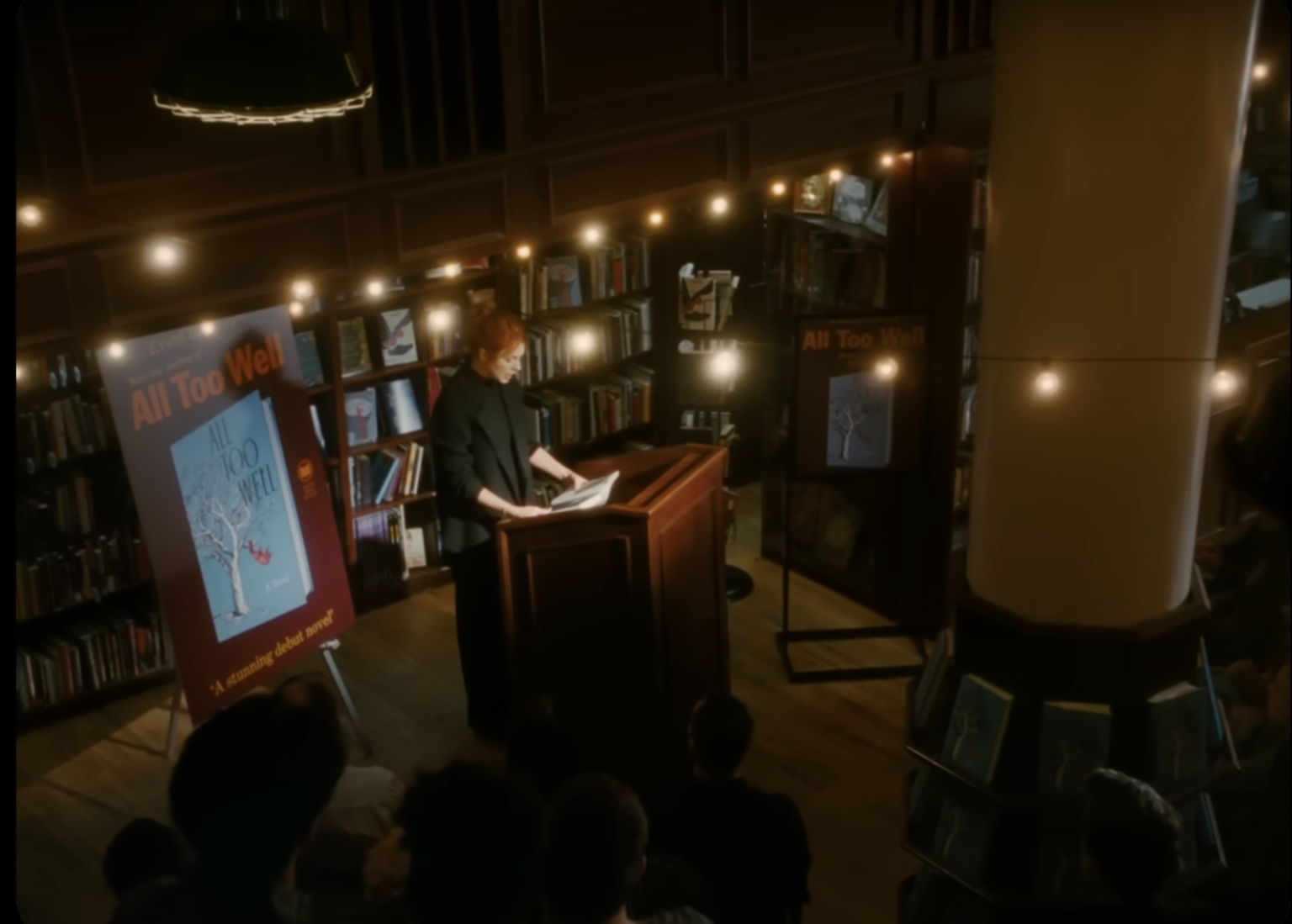
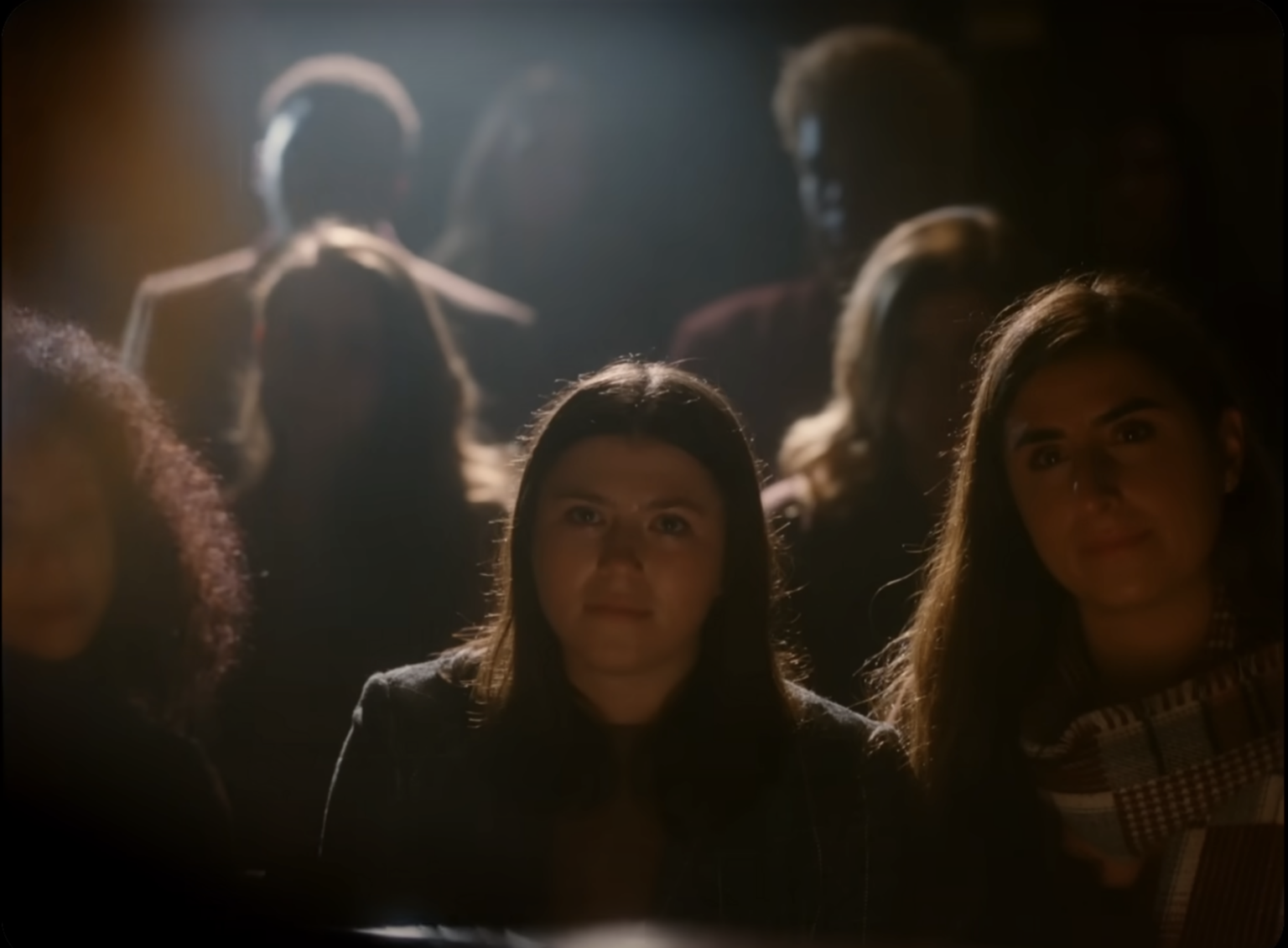
In a scene from her short film All Too Well, Swift depicts this relationship literally onscreen. She plays an author who has written a book entitled “All Too Well” which is meant to represent the song of the same name which forms the basis of the film. A shot of her reading from her book is intercut with a shot of an audience made up of young women listening intently to her every word. By choosing this frame story for her film, Taylor Swift demonstrates an understanding of the author/reader dynamic that exists between herself and her fans. As the author, Swift provides an opportunity for her fans to participate in the very act of creating her art through their “uncoding,” “deciphering,” and “unpacking,” and to explore what it truly means to be a “reader.” Hint: it’s the polar opposite of vapid, shallow, and silly.
Bookish Aesthetic
Taylor Swift’s readers can decipher anything — from the pattern formed by her Instagram grid to the color and texture of the clothes she wears in paparazzi photos — but the most common subjects of this reading are the distinct “eras” into which she divides her discography. Each era typically accompanies an album and embodies a particular aesthetic: cowboy boots/yellow/sparkles (Fearless); snakeskin/black and red/leather (reputuation); cardigans/grey and white/braids (folklore), etc. These differentiated aesthetics form the basis of Swift’s Eras Tour, as well as a large portion of Swift’s merchandise, marketing, and fan-created products.
While some elements of “nerdiness” have been incorporated into previous eras (think the bespectacled protagonist of the You Belong With Me music video), none have been more saturated with books and reading than Swift’s most recent era: The Tortured Poets Department (TTPD). With an expanded album entitled “The Anthology,” how could it not be? Even before the album was released, the bookish character of the era was clear. In mid-April 2024, Spotify hosted a pop-up teaser display in Los Angeles that imagined TTPD as a literal library, complete with bookshelves, knick-knacks, and even the sliding ladder of every bibliophile’s dreams. At the center of the display was a large card catalog cabinet with several drawers pulled out. While using a fake library to advertise an album with the word “poet” in the title is an obvious choice, this pop-up is significant for the conversations it inspired among Swifties and the public at large.
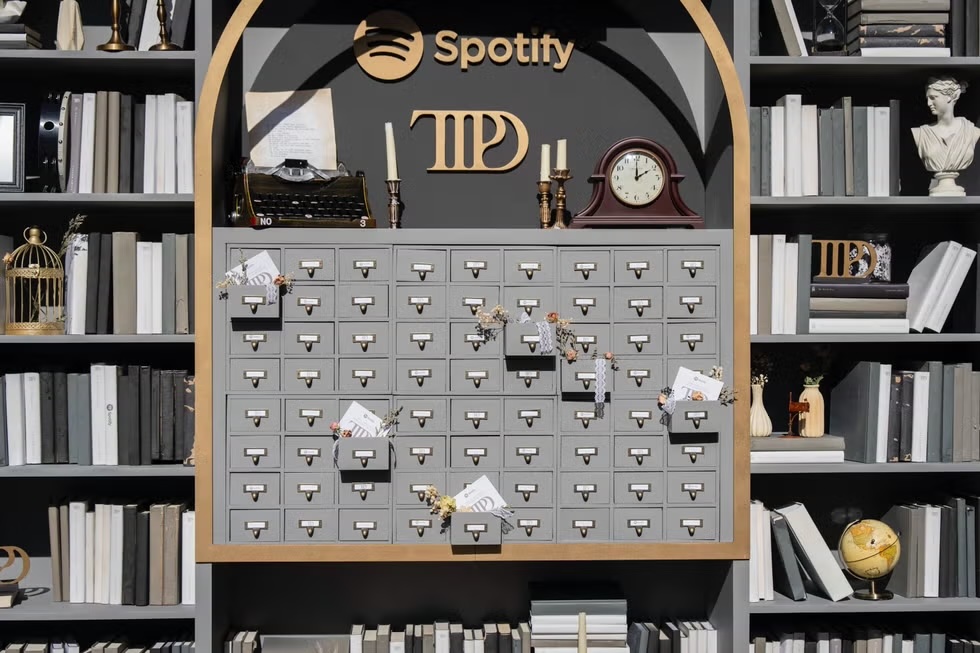
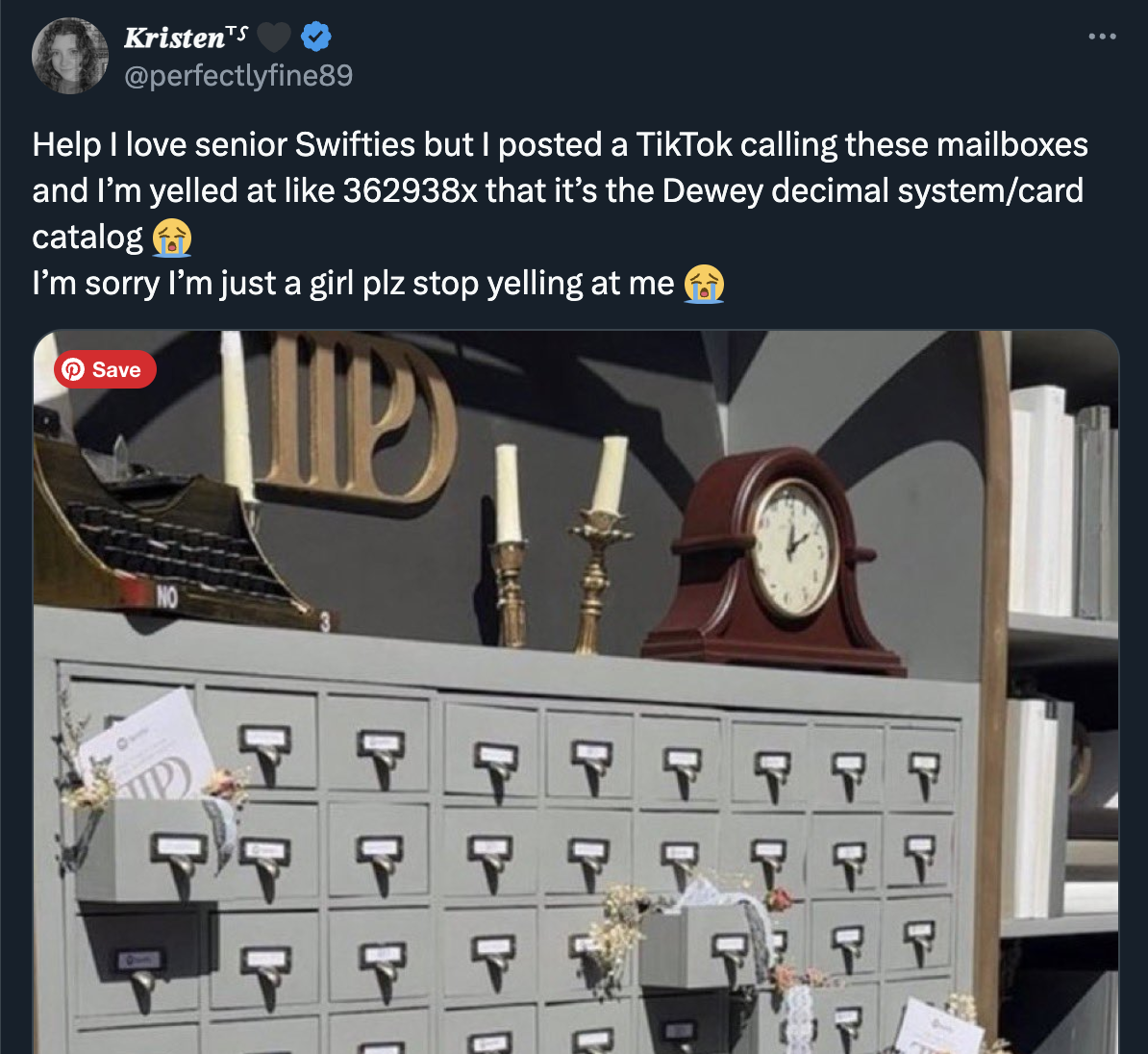
Amidst the feverish debates about the symbolism of the pulled-out drawers, several people misidentified them as mailboxes. Much to the chagrin of many a librarian, a large number of young people have never seen a card catalog in use, nor do they have an understanding of how it functions. However, the aesthetic choices made by Swift and her team for the TTPD era resulted in a larger discussion of historical library infrastructure online, enmeshing those topics into the current discourse (at least for a time).
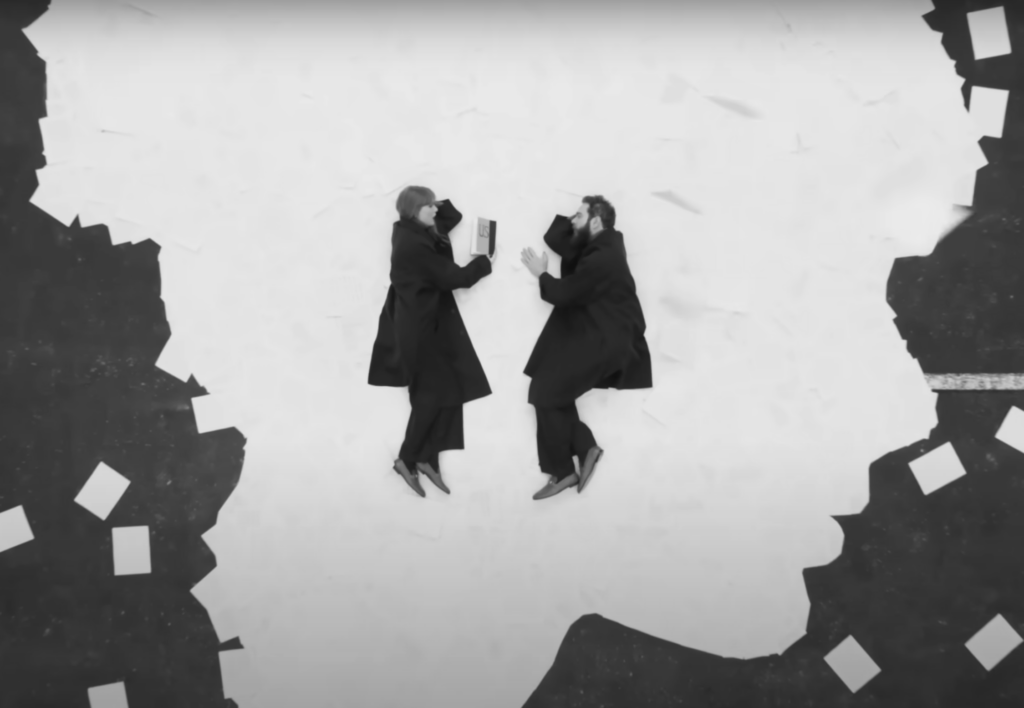
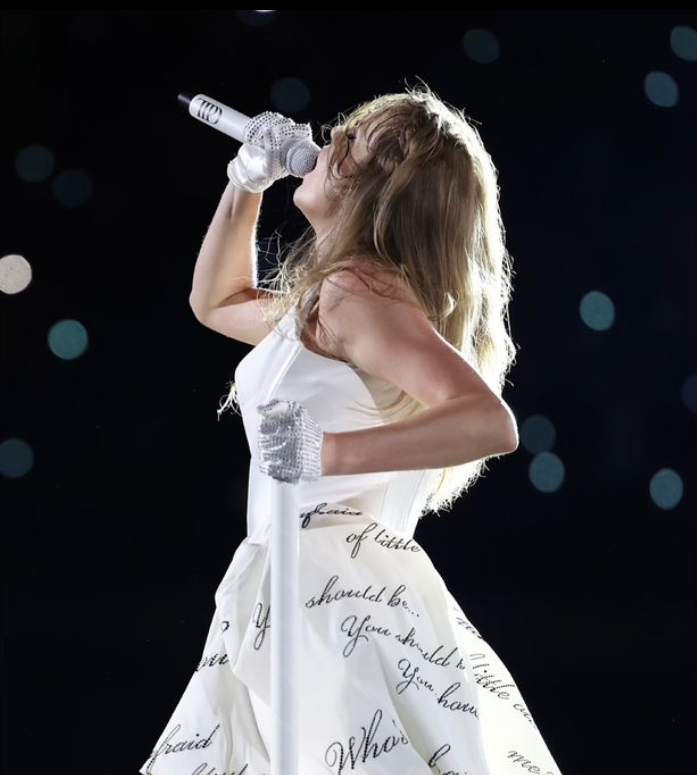
The Tortured Poets Department era also participates in what Amaranth Borsuk calls the “fetishiz[ation]” of “the aesthetic of bookness.”[xvii] Disembodied elements of books find their way into Swift’s music videos, her costumes, and her merchandise (both official and fan-made). As she grasps a book entitled “Us” while surrounded by reams of white pages or wears a dress emblazoned with the lyrics of the song she is currently singing, Swift is using these aesthetics to advertise herself and her music. She is the book, and she invites her audience to see what she has to say.
Her fans themselves are also enamored with the “aesthetic of bookness.” Taylor Swift’s official store offers TTPD notepads, leather-bound journals, a fountain pen, and even at one time an exclusive metal bookmark.[xviii] Unofficially, fans are creating T-shirts, stickers, clothing, and artwork related to reading, books, and the “bookish” aesthetic. The author of this article, in fact, was partially inspired to write about this topic when she was gifted a book-themed Taylor Swift T-shirt. This “commodification of the book object,” is, of course, nothing new, but it is occurring on a much larger scale due to Swift’s enormous popularity.[xix]
Conclusion
“The book,” writes Amaranth Borsuk, “has been transmuted into an idea and ideal based on the role it plays in culture.”[xxii] The same could be said for Taylor Swift. She is no longer just a musician, or even just a celebrity. She plays a large role in the lives of her fans and has achieved almost mythic status globally. Therefore, Swift’s use of the idea of the book (through her lyrics, her relationship with her fans, and her aesthetic choices) represents a significant opportunity to spread this idea to a large portion of mainstream culture and to inspire new conversations about what it really means to be a reader.
[i] Eliana Dockterman, “Taylor Swift Calls Critics of Her Songs About Exes ‘Sexist.’” Time, October 20, 2014, https://time.com/3524641/taylor-swift-feminism-critics-sexist/.
[ii] Eliza Thompson, “Taylor Swift’s Literary References: From Debut to TTPD.” Us Weekly, April 19, 2024. https://www.usmagazine.com/entertainment/news/taylor-swifts-literary-references-before-tortured-poets-department/.
[iii] I am by no means the first or the only one to point this out. In fact, a scholarly monograph examining Swift’s intertextuality is set to be published by Bloomsbury in just a few weeks: https://www.bloomsbury.com/us/literary-taylor-swift-9798765104538/
[iv] Patrick Doyle, Mary McCartney, Grace Guppy, Pedro Faria, and Alexander Brunacci, “Musicians on Musicians: Taylor Swift & Paul McCartney.” Rolling Stone, November 13, 2020, https://www.rollingstone.com/music/music-features/paul-mccartney-taylor-swift-musicians-on-musicians-1089058/.
[v] “Taylor Swift – happiness Lyrics,” Genius, https://genius.com/Taylor-swift-happiness-lyrics.
[vi] F. Scott Fitzgerald, The Great Gatsby (New York: Charles Scribner’s Sons, 2004), 17.
[vii] “Taylor Swift – invisible string Lyrics,” Genius, https://genius.com/Taylor-swift-invisible-string-lyrics.
[viii] Ernest Hemingway, The Sun Also Rises (New York: Charles Scribner’s Sons, 1926), https://www.gutenberg.org/cache/epub/67138/pg67138-images.html.
[ix] Nina Baym, “Novel Readers and Novel Reading,” in Novels, Readers, and Reviewers: Responses to Fiction in Antebellum America (Ithaca: Cornell University Press, 1984), 50, http://www.jstor.org/stable/10.7591/j.ctt2204nx9.6.
[x] Piers Morgan Uncensored, “‘He Diagnoses The Problems Correctly’ Matt Walsh On Andrew Tate & More,” YouTube video, 31:07, https://youtu.be/Cs3UbPAIptI?si=yfQ7HsoNnVA6TZSI&t=435.
[xi] “Taylor Swift – The Manuscript Lyrics,” Genius, https://genius.com/Taylor-swift-the-manuscript-lyrics.
[xii] Julie Chen and Clifton Meador, How Books Work (Oakland: Flying Fish Press, 2011), 9-16, https://flyingfishpress.com/portfolio-item/how-books-work/.
[xiii] Taylor Swift, “Taylor Swift – All Too Well: The Short Film,” YouTube video, 14:55, https://youtu.be/tollGa3S0o8?si=0ylZH9rqqny_ruDC&t=743.
[xiv] Ibid.
[xv] Alyssa Bailey, “Inside Taylor Swift’s ‘Tortured Poets’ Spotify Pop-Up Library.” ELLE, April 16, 2024. https://www.elle.com/culture/music/g60503898/taylor-swift-tortured-poets-spotify-pop-up-library-photos/.
[xvi] @perfectlyfine89, “Help I love senior Swifties but I posted a TikTok calling these mailboxes and I’m yelled at like 362938x that it’s the Dewey decimal system/card catalog,” Tweet, posted April 16, 2024, https://x.com/perfectlyfine89/status/1780354468485222607.
[xvii] Amaranth Borsuk, The Book (Cambridge: Massachusetts Institute of Technology, 2018), 113.
[xviii] “The Tortured Poets Department Shop,” Taylor Swift, https://store.taylorswift.com/collections/the-tortured-poets-department-shop.
[xix] Borsuk, 113.
[xx] Taylor Swift, “Taylor Swift – Fortnight (feat. Post Malone) (Official Music Video),” YouTube video, 4:09, https://youtu.be/q3zqJs7JUCQ?si=EZ6qaGm4180YHMJF&t=118.
[xxi] @taylorswift, “WOW. MILAN.,” Instagram post, July 15, 2024, https://www.instagram.com/p/C9c3Mo1uFd2/?img_index=9.
[xxii] Borsuk, 194.