
Ada Maria Kuskowski. Vernacular Law: Writing and the Reinvention of Customary Law in Medieval France.
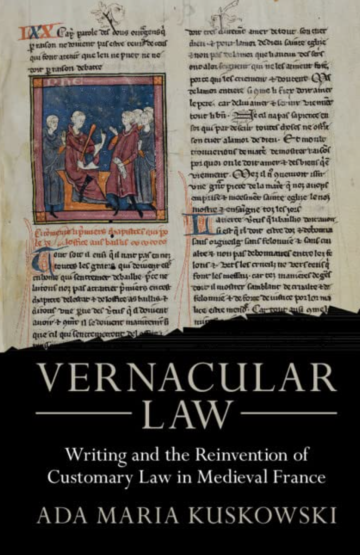
Ada Maria Kuskowski. Vernacular Law: Writing and the Reinvention of Customary Law in Medieval France. Cambridge, UK: Cambridge University Press, 2023. 412 pages. ISBN 9781009217897. US $125.00 (hardcover).
Ada Maria Kuskowski’s Vernacular Law: Writing and the Reinvention of Customary Law in Medieval France is an innovative study of the earliest customary lawbooks (coutumiers) written in northern France that offers a fresh take on the transition from orality to literacy. Produced roughly between 1200 and 1300, these coutumiers were written to describe the practice of lay courts, as distinct from that of the ecclesiastical canon law courts. The process of writing down orally transmitted practice occurred against the background of the rediscovery of late antique written Roman law, which was increasingly taught at the universities. Coutumiers are often seen as merely fixing in writing an orally transmitted body of rules that had existed unchanged from time immemorial—a misconception Kuskowski challenges. By carefully reading what is said about customary law in the coutumiers themselves and in other contemporary works, and by observing differences among manuscripts and the texts they contain, Kuskowski shows that legal custom, far from being fixed, was self-consciously in constant flux, with individual customs being introduced and abrogated through discussion and negotiation as cases were resolved, often through compromise rather than by reference to a unitary authority.
After a thorough description of the individual works included in her study, Kuskowski, now an Associate Professor of History at the University of Pennsylvania, carefully teases out understandings of custom in university, canon law, and lay contexts. In all three contexts, she demonstrates custom was understood to be unwritten, as opposed to written Roman or canon law; as a result, the writing of custom is anomalous. Kuskowski then situates the coutumiers within the contemporaneous movement of writing serious literature in the vernacular, exploring how the vernacularity of written custom required an enrichment of everyday speech through the introduction of technical vocabulary and the honing of rhetoric. Although the influence of learned Latinity can often be seen in these early works (some were apparently written first in Latin, then translated), their distinction from previous written law is clearly evident in compositional method as well as in formal presentation.
Medieval books of Roman and canon law, like most books in the scholastic tradition, typically presented the urtext surrounded by a gloss that often became standardized (the so-called ordinary gloss). Such lawbooks were produced in theoretically identical form for university study under the pecia system, in which students rented portions of copy-text to create their own textbooks. Coutumiers, on the other hand, freely incorporated text from various sources, often with no or minimal attribution and no articulated hierarchy. Incorporated text might include Roman or canon law translated into the vernacular or text from other coutumiers, sometimes though not often including those written for other jurisdictions (with the name of the jurisdiction merely changed). The effect of the coutumiers’ use of incorporated text is not so much that of an interpretation of a legal text taken as authoritative—an urtext and a gloss—but rather of a freewheeling dialectic in which legal principles are gradually abstracted through citation of anything that seems relevant, written or previously unwritten, witnessed or merely heard, established or unsettled: individual cases, learned law, well-known maxims, previous decisions, royal ordinances, or personal opinion.
Kuskowski argues that this dialogic flux, with unstable boundaries between texts and variation between manuscripts, reveals a culture in which writing was not understood to produce fixity but rather existed as a continuation of orality by other means, with voices in each medium attempting to discover principles and produce justice in a continuing debate. In a particularly interesting example, she reconstructs what contemporary legal debate might have looked like by analyzing a fictional trial in the humorous animal tale the Roman de Renart, in which jury deliberations involve carefully reasoned arguments to establish the customary rules relevant to the case, including cultural as well as legal standards, and then to evaluate the validity of those rules in light of abstract justice, thus invoking while also constructing custom. Although some of the legal works Kuskowski discusses have named authors who write in the first person, many are anonymous. All of these authors, both named and anonymous, express their authorial agency through creative citation, sometimes limited to selection and arrangement of large blocks of already circulating text with subtle but strategic alterations. Thus each text, work, and manuscript represents an intervention in an ongoing conversation about the particular provisions and abstract nature of law.
Kuskowski insists that each manuscript should be seen as authoritative. She critiques standard critical editions of the coutumiers, with their single best text and variations relegated to footnotes, arguing instead for an analysis of each manuscript in itself. She also suggests that understanding the dialogue between texts requires an acknowledgment of other works included in individual manuscripts as well as annotations added by readers. Quite provocatively, Kuskowski maintains that writing customary law did not produce fixity but rather continuous creative innovation. This resulted in what she calls “dynamic text”: an unstable proliferation of legal texts that, through a gradual process of consensus-building, began a movement toward a French common law, which proceeded first through royally mandated consolidation of local custom in official written form and then through print, resulting ultimately in the Napoleonic codifications of law during the nineteenth century. By focusing on this earlier moment rather than reading backward from later developments, Kuskowski presents an instructive view of the practice of early vernacular writing in all of its innovative and unstable freshness, while also offering a striking depiction of medieval legal culture as one of improvised negotiation effected through a bricolage of writing and orality, which transmitted but also invented tradition. The book will be of interest to book historians as well as to its primary audience of legal historians.
Robert O. Steele, Independent Scholar