
Andrew Pettegree. The Book at War: How Reading Shaped Conflict and Conflict Shaped Reading.
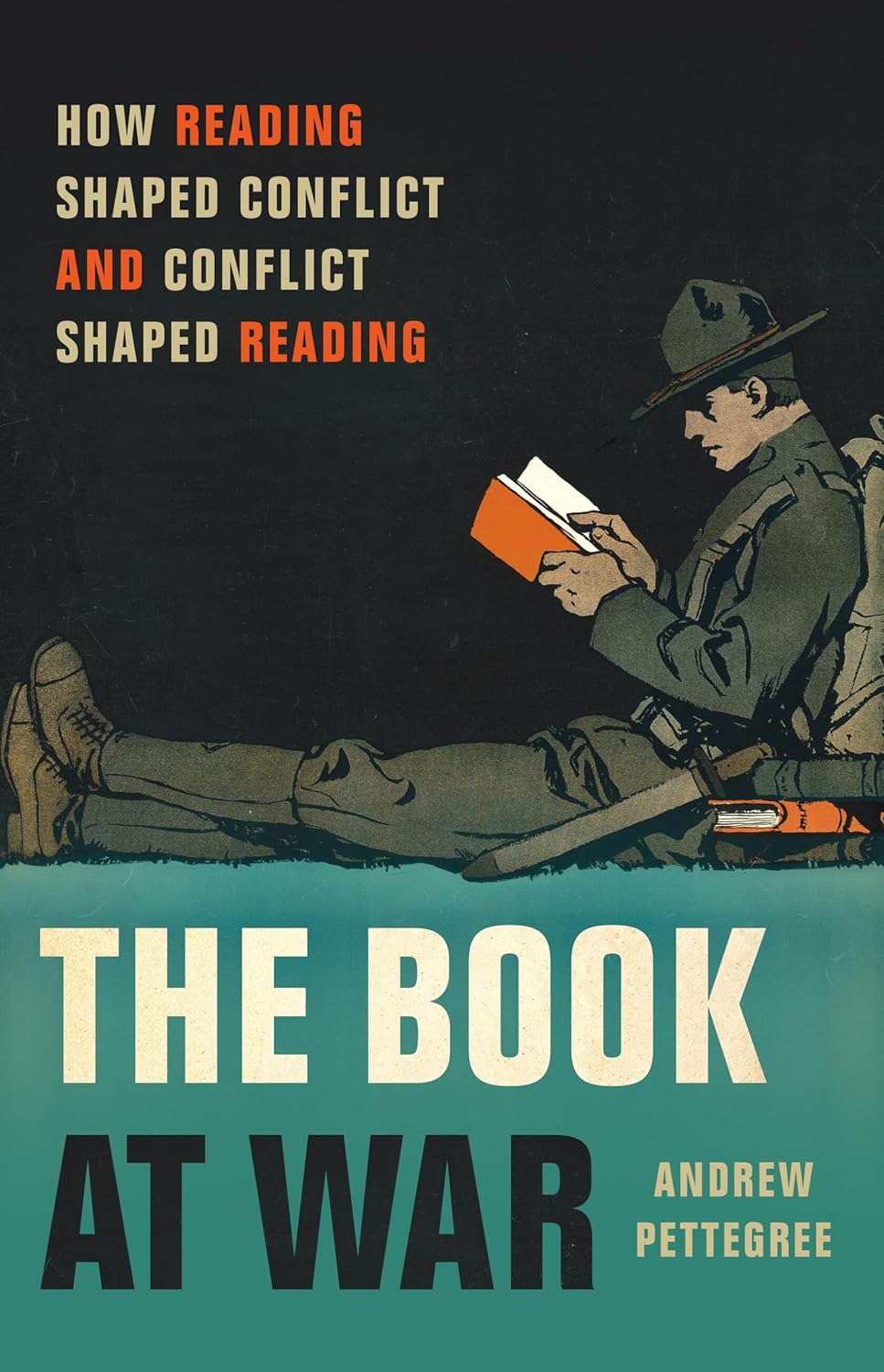
Andrew Pettegree. The Book at War: How Reading Shaped Conflict and Conflict Shaped Reading. New York: Basic Books, 2023. 480 pages. ISBN 1541604342. US $35.00 (hardcover).
For the past twenty years, the interaction between conflicts, politics, and print cultures has been the object of sustained research. Following Frances Stonor Saunders’s pioneering study (Who Paid the Piper? The CIA and the Cultural Cold War, 1999), scholars including Valerie Holman (Print for Victory: Book Publishing in Britain 1939-1945, 2008), John B. Hench (Books As Weapons: Propaganda, Publishing, and the Battle for Global Markets in the Era of World War II, 2010), Alfred A. Reisch (Hot Books in the Cold War: The CIA-Funded Secret Western Book Distribution Program Behind the Iron Curtain, 2013), Greg Barnhisel (Cold War Modernists: Art, Literature, and American Cultural Diplomacy, 2015), and Amanda Laugesen (Taking Books to the World: American Publishers and the Cultural Cold War, 2017) have explored the role of reading materials in wartime and their use as propaganda in ideological conflicts during the twentieth century.
Andrew Pettegree’s The Book at War: How Reading Shaped Conflict and Conflict Shaped Reading spans the nineteenth century to the post-Soviet era and expands the historical scope of previous studies. Pettegree, Bishop Wardlaw Professor at University of St Andrews and an expert in the early modern and modern history of the book trade, tells the story of how “political leaders identified books and authors, poets and publishers as key resources in the business of war” (p. 12). By uniting existing scholarship with new analysis of books, periodicals, and ephemeral material, he investigates the multifaceted ways that books shape and are shaped by conflicts, as well as how wars have influenced writing, publishing, reading and collecting practices.
This represents the first strength of this study: it considers the entire communication circuit, from writers, editors, and translators, to publishers, printers, distributors, booksellers, and, crucially, librarians. Indeed, libraries and book collections are often at the fore of Pettegree’s attention; he considers how war leads to the destruction of libraries as well as opportunities to discover books for the first time—for example in “the forced isolation of a prisoner-of-war camp” (p. 6). Significantly, the UK edition of The Book at War (Profile Books) is subtitled Libraries and Readers in an Age of Conflict, underscoring how the book makes an ideal companion to Pettegree’s and Arthur der Weduwen’s The Library: A Fragile History (2021).
The structure of The Book at War is both thematic and chronological. Part I (Building the Fighting Nation) opens by examining the contribution of books and libraries to the construction of national identities (Ch. 1), before moving to their roles in military training programmes (Ch. 2) and in winning over supporters to the fighting cause (Ch. 3). Part II (The Mobilisation of Knowledge) stresses the importance of scientific and scholarly libraries in wartime, both on the home front and for the enemy (Ch. 4), while also exploring the relationship between intelligence, knowledge, academia (Ch. 5), and cartography (Ch. 6) in conflicts. Part III considers publishing (Ch. 7) and reading practices (Ch. 8) on The Home Front, while also addressing approaches to censorship and “enemy” books (Ch. 9).
Part IV (Books for the Boys) concentrates on book publishing and collecting for the troops (Ch. 10), on authors’ complex relationships with wartime government agencies (Ch. 11), and on the role of books in prisoner-of-war camps (Ch. 12). Part V (The Bomber Will Always Get Through) looks at attempts to save libraries and books collections (Ch. 13), at book pillaging and acquisitions (Ch. 14), and at the effect of the devastation of war on the experience of civilians (Ch. 15). It is particularly in exploring the experience of these common readers that Pettegree illuminates the complex and often surprising ways books and war affect each other. Both propaganda tools and weapons of resistance, objects of destruction and sources of admiration, books also symbolised “sources of comfort and solace in turbulent times” (p. 6).
A second key accomplishment of this work is its comparative and transnational approach. While Pettegree privileges instances of writing, publishing, and reading that took place during World War I, World War II and the Cold War, The Book at War also engages with a variety of case studies on the role of printed matter in fights for independence in formerly colonised countries, including Algeria and Kenya (pp. 401-404). Part VI (War as Peace) turns to the postwar period to assess the “cleansing” of libraries (Ch. 16) and discusses restitution attempts (and lack thereof) of books and archival material removed by invading troops and during racial persecutions (Ch. 17), before zooming in on the ideological polarisation of the Cold War decades and on movements for national independence (Ch. 18). The coda reflects on the continuation of wars in the twenty-first century, and on the enduring function of books in conflict-affected areas. As Pettegree writes, “the accrued intellectual capital of books will continue to play a part in our lives and conflicts, notwithstanding the domination of new technologies of war-making and information gathering” (p. 413).
Overall, this work is a much-welcomed addition to interdisciplinary research on book history and war. Throughout, illustrations help ensure an engaging reading experience, while offering insights into the paratextual and material features of primary sources across formats and languages. As an example, we can look at a colour reproduction of a US forces miniature edition of The Times from June 1943, depicting a troubled-looking Benito Mussolini (Fig. 19) and compare it to the portrayal, just across the page, of smiling troops inviting to support the purchase of books for soldiers on a German poster (Fig. 22).
The Book at War speaks to specialists and students across book and cultural history, politics, literature and modern languages, and translation studies. While each chapter opens a myriad of potential directions for further study, Pettegree’s new book will also appeal to anyone interested in the legacy of past wars and cultural conflicts in the contemporary world.
Anna Lanfranchi, University of Warwick