
A Muppet History of the Book

At the beginning of special collections instruction sessions, I sometimes ask students what books are meaningful to them and why. If there’s time, I might share The Monster at the End of this Book as one that’s important to me — a Little Golden Book (libellus aureus, if you will) written by Jon Stone and illustrated by Michael Smollin. Its sole character is Muppet (and monster) Grover from the children’s TV series Sesame Street. It’s one of my earliest memories of a book, and now a book I use to demonstrate how new readers learn to operate a book and how to face emotions about books.
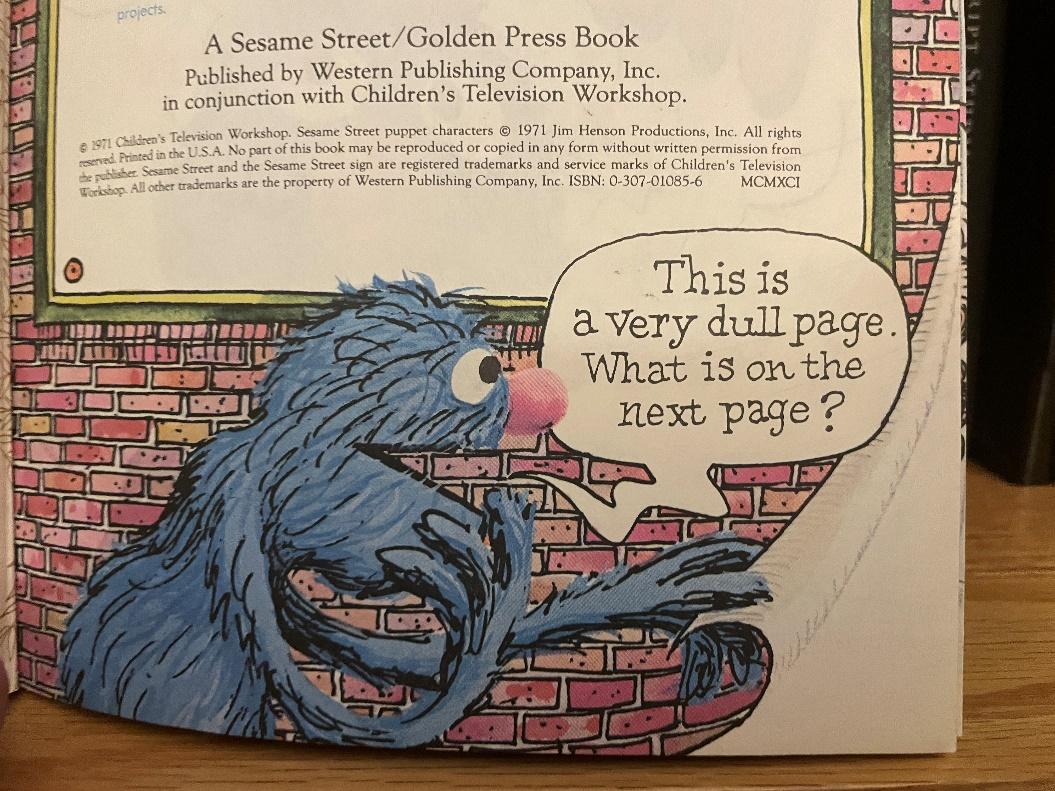
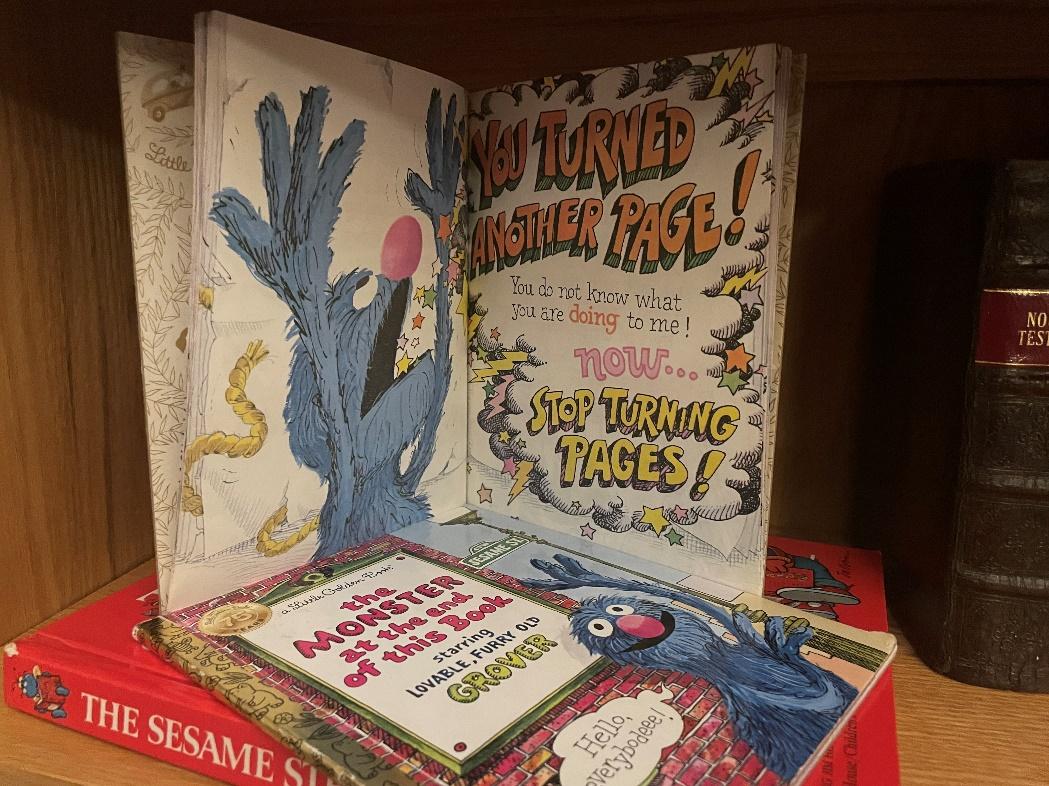
The Monster at the End of this Book is a more than usually bookish entry into Sesame Street and the wider Muppets universe. Grover breaks the fourth wall in screen or theater terms, but his pleas for the reader to stop turning leaves also resemble notes to the reader and colophons in much earlier books, asking for readers to extend compassion for the author and their work.
Incorporating The Monster at the End of this Book into library instruction grew out of working with education students studying literacy and its connection to books as artifacts in library instruction over the course of a semester. As I remind students in these sessions, interacting with books as artifacts means revisiting the skills and senses we take for granted when interacting with books.
In the first weeks of teaching a mini course on book history, I also shared Martians encountering a book on Sesame Street. They encounter new objects with silly incorrect approaches. The Martians would make ideal students of book history: the Martians’ instinct to “smell book” is aimed at young children, but easily corresponds to Ian Gadd’s introductory “book and a blindfold” classroom exercise. Their attention to the ways the book moves, what it does and what it doesn’t do, are examples worth emulating in the classroom.
Learning About Books
Muppet readers like Grover and the Martians often engage in silliness — actions like “smell book” and “hear book” — which turns out to be key to learning about books as material objects. These sensory exercises can reach back to earlier experiences with books. To continue down the path of “eat book”: gnaw book, throw book, tear book are all forbidden in a reading room but accommodated in children’s books — sturdy board books, even cloth book toys are made expecting them. Touch and taste are key sources of information for the pre-readers who make up the audience of those books, just as sensory information is important to studying books as material objects more broadly.
Students of book history can be reticent to touch or interpret a book, and can experience tension when they can’t read a book/text the way they’re used to reading. It’s easy to sympathize with Grover or the Martians in this case, exemplars when asking students to follow the book’s lead in the give of its binding or the texture of paper; to continue on when asked to adjust the way they handle the book, and to note their immediate reactions, shaping them into a response.
Just like Grover, students may not have straightforward, conclusive interactions with a book. Grover’s monologue to the reader makes reading an exchange, even when it’s not positive. The Monster at the End of this Book is a way in to acknowledging fear, boredom, even disgust when interacting with books and texts, and how those emotions can shape reading, collecting, and preserving books.
What is Muppet Book History?
One approach to Muppet book history incorporates play, affect, and pedagogy linked to the “visual shorthand for the general idea of learned-ness” of Pop Bibliography. In the classroom, book materiality is often connected to books as symbols of literacy: interrogating what literacy means in different times, places, and contexts.
There are certainly further areas to explore in Muppet bookishness outside of the classroom. In texts and readership, there’s tracing the social media phenomenon of discussion threads proposing Muppet casts for book adaptations and film remakes, in line with Muppet Treasure Island and The Muppet Christmas Carol. Muppets also appear in print, with numerous Sesame Street books for children produced over five decades, as well as different iterations of Muppets comics.
To return to a pedagogy of book history, though, there are further connections to book history scholarship. Many bookmakers demonstrate “a combination of commercial savvy and anticonformist creativity,” as Jordan Schildcrout describes Jim Henson’s work. And so the Muppets have a majuscule M as an Aldine has a majuscule A. There’s also the matter of intellectual property: compare the reuse of the Aldine dolphin and anchor to any number of Muppet imitations and iterations, and what Muppetness conveys to an enterprise. The world isn’t lacking for examples of art balanced with commerce which can be compared to printing and selling books, but Muppets have a breadth of work, a cultural and commercial presence, and, frequently, a queerness which aligns well with my own goals toward a queer history of the book in library instruction.
A Muppet book history recognizes the sometimes messy and uncanny interactions between humans and books not easily diagramed, and perhaps unresolved underneath the performance of academic participation. Queer bibliographies have connections to a Muppet book history, as they embrace “celebrating the out-of-place and ephemeral” “center affect and embodiment.” Introducing students to the study of books as material objects should mean balancing the unusual with the rote, and questioning as teachers what we are taking for granted. A Muppet book history offers the opportunity to address failures, fragments, and odd embodiments, to destabilize the “hidden gems” and “treasures” rhetoric that often accompanies one-shot instruction with rare books.
Teaching Muppet Book History: Resources
Beyond the greatest hits of a standard show-and-tell instruction session, special collections can and do get much stranger. A Muppety intervention could consist of even one or two items that disrupt assumptions about literacy, readership, and rare books, and could include examples and categories like the following:
- Monsters in books
- Lovable, furry old books (insofar as the fur isn’t mold)
- Books that know they’re books
- Golden books (Little Golden Books, Big Little Golden Books, stamped publisher’s bindings, illuminated initials, gilt top edges… what value is expressed?)
- Technically accomplished books; books that do something for books as the bicycle scene in The Muppet Movie does for puppetry
There is much more potential beyond this blog: consider it an encouragement to revisit book histories with a sense of play, to invite an ensemble of materials into the classroom, and to bring a celebrational, Muppetational approach to the high- and lowbrow history of the book in the classroom.
Works Cited
Alvis, Alexandra. “Pop Bibliography.” Allie “Book Historia” Alvis, December 13, 2023. https://www.bookhistoria.com/blog/pop-bibliography.
Gadd, Ian. “From Printing Type to BlackboardTM: Teaching the History of the Early Modern Book to Literary Undergraduates in a ‘New’ UK University.” In Teaching Bibliography, Textual Criticism and Book History, edited by Ann Hawkins, 65–71. Routledge, 2006.
Noble, Malcolm, and Sarah Pyke. “Queer Bibliography: A Rationale.” The Papers of the Bibliographical Society of America 118, no. 2 (June 2024): 147–69. https://doi.org/10.1086/730427.
Schildcrout, Jordan. “The Performance of Nonconformity on The Muppet Show—or, How Kermit Made Me Queer.” The Journal of Popular Culture 41, no. 5 (2008): 823–35. https://doi.org/10.1111/j.1540-5931.2008.00551.x.
Sesame Street: Martians Discover a Book, 2009. https://www.youtube.com/watch?v=TStPNqex3uA.
Stone, Jon, and Michael Smollin. The Monster at the End of This Book. Little Golden Books. New York, New York: Golden Books, 1999.