
Beth Driscoll. What Readers Do: Aesthetic and Moral Practices of a Post-Digital Age.
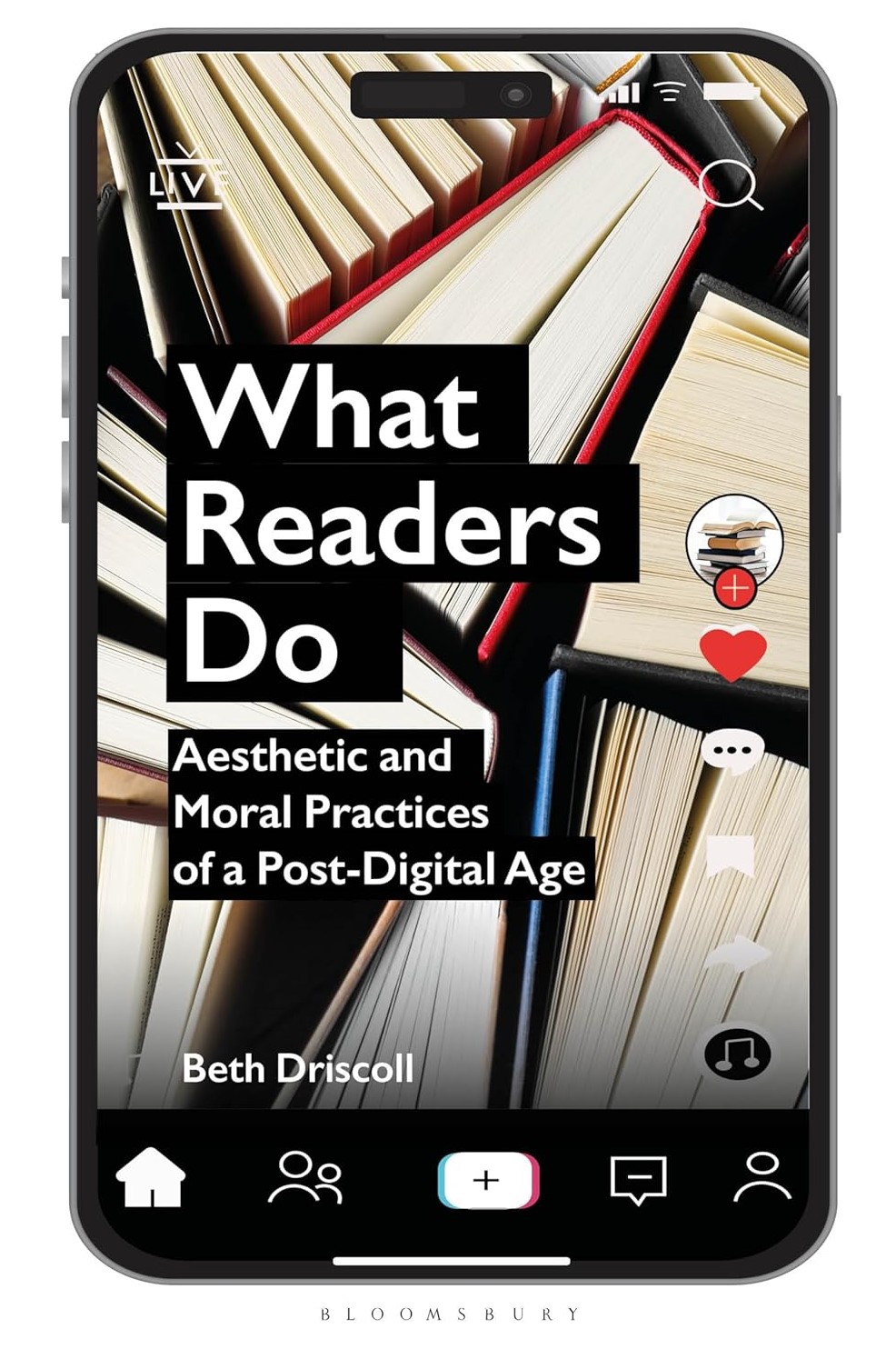
Beth Driscoll. What Readers Do: Aesthetic and Moral Practices of a Post-Digital Age. London: Bloomsbury Academic, 2024. 216 pages. ISBN 9781350375185. US $24.25 (paperback).
Beth Driscoll is the author or coauthor of four monographs that focus on popular genres and literary events. Her new work, What Readers Do: Aesthetic and Moral Practices of a Post-Digital Age, centers on the practices and infrastructures of contemporary book reading cultures and draws together strands of research she has pursued in her previous work. Rather than approaching recreational reading as passive and solitary, What Readers Do reconceptualizes reading as active and networked.
In chapter 1, “A Methodology for Contemporary Reading Studies,” Driscoll deftly situates her approach at the intersection of multiple fields that are concerned with the role of the reader: literary studies (especially via Rita Felski), the sociology of reading, and book history. To draw these together in a reader-centered methodology, Driscoll borrows from Actor-Network theory (ANT). An ANT-led approach assumes a “flat ontology” and asks us to redistribute our attention and care evenly between all actors, be they human or non-human, as equal participants. Driscoll applies this approach to decenter the hierarchies implicit in academic reading and literary research. She shifts attention from the usually privileged canon-based professional reading and gives researcher and research subject equal priority. Starting with readers and their choice of reading material and then following the networked paths to which readers and their books belong ensures a bottom-up perspective that focuses on the readers themselves in networks they forge. What Driscoll’s perspective loses is the equal attention to objects and usually invisible infrastructural elements that an ANT-based analysis typically demands. This theoretical framework brackets other creative methods that generated the diverse data the book draws on: a reading group that Driscoll co-facilitated, her fiction of the book fair, The Frankfurt Kabuff, interviews with attendants at the Melbourne Writers Festival, and an Instagram account with a bookish aesthetic that she maintained. This plurality of creative methods is particularly interesting for anyone coming to this book from literary studies.
The next chapter, “Networks of Readers,” puts this methodology into practice and unfolds the identities that readers adopt, as consumers, as citizens, and as discussants, within different contexts and institutions. Driscoll surveys book clubs, Goodreads, and author readings as spaces that allow readers to perform their “bookish” identity, interacting with other readers and sometimes with the authors themselves.
In the third chapter, “The Aesthetic Conduct of Readers,” Driscoll examines how what Jessica Pressman has called “bookishness” functions as a lifestyle and mode of self-presentation. The active and socially performed aspect of this affiliation with books and reading figures as “aesthetic conduct,” a phrase that underlines Driscoll’s emphasis on readers’ active “doing” of readerly identities. She illustrates this using three cases. The first, bibliomemoirs, are autobiographical texts in which authors reminisce about their reading lives. As a genre, bibliomemoirs “draw explicit links between reading and the style of life” (p. 72) that their authors offer as a model for “ordinary” readers. Aesthetics is also a key concept on Bookstagram and BookTok, which as Driscoll demonstrates function as sites of aesthetic conduct as performance. On these platforms, images of books, reviews, and lists collated by users and embedded in networks showcase readerly identities on the basis of aesthetic judgements and presentations. The last example concerns a book club. Here, she argues, aesthetic conduct in face-to-face situations takes the form of participants voicing aesthetic judgements and opinions on texts while negotiating the power imbalance between facilitators and participants. Driscoll is careful to mention that the commercial aspect overtly visible in platform-based aesthetic conduct also determines the bibliomemoir and the reading group. The memoirs are lucrative products, while publishers and platforms profit from the aesthetic conduct of bookish users and readers.
Driscoll begins the fourth chapter, “The Moral Force of Readers,” by asserting that book reading is morally freighted with expectations of making readers into better people by instilling civic values and empathy, supposedly turning them into responsible “citizen readers” (p. 96). This serious, middlebrow attitude plays out in book clubs and literary festivals, which invite readers to hone their moral judgement and participate in open discussion. By contrast, digital platforms have been the site of moral controversy centering on authors and publishers, most prominently J.K. Rowling’s anti-trans tweets. The most drastic act of moral conduct, however, constitutes deliberate and narrativized “not reading,” which forges connections not between readers, but between those who strategically refuse to read specific books or authors. But as Driscoll makes clear, authors and publishers usually act from a position of power, while readers’ voices struggle to be heard.
Chapter 5 returns to the conventional image of the reader as lost in a solitary pursuit—a practice which is difficult to research, as Driscoll concedes. Hence, “Private Reading as Self-Care” analyses popular media discourses of private reading in which Driscoll identifies three registers: reading as erotic, as deep and uninterrupted, and as a mindful practice. These modes hold different potentials and tensions: erotic reading is a mode of understanding reading through “desire” and “satisfaction” (p. 118), and enabling communion with the author mediated by the text. The “eroticized reading experience” (p. 124), Driscoll argues, is also potentially politically disruptive, because emotions and intimacy felt through reading and the playfulness associated with the staging of emotional reading experiences sometimes transform into collective action. By contrast, deep reading has been formulated as a scientific ideal of reading based on how brains are understood to work and process information. Digital media are anathema to this slowed-down and sustained attention that book reading requires, so that analogue reading emerges as a counterpoint to digital technology. Mindfulness—critically understood as an individualized strategy of coping with adverse structural circumstances—describes discourses on private reading that highlights the therapeutic and meditative quality of reading, which too, is cast as the opposite of digital media, “even as it occurs among digital media,” (p. 134) a constellation that is the hallmark of the post-digital environment.
In the brief conclusion, Driscoll acknowledges that the different identities of readers determine how they inhabit the category of “reader” online and offline. Positioning recreational reading in the post-digital moment raises questions about the future viability of book reading: Driscoll argues that the institutional entrenchment of reading as well as the social relations readers create in networks will ensure its survival. Furthermore, the nostalgic quality of books as objects, and their increasingly lavish design as collectibles could ensure that reading turns into an even more popular pastime in the future. What Readers Do offers a rich and concise overview of different facets of post-digital reading by skillfully unlocking the black box of ordinary and everyday practices. Its strengths lie in Driscoll’s ability to make visible the social dimension and complexity of a largely private pastime. The book offers an intriguing look at recreational readers, readerly identities, and ideals that should appeal not only to experts in the field, but also to students, scholars from other disciplines, and any reader interested in a carefully theorized bird’s-eye view of their hobby. What seems to be missing, however, especially considering non-specialist audiences, is a more detailed explication of “post-digital” as a central concept. That said, reading Driscoll’s volume immediately made me reflect on my own (recreational and professional) reading as a solitary and networked practice. Driscoll succeeds in illuminating an everyday phenomenon and models a strategy to open it up to further and creative research.
Sabina Fazli, Johannes Gutenberg-Universität Mainz