
Jane McLeod. Print, Politics and Trade in the French Atlantic: The Labottière Family as Eighteenth-Century Cultural Brokers.
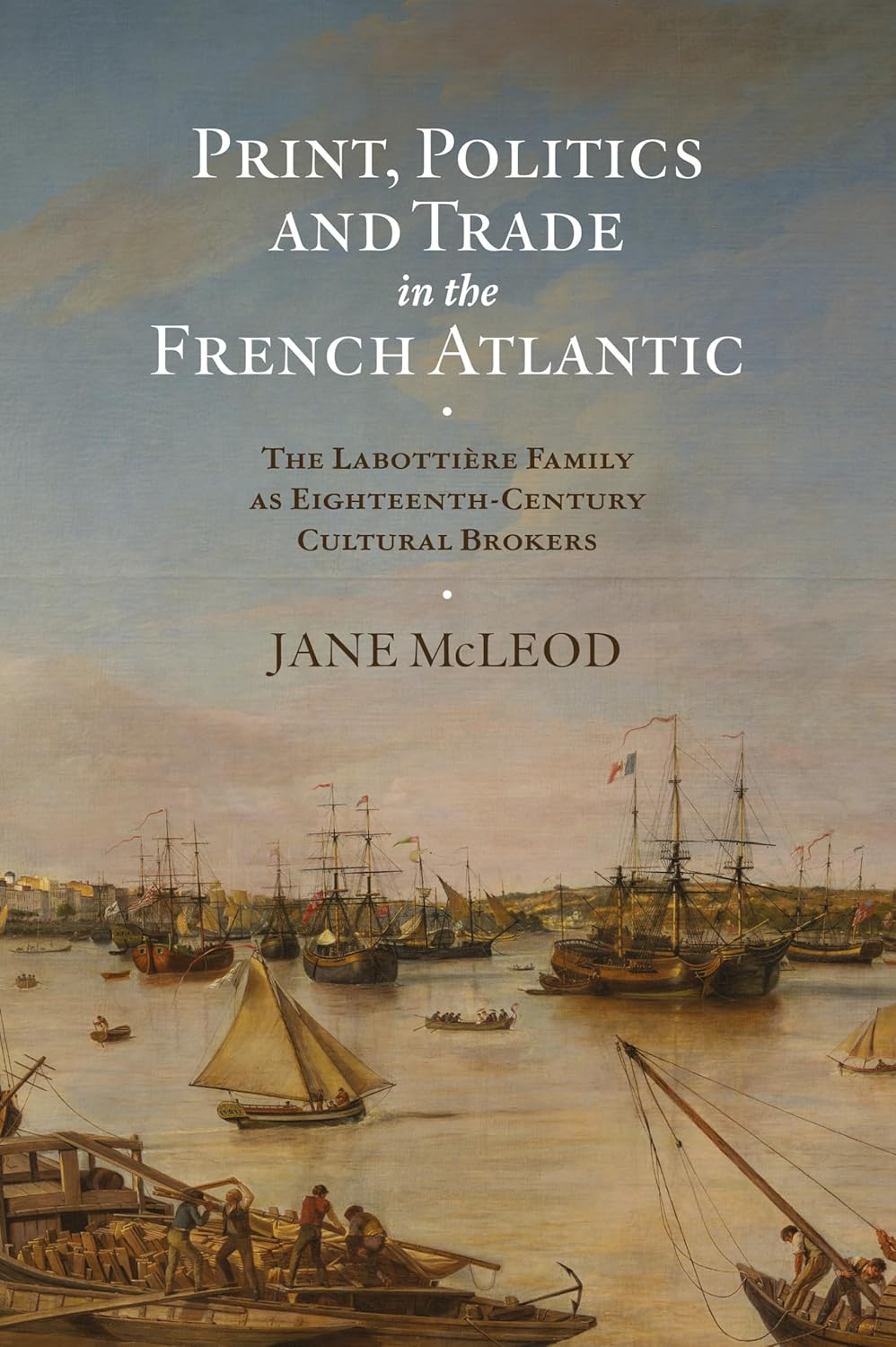
Jane McLeod. Print, Politics and Trade in the French Atlantic: The Labottière Family as Eighteenth-Century Cultural Brokers. Woodbridge, Suffolk: Boydell Press, 2024. 362 pages. ISBN: 9781837650866. US $130.00 (hardcover).
Print, Politics and Trade in the French Atlantic is the work of Jane McLeod, an early modern historian at Brock University. Members of the extended Labottière family were printers and booksellers in Bordeaux from the 1680s, when Claude Labottière emigrated there from Lyon via Paris, to 1794, when the businesses collapsed due to economic and financial disruptions caused by the French Revolution. The book is a microhistory of 31 members of this provincial printing/bookselling family, showing their rise to prominence over several generations, the works they printed and imported to sell, and the two newspapers they published (first Affiches de Bordeaux and then Journal de Bordeaux). Readers will also learn how they coped with the French Revolution, government scrutiny, and their competitors, their workers, their business and familial connections to Iberia and the Caribbean, and their financial collapse.
The Labottières strategically located their printing operation and chief bookstore opposite the buildings of the local parliament and Jesuit college in Bordeaux. Much of their printing and bookselling was done to meet both religious and governmental needs; churchmen and legal personnel were 87% of their book-buying customers. Their firms’ account books show that other elites, such as doctors, apothecaries, surgeons, professional people, nobles, and a few women bought books from them; fewer merchants were customers until towards the end of the eighteenth century. From the firms’ catalogs McLeod suggests that the books the Labottières imported to sell reflected the family’s self-image as agents furthering modernity, Enlightenment ideas, science, and political awareness. There were seven printers and booksellers in the Labottière family; a wider team of family, associates, and friends all played roles, including wives, mothers, and clerks. Their business records show a focus on printing pamphlets, posters, copies of legislation, and copies of judicial decrees. Their newspapers included reprintings of stories from other French newspapers and from foreign newspapers, local news, announcements, and advertisements (including those related to the slave trade).
In this study, McLeod breaks new ground by considering her topic in light of recent research on the history of the book, by highlighting the political role played by the Labottière family, and by integrating their story into the flourishing field of Atlantic history. Because of what she uncovered by studying this printing/bookselling family, she concludes,
We have changed the way in which we look at their activity and significance as printers and booksellers. Gone are some of the traditional themes in eighteenth-century French provincial publishing history: the sad tales of decline, subservience to Parisian and foreign publishers, of their victimization by both these interest groups and by the royal government. This traditional narrative…frequently obscures the importance of provincial printers and booksellers in transmitting the ideas and political information that structured and gave impetus to the Revolution in France. (p. 293)
Although no personal papers from the Labottière family survive, McLeod did extensive archival research for this work using manuscripts at several institutions in France, including the Archives Nationales de France, Archives Nationales d’Outre Mer, and the Bibliothèque Nationale. Other primary resources consulted were the almanacs the family firm published, their catalogs of works for sale, issues of their two newspapers (heavily used), and the pamphlets and monographs they printed or imported. McLeod has included extensive genealogical tables at the back, which are necessary for understanding the family members and their relationships with each other.
In spite of the wealth of details about the various Labottière family members and the content of the works they printed and imported for sale, the book is easy to read because McLeod carefully articulates the goal of each chapter. Her interpretive work on how the Labottières, their editors, and printers navigated printing and selling the ideas of the Enlightenment and the changing politics of the French revolutionaries is fine and detailed. Freedom of the press, the so-called Fourth Estate, was new, and as the Revolution progressed, printers like the Labottière family had to decide what to print in their newspapers without enraging those in political control. Claude’s grandsons Antoine and Jacques were careful to support the Revolution without seeming too strident; they survived the guillotine.
McLeod is not a newcomer in this corner of book history scholarship. In an earlier work, Licensing Loyalty, Printers, Patrons, and the State in Early Modern France, she dealt with media-state relations, the coming of licensing of printers and increased state control by the monarchy, and provincial printing more broadly, from 1667 to the French Revolution.
Who will be the readers? Early modern continental book history scholars and enthusiasts.
Agnes Haigh Widder, Michigan State University