
Paul Fyfe. Digital Victorians: From Nineteenth-Century Media to Digital Humanities.
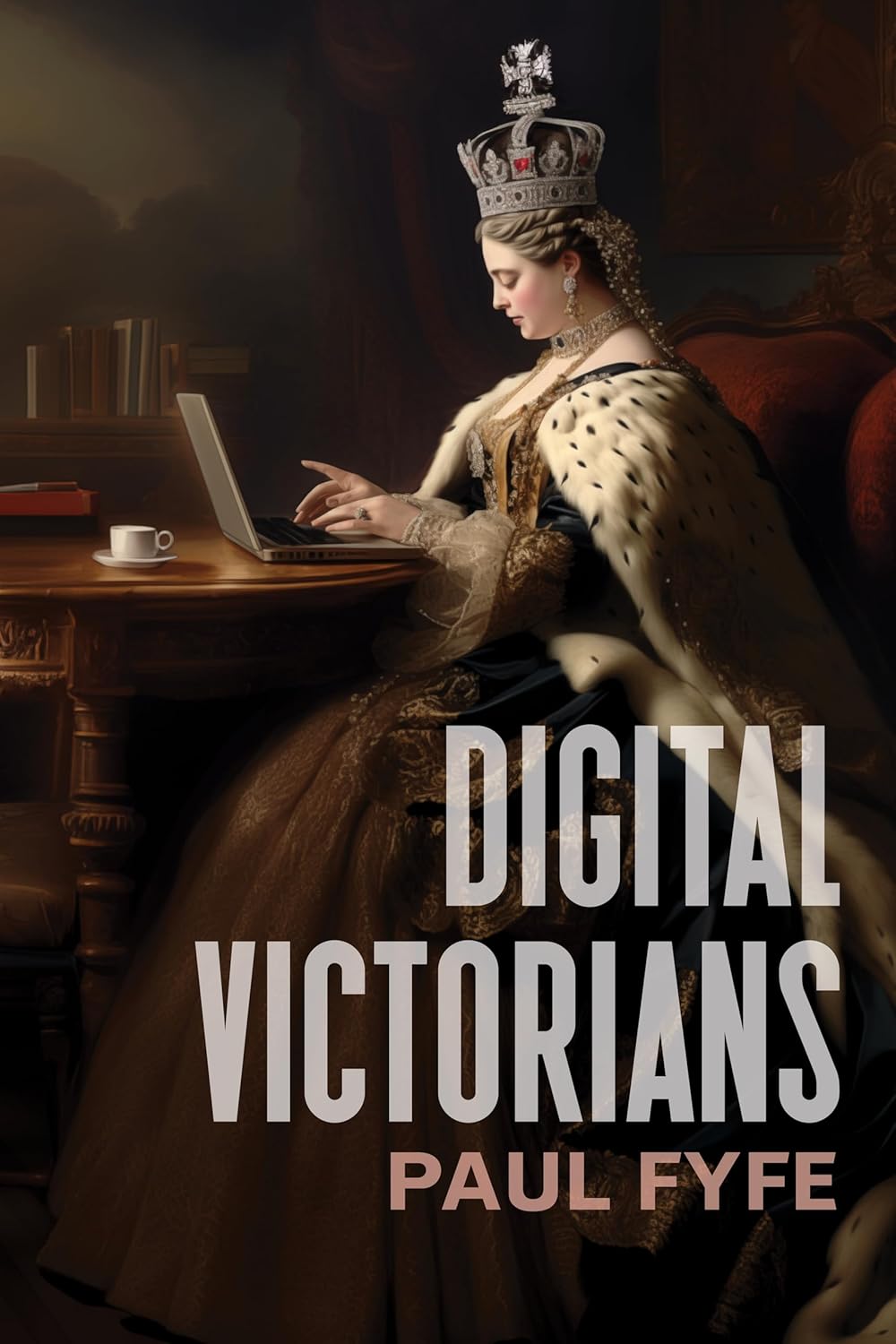
Paul Fyfe. Digital Victorians: From Nineteenth-Century Media to Digital Humanities. Stanford: Stanford University Press, 2024. 294 pages. ISBN 9781503640948. £10.79 (paperback).
“If the Victorians were already digital, they might help us envision a more encompassing field or alternative futures for digital scholarship now” (p. 4). One of the biggest delights of reading Paul Fyfe’s Digital Victorians is how convincingly he makes his anachronisms—exemplified by this quote and the book’s title—work. He does this through a thorough literary and sociological analysis of an unlikely but effectual selection of authors: Thomas De Quincey, George Eliot, George du Maurier, Henry James, and Robert Louis Stevenson. The key to establishing a fruitful “dialogue with the past” (p. 22), he argues and ultimately demonstrates, lies in critically analyzing and strategically employing our presentism and anachronisms.
Through the first four chapters that delve into these authors’ works, Fyfe instantiates pre-digital anxieties around deliberately mystified algorithmic black boxes, information overload and privacy concerns, distant reading and machine learning, and discourses of literary authority in cross-media and transmedia contexts. In doing so, he establishes some interesting genealogies for our ongoing encounters with newness and new media.
The first chapter traces a genealogy of networked cultures through Thomas De Quincey’s essay “The English Mail-Coach, or the Glory of Motion,” which appeared in Blackwood’s Edinburgh Magazine in 1849. Fyfe uses the mail coach and its “mystified” workings to analogize the erasure of labour and the seeming disembodiment of material conditions of production that algorithmic networks perpetuate (p. 42). The second chapter employs Marian Evans’s 1859 “doxxing” (another clever anachronism), which revealed her to be the pseudonymous George Eliot, to discuss privacy discourses and data ethics endemic to the information age (p. 67-68). In addition to Eliot’s 1859 novella The Lifted Veil, Fyfe uses George du Maurier’s novel Peter Ibbetson (1891) to effectively establish that “[t]he concept of information overload or too much information (TMI) is both recent and a historical cliché” (p. 73).
In the third chapter, this reviewer’s personal favourite, Fyfe delineates the methodological anxieties engrained in the still-emerging field of Digital Humanities (DH) through the unnamed telegraphist in Henry James’s In the Cage (1898), who uses numbers and word correlations in telegraphs to infer meaning about the lives of the people sending and receiving them. Fyfe’s analysis of this text grounds the question: “How do we get from numbers to meaning?” (p. 113). In addition to finding Victorian roots for distant reading, the chapter also offers a particularly strong and relevant commentary on the obscuring (and eroticization) of women’s labour in machine learning and automation operations, an argument Fyfe supplements with the examples of Apple’s Siri, Amazon’s Alexa and Google’s Cortana that perpetuate “gendered assumptions about [women’s] subservience” (p. 129).
Chapter four explores Robert Louis Stevenson’s The Strange Case of Dr Jekyll and Mr Hyde (1886). Fyfe’s original and convincing textual analysis positions the mirror in one of Stevenson’s scenes as an articulation of reproductions and replications enabled by new media. “Mirrors placed opposite each other (seeing themselves?) create a diminishing tunnel ad infinitum…. The passage everywhere signals the problem of distorted replication that the novel cannot name” (p. 141). This prefaces the exploration of the figures of Jekyll and Hyde being reproduced across media, from stage to film to audiobook, to even a 1910 advertisement from the American Telephone and Telegraph Company (AT&T) invoking the characters to portray rude customers. Such examples present a metadiscourse on remediation and its associated anxieties about creative authority and hermeneutical challenges.
Locating nineteenth-century antecedents for anxieties of a periodized digital age has an understandable allure. From incipient media and technological shifts to the “unprecedented textual scale” of the Victorian literary marketplace (p. 110), Fyfe’s textual analysis interpreting these themes is as creative as it is convincing. His fifth chapter, however, seems sequentially misplaced. This chapter examines the archaeological and transmission history of digital preservation projects of nineteenth-century periodicals through microfilms, scans, and other digitized repositories, and the associated complexities involved in accessing them. The chapter admittedly serves as an important expansion on the overall themes of material erasures, forgotten histories, and institutional actors in digital preservation projects that will particularly interest DH scholars and aspirants. Given its exploration of data and database creation, it perhaps would have more effectively followed the Henry James chapter. Nonetheless, this chapter brings into the book’s remit the ephemera that formed such a large chunk of Victorian literary culture. Finally, Fyfe’s afterword acknowledges the enduring challenges of both digital scholarship and Victorian studies: the limited corpora that is available for us to access and study, and the need for more counternarratives to the largely colonial enterprise these are determined by, which he frames as a call to “globalize DH” (p. 223).
Fyfe has longstanding expertise in Victorian studies, nineteenth-century literatures, and Digital Humanities, and has been recently involved in AI research. He brings all of these together in Digital Victorians, which explores and complicates a range of questions involved in studies of nineteenth-century literatures, new media, and DH methodologies. The book even complicates its own title by acknowledging the challenge of neatly periodizing the digital and the Victorian age. The primary and especially the secondary sources Fyfe examines in his work span a range of disciplinary contexts, including literary studies, media studies, information studies, and book history, a “cross-fertilization” that is “encouraged” by the digital age (p. 10). The sheer scale of these cross-disciplinary conversations can seem overwhelming, but also contributes to a wide range of scholarship. My own bias towards the book’s textual analysis and choice of literary fiction contributed to the feeling that Fyfe might have explored a wider range of fiction authors. Given Fyfe’s previous work on nineteenth-century newspapers, it would also have been interesting to see more attention given to questions of serial publication. Ultimately, the book presents a convincing case for historically grounding an otherwise dynamic field. It is a tricky undertaking, but Fyfe’s approach is effectively self-reflexive. In fact, as scholars grapple anew with AI, the book’s relevance is impressively wide-reaching. As Fyfe proffers: “The Victorian moment of new media is also our moment” (p. 2).
Swara Shukla, University of Münster