
Debbie Berne. The Design of Books: An Explainer for Authors, Editors, Agents, and Other Curious Readers.
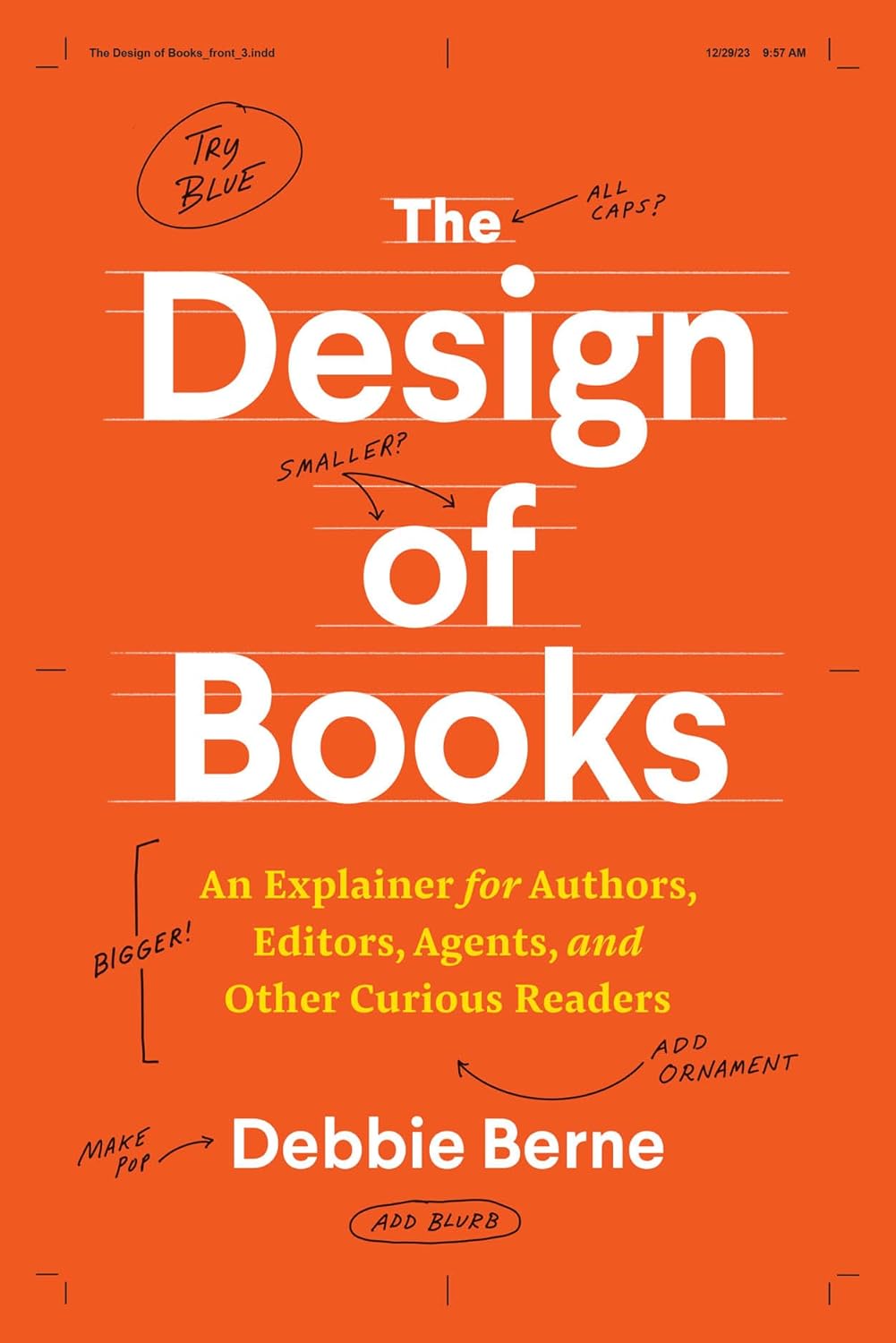
Debbie Berne. The Design of Books: An Explainer for Authors, Editors, Agents, and Other Curious Readers. Chicago: University of Chicago Press, 2024. 256 pages. ISBN 9780226822952. US $22.50 (paperback).
Book publishing is a long and intricate process in which certain stages are less transparent to readers and authors. Designing a book for publication is one stage that remains comparative invisible. Debbie Berne, the author of this book and a book designer with over twenty years of experience in the US publishing industry, undertakes the challenging task of illuminating the process of designing books and navigating the various editorial, aesthetic, and production complexities involved. Berne’s work is primarily aimed at authors (though it also addresses editors, agents and curious readers) because these are the people who are generally “estranged” from the production of their work (p. 3). She addresses both writers who collaborate with a publisher and those who self-publish, employing a friendly and knowledgeable voice to introduce them to the nuanced aspects of book design. The basic principle of her approach is summarised in one statement: “Design isn’t (only) about making things look pretty” (p. 5). Since books are made for readers, content and its visual form should be entwined for effective communication. Berne’s primary objective is to persuade readers of the value of design within the publishing process and to demonstrate the expertise that designers can contribute to it.
This book is an insightful addition to the bibliography on book design. Rather than presenting an overview of a designer’s work to her peers, it acts as an explainer of the critical role design plays in book publishing. Berne frames book design as a complex decision-making process that involves various departments within the publishing house. In this context, the designer emerges as a creative communicator who interprets the author’s work while navigating the constraints imposed by the publisher’s strategy and target market.
References to the history of books, printing types, and the origins of bookmaking contextualize the evolution of book design from a craft to a contemporary practice shaped by technological advances, new materials, and changes in culture and reading practices. A glossary of common terms is included for quick reference; its usability could be further enhanced by establishing a visual connection between key terms and their initial appearance in the main narrative. Berne frequently shares her thought processes, methods, and practical insights, which add credibility to her recommendations. This rhetorical approach makes the text persuasive and underscores the nuances and complexities inherent in a design process that unfolds in iterations and in which decisions are often subject to change.
Berne’s metaphors and similes provide vivid and memorable explanations, e.g., likening the half-title page to a welcome mat at the front door of the book (p. 103), depicting back matter as the “back stoop” (p. 107), or describing tagging (i.e. text markup) as “the x-ray that reveals the skeleton” (p. 181). The line illustrations by Vivian Barad decorate the chapter openers welcoming the reader and effectively show structural elements and configurations—such as the anatomy of the cover and jacket, layout and grids, and visual hierarchy—that are often invisible to readers. Additionally, Berne uses the book’s page layout to visually clarify design characteristics, further engaging readers. Endnotes elucidate various points and Berne’s suggestions for further reading introduce foundational graphic design literature.
The book’s structure, divided into seven chapters, covers the entire process of designing physical books and ebooks. Chapter 1 focuses on the physical book. Berne meticulously presents its parts, describing their function and their visual and physical characteristics. Chapter 2 presents the details of making and using typefaces, a craft as old as printing. It introduces readers to the subtleties of type design and offers guidance on choosing and pairing the most suitable fonts. Chapter 3 concentrates on cover design as a specialized practice, essential for visually interpreting the book’s content in line with editorial, marketing and authorial intentions. Berne explores how cover design varies across genres, evolves with societal trends, and influences the audience’s reception of the work. In chapter 4, she unveils the often overlooked work involved in transforming a Word file into a well-structured and visually appealing book page. Berne provides technical details showing the complex demands of the designer’s work and the negotiations between aesthetics and functionality. She also urges more publishers to educate readers to “appreciate design and typography” (p. 107) by expanding the traditional colophon. Chapter 5 is dedicated to illustrated books, a genre with special requirements since these books should be designed as objects “worth having” (p. 134). Berne stresses the importance of careful planning and organization facilitated by design tools (mood boards, sample pages, book maps), where visual considerations should drive decision-making.
Chapter 6, on ebooks, offers a comprehensive discussion of the design of this significant component of the publishing landscape, which design books rarely address. Berne rightly claims that despite the limitations imposed by ebook technology, which allows readers to customize their reading experiences and removes designers from total control over their work, designers can still impact the typographic quality of ebooks. She offers helpful, practical advice and clearly explains key technical aspects of ebook design. In the final chapter, Berne presents an overview of the book design process as it unfolds in a traditional publishing house or a self-publishing context. She suggests that authors engage in the process by providing constructive feedback to designers based on their content expertise while relying on designers to offer design solutions. The appendix includes useful tools, such as a sample of a freelance design contract and helpful resources.
Berne’s work will be a valuable reference for authors who want to better understand the design of their books and an excellent resource for graduate students and junior designers entering the publishing industry. Published at a time when Generative AI tools are automating various design tasks, the book underscores the enduring role of expert designers, asserting that their unique creative mindset will be difficult to replace.
Niki Sioki, University of Nicosia, Cyprus