
Deborah Parker. Becoming Belle da Costa Greene: A Visionary Librarian Through Her Letters.
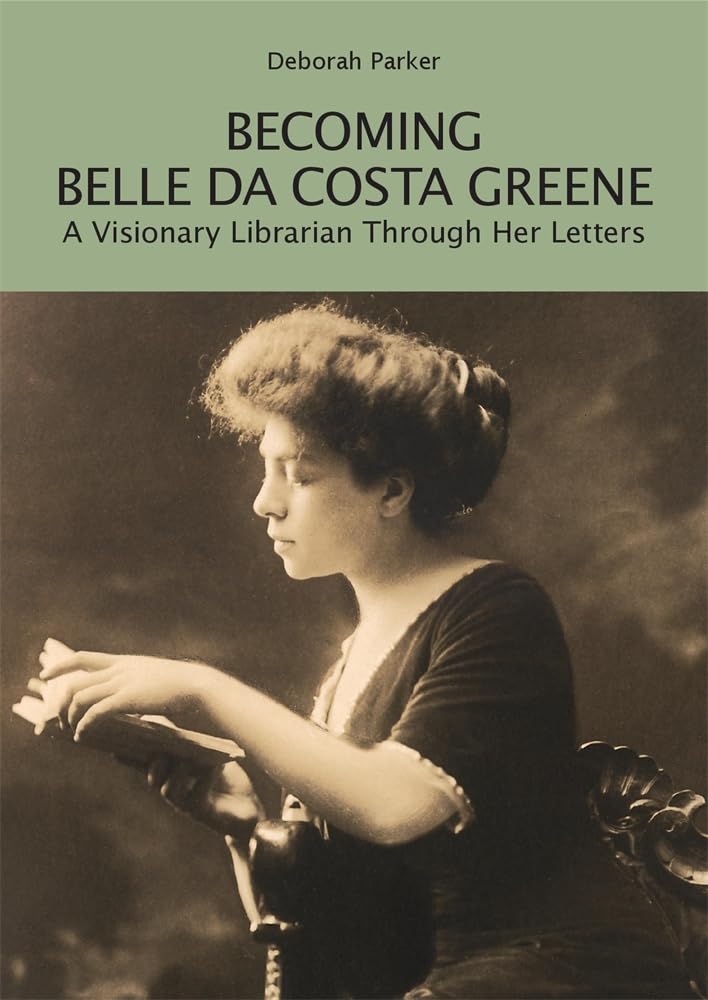
Deborah Parker. Becoming Belle da Costa Greene: A Visionary Librarian Through Her Letters. Cambridge: Harvard University Press, 2024. 160 pages. ISBN 9780674299818. US $25.00 (paperback).
Belle da Costa Greene (1879-1950), famous for her work as the first librarian of the Morgan Library, is brought to life through her letters to art critic and historian Bernard Berenson in this new volume by Deborah Parker. Because Greene destroyed her personal papers before her death in 1950, this correspondence to Berenson is crucial in painting a portrait of her life outside of the library.
Belle Greene and Bernard Berenson met at J. P. Morgan’s library in January 1909 and quickly formed a friendship. Though Berenson was married, they became romantically involved and built a long-distance relationship sustained by their letters. Greene wrote nearly 600 letters to Berenson, mostly between 1909 and 1916. These letters constitute the largest extant archive of Greene’s papers and are preserved at the Villa I Tatti, the home that Berenson donated to Harvard University, which is now the Harvard Center for Italian Renaissance Studies.
Deborah Parker arranges her chapters thematically, which gives the reader greater insight into Greene’s life and centers her personal experiences over her relationship with Berenson. This organization, rather than a chronological arrangement, allows Parker’s analysis of Greene’s rhetorical style to shine in Chapter 1. Parker analyzes Greene’s hurried approach to writing, noting how she created her own spelling, punctuation, and style. Greene comes to life through Parker’s discussion of her uses of juxtaposition, possessive pronouns, and eye dialect (incorrect spellings used to mimic speech). Chapter 2 examines how Greene fashioned herself, arguing that she had a fluid sense of self. As a Black woman passing as white in segregated America, Greene consciously constructed her identity and reshaped herself for different situations. Chapter 3 explores Greene’s relationship with books and reading. Finally, Chapter 4 discusses her work, including her feelings about her employers, J. Pierpont and Jack Morgan.
The letters include more detail about Greene’s daily life than her work correspondence found in collections at the Morgan Library. She wrote to Berenson on a wide variety of topics and these letters reveal her social life, the books she read, the collections and exhibitions she viewed, her career, and her evolution from a new librarian into an internationally recognized expert. This personal correspondence doesn’t always show Greene in a favorable light. She makes fun of friends and acquaintances, uses racial slurs, and disparages her maid. Parker doesn’t shy away from these difficult topics and by including them, depicts Greene as the complex figure she was.
The volume’s appendix includes Parker’s transcriptions of a small selection of letters from Greene to Berenson. They cover a wide range of topics, giving a glimpse into her life and further illuminating some of Parker’s key points. Parker includes helpful annotations to explain references that readers may not recognize, such as particular books and people. She also includes translations of the French that Greene often used in her writing.
Because Parker primarily relies on the letters that Greene sent to Berenson, there are areas—such as her work life in chapter 4—that are thinly covered and could use additional resources to create a fuller portrait. While Parker occasionally brings in other correspondence, such as Greene’s letters with photographer Alfred Stieglitz housed at Yale University, she fails to incorporate the whole range of Greene’s extant correspondence. Indeed, Parker doesn’t cite any letters or documents from the Morgan Library itself. The discussion of Greene as a librarian in chapter 4 would have been greatly enhanced by the use of her professional papers at the Morgan Library, but Parker only incorporates letters outside her correspondence to Berenson for comparison or to provide context.
Parker’s focus on the letters to Berenson gives insight (as she reminds her readers several times) into Greene’s life and personality that we would not otherwise have. However, her focus on only the letters to Berenson might be due to her fellowship at Villa I Tatti, which also funded the publication of this work.
Though this book could have been enhanced by using more of Greene’s correspondence and documents found in other archives, Parker creates a portrait of a complicated woman who was more than just her job. The text is an easy and enjoyable read and illuminates the life of Belle da Costa Greene.
Cassie Brand, Washington University in St. Louis