
Nir Shafir. The Order and Disorder of Communication: Pamphlets and Polemics in the Seventeenth-Century Ottoman Empire.
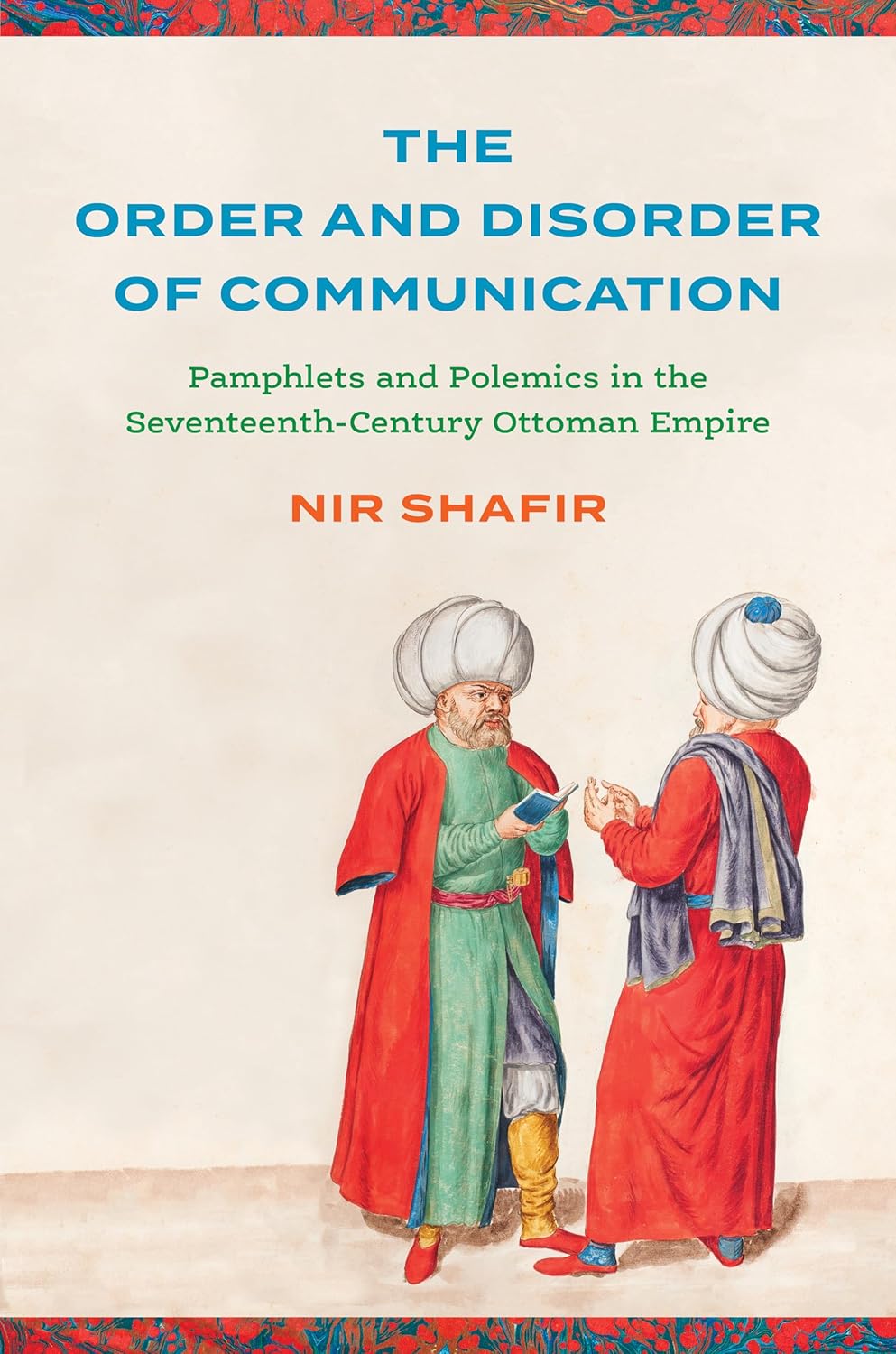
Nir Shafir. The Order and Disorder of Communication: Pamphlets and Polemics in the Seventeenth-Century Ottoman Empire. Stanford: Stanford University Press, 2024. 436 pages. ISBN 9781503638952. US $75.00 (hardcover).
Nir Shafir’s The Order and Disorder of Communication: Pamphlets and Polemics in the Seventeenth-Century Ottoman Empire begins by posing a simple question. Unlike parts of Asia and Europe, why did the Ottoman Empire and the Islamicate world continue to use manuscript technology until well into the nineteenth century? The book refutes earlier arguments that religious fundamentalism led the Ottoman Empire to resist adopting print and that public communication practices were dormant during the early modern Ottoman era. Instead, Shafir provides a detailed account of how communication ecosystems in the early modern period refused print in favor of manuscripts, and scrutinizes how public discourse evolved through manuscript production. Rather than restating the revolutionary characteristics of printing technology and casting the Empire as ignorant of modernity, the book traces why early modern Ottomans prioritized manuscripts as the desired form of social communication and explores their multifaceted and complex effects on the public sphere.
Shafir’s work clearly explains both the contexts and reach of pamphlet circulation throughout the Ottoman empire. Part I, titled “Order,” gives a complete picture of the existing mechanisms of manuscript production and publishing, such as the process of producing manuscripts, the networks around the Ottoman territories in which they circulated, and the literacy and education levels of ordinary readers and the elite reading class. In this part, Shafir effectively describes the conditions that shaped the politics of communication in the seventeenth-century Ottoman Empire. Part II, “Disorder,” moves on to discuss deeper cultural and social ramifications of the pamphlet wars. It details the fissuring polemics that gave rise to a more divided culture of pamphlet debates, which in turn led to a toxic polemical culture and the involvement of the “middling peoples—merchants, artisans, palace employees, and even villagers” (p. 13).
The manuscript medium, Shafir suggests, “create[d] a radically decentralized and noncommercialized system of written communication” (p. 8), and to the disgruntlement of the elite Ottoman society, paved the way for the masses to enter into public discourse. At the same time, as the Muslim population grew manifold and learning opportunities improved, this education system created a significant learned class, trained in basic Islamic law (sharia) or Arabic or Persian languages and literature, who were eager to enter into state echelons—the military, clerical and scribal positions. In an atmosphere where the Ottoman sovereign enforced a Sunni confessional identity, there emerged a fervent manuscript-based pamphlet culture of reflection and debate on Islamic laws, rituals, and ideals among enthusiastic Muslims in state employment as well as within a religiously aware citizenry. Everyday actions and questions of their religious permissibility came to the forefront of public discourse. Legalistic notions that favored minute boundaries on legal terms for religious practice contrasted with Sufist opinions that favored encompassing conceptions of piety and devotion. Adherents of both factions took upon themselves to demarcate religiosity in trivial everyday conduct among the Ottoman subjects through the use of pamphlets.
However, Shafir is aware of the common oversight that scholars have made in viewing early modern Ottoman history merely as an offshoot of Islamic movements; in particular, of the Salafist movement, which argued for a return to the earliest Islamic practices. Shafir distinguishes between Salafists and Legalists, also known as Ḳāḍīzādelis, after the popular preacher Ḳāḍīzāde Mehmed (d.1635). Legalists called for religious practices to conform closely to Islamic legal codes and laws, and they rebuked Sufism for its perceived deviance into unlawful rituals and customs. While the Salafists were afraid of bidʿa, or innovations that veered away from the salaf, or the first generations of Islam, the Legalists—as Shafir prefers to call them for their unbending adherence to law—did not demand any such return to past Islamic practices. Instead, they were more concerned with legal definitions and interpretations of Islamic law developed by jurists over time under the light of the holy texts Quran and Hadith, the account of Prophet Muhammad life’s sayings and preachings.
The rise of the pamphlet under conditions of quick and extreme fractionalisation points to an Ottoman empire bifurcated into two rigid religious camps and, more importantly, reflects a public that was both driving and being shaped by this dynamic pamphlet culture. Legalists, preachers, scholars, and Sufis used pamphlets to circulate short, crisp tracts of legalistic commentaries on pressing religious questions among ordinary Muslims. As affirming one’s pietism became a vehemently debated topic amongst Ottoman Muslims, pamphleteers also started weighing in on diverse topics, such as whether smoking tobacco or certain medical procedures were permissible. As the Ottoman state legitimized its rule by restructuring itself around constrained notions of Islamic law, a growing learned population educated at madrassas familiarised itself with significant legal aspects and jurisprudential opinions on Islam. Writers exploited the smaller pamphlet format to spread their criticism and contentions on Islamic faith, quickly reaching the edges of the Empire and contributing to ever-expanding discussions.
The polarised debates fueled by pamphlet culture between 1650 to 1700 lay the groundwork for an Ottoman public divided between the Legalists and the Sufis. Moreover, the highly opinionated, unsettled, and influential public discourse amplified by these pamphlets forced ordinary individuals to take either a Legalist or a Sufi side—and prompted them to engage and employ pamphlets themselves to further their respective reach throughout the Ottoman Empire. The increased use of pamphlets was further magnified due to the rise in false ascription, in which individuals took on the identity of more prominent scholars to promote their own views, leading to a proliferation of pamphlets published under the names of reputable scholars. Limited ways to ascertain authorship meant that pamphlets could be written by any counterfeiting author to support or refute any claim.
Shafir’s account gives a painstaking study of popular pamphlet controversies that arose in the seventeenth century and scrutinises writings of prominent pamphleteers such as Abd al-Ghanī al-Nābulusī (1641–1731), who wrote more than a hundred pamphlets. He also provides a deeper look at the reading and informal circulation systems that disseminated pamphlets throughout the Ottoman Empire. Notwithstanding the ephemeral nature of pamphlets and their lack of survival in archives today, The Order and Disorder of Communication imagines a lively early Ottoman Empire that is highly invested in religious debates across social classes and boundaries. Pamphlets and polemics defined the seventeenth century and came to shape a public that was informed, interested, and inclined towards aspects of religiosity and devotion unlike any time before. Shafir skillfully delineates the complex aspects of Islamic piety during the Ottoman Empire and how it affected questions of Muslim identity and community. Elucidating debates at the intersection of evolving communicative practices and religious notions, this account provides an astute backdrop to studying the history of the modern Ottoman world. Beyond scholars working in the field of print history, this book is relevant for academics in religious studies, especially in relation to West and South Asia. With its straightforward writing approach, the book is also an engaging read for anyone interested in the histories of reading and communication.
Shaiq Ali, University of Minnesota Twin Cities