
Seth Kimmel. The Librarian’s Atlas: The Shape of Knowledge in Early Modern Spain.
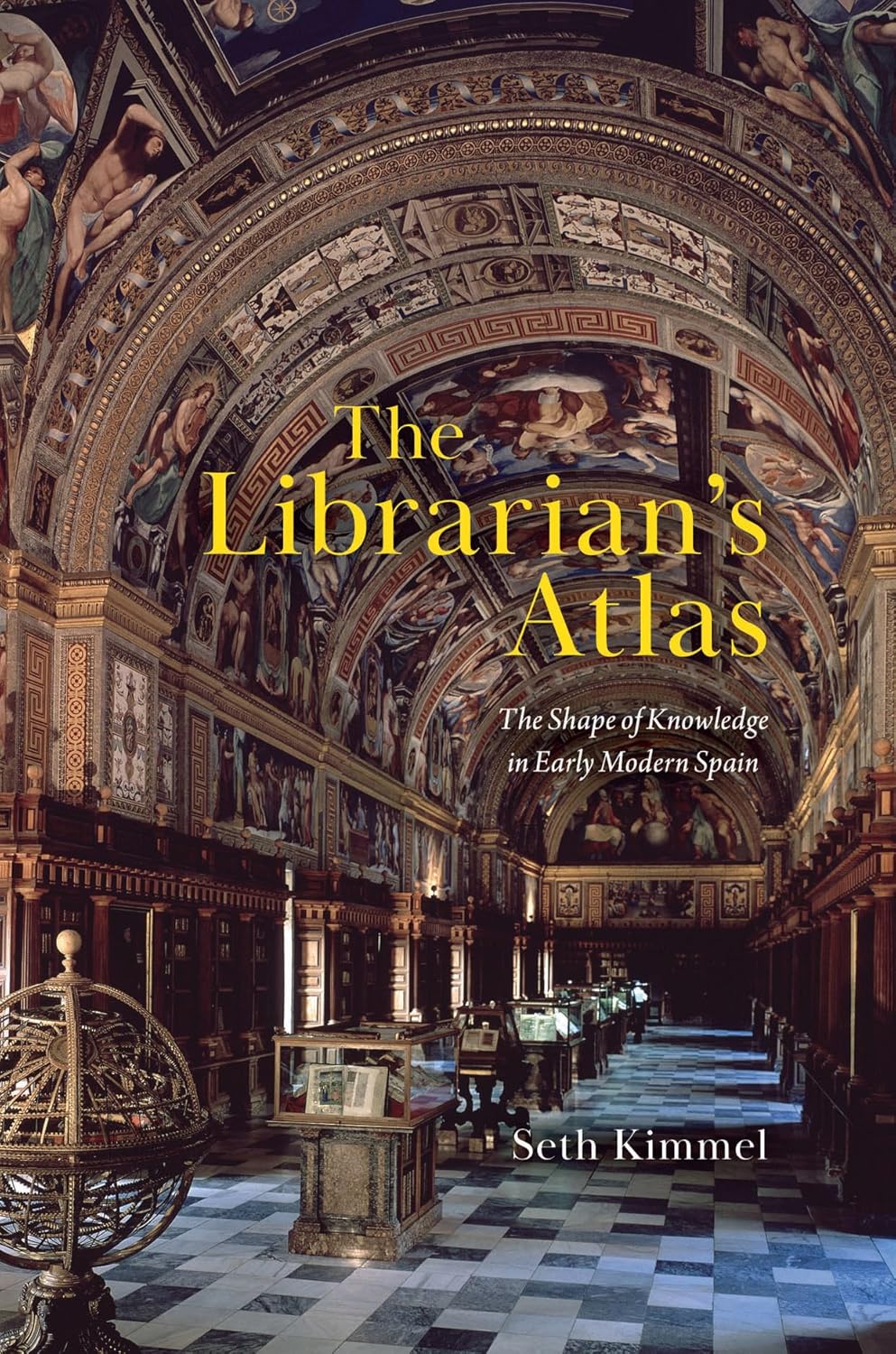
Seth Kimmel. The Librarian’s Atlas: The Shape of Knowledge in Early Modern Spain. Chicago: The University of Chicago Press, 2024. 262 pages. ISBN 9780226833170. US $45.00 (hardcover).
In The Librarian’s Atlas: The Shape of Knowledge in Early Modern Spain, Seth Kimmel traces the exchange and uses of information collection and organization practices across Iberia and the Mediterranean in the sixteenth and seventeenth centuries. The book’s central threads connect three substantial libraries of the period: the immense collection assembled in Seville by Hernando Colón (1488-1539), son of Christopher Columbus and one of the foremost book collectors in early modern Europe; the library of the Monasterio de El Escorial, which was founded in the second half of the sixteenth century and lies northwest of Madrid; and the royal library of the Sa’adī Sultanate in North Africa. By examining individuals and collections related to these libraries, Kimmel argues that library culture, or “the bibliographic methods, metaphors of assemblage and compilation, and forms of learned sociability that characterized the processes of collection and conservation occurring in libraries” (p. 4), impacted the shape of scholarship and knowledge as well as the political uses of books in early modern Spain.
The first four chapters explore the scholarly impact of bibliography and library culture, particularly how information organization influenced the study of places and words. Chapter 1 examines the reciprocal relationship between bibliography and cosmography via Colón’s library catalogs and his unfinished Cosmografía. While geographical metaphors to represent libraries and knowledge were already common, Kimmel shows that Colón’s particular study of cosmography was strongly influenced by his book collecting, knowledge organization, and indexing endeavors. Chapter 2 demonstrates that Colón’s biblio-cosmographical methods endured in the cosmographers and antiquarians of sixteenth-century Seville, who likely had access to the portion of his books and manuscripts surviving in the city’s cathedral. Chapter 3 moves us to the Escorial, where the cosmography-bibliography connection played out in the library’s design and organization, as Kimmel shows via his analysis of both the manuscript corpus of Juan Páez de Castro (royal chronicler and advocate for the creation of a royal library) and the library’s classification systems. Chapter 4 examines the centrality of place in Benito Arias Montano’s collection development for the Escorial and biblical scholarship for the Biblia Regia. Here Kimmel addresses the role of place both in a literal sense, as seen in the continued importance of cosmography and geography, and in a metaphorical one, as seen in the practice of commonplacing and the ars memoriae (techniques for memory recall and forming arguments).
The last two chapters address the political potential of books and libraries. Chapter 5 studies how the Escorial’s design and the Hebrew and Arabic topographical and lexicographical scholarship associated with the library served to fashion the Escorial as another temple of Solomon, Philip II as a new King Solomon, and the Iberian Peninsula as a new Holy Land. Finally, Chapter 6 dives into the parallels between uses of libraries and bibliography as political tools in the Spanish Monarchy and the Sa’adī Sultanate. Kimmel opens the chapter by introducing the Sa’adī royal library, which French pirates captured in 1612 and the Spanish government eventually acquired for the Escorial in 1614. He then considers the collection of fahāris (catalogs of works read or discussed with teachers) and ijāzāt (licenses to teach particular works) compiled by Sultan Aḥmad al-Manṣur and the rest of the Sa’adī royal family to project an image of scholar-sultans.
Key to Kimmel’s approach is his attention to the organization of both textual materials and physical spaces. Across the chapters, Kimmel employs close readings of library catalogs, manuscript and printed reference works and treatises, and the Escorial building itself. Specific materials include the indexes and library catalogs Colón used to manage his books and cosmographical data, the lexicographical and topographical research of Arias Montano and Sebastián de Covarrubias, and Diego de Urrea and Francisco Gurmendi’s catalogs of the Escorial’s Arabic holdings. Perhaps unsurprising given his background in comparative literature, Kimmel takes a comparative approach to classification and organization systems as well as to Iberian and Sa’adī book cultures. While the book’s focus is Iberia, it thus also addresses calls for comparative approaches in book history and the study of book lists, as recently expressed by Rindert Jagersma, Helwi Blom, and Ann-Marie Hansen in their introduction “Goldmines or Minefields? Private Libraries and Their Documentation (1665–1830)” for Private Libraries and their Documentation, 1665–1830 (Leiden: Brill, 2023).
Kimmel’s style is engaging, which is especially helpful given certain complex examples and arguments, and his explanations of supporting evidence and examples are clear and interesting. One criticism, however, is that “bibliography” is not well defined. For Kimmel, bibliography seems to be synonymous with “library culture,” or perhaps references the older association of bibliography with library science more common at the beginning of the twentieth century. At the very least, it seems to encompass collection development, information organization, and cataloging, rather than the enumerative, descriptive, and analytical branches of Anglo-American bibliography more commonly associated with the word “bibliography” today, especially in book history.
Regardless, the book effectively speaks to the impact of collection development and information organization on knowledge and politics. In this way, Kimmel dialogues explicitly with other works on the history of information organization and management, and implicitly with modern information and library science (ILS). For this reason, while the absence of modern ILS scholarship does not detract from the book, it would have been interesting for Kimmel to respond to studies such as Geoffrey Bowker and Susan Leigh Star’s Sorting Things Out (MIT Press: 1999), which similarly seeks to understand the work that classification can do in the world.
Given the breadth of topics discussed, The Librarian’s Atlas will be of interest to many historians, but most specifically book, library, and information historians who research information organization and catalogs. Kimmel’s argument that information and space are connected is particularly insightful because it shows how information organization practices originating in Colón’s cosmographical work and continued in the Escorial fomented an early modern spatial turn. Kimmel demonstrates how geographical thinking spread to antiquarianism, biblical scholarship, and lexicography because of the connections individuals made between bibliography, cosmography, and toponymy. More broadly, book historians and historians of Spain and the Mediterranean will be interested in the role played by the Escorial and Sa’adī libraries in Iberian and Mediterranean politics. At a moment when the political values and uses of books and libraries are being debated by academia, the government, and the general public, The Librarian’s Atlas is a timely work. Through historical examples, it speaks to the contemporary concern that, as revealed by the collection development and organizational choices they make, libraries—even those aspiring to universal comprehensiveness—are not neutral.
Alexandra Wingate, Indiana University