
Amos Paul Kennedy, Jr. Amos Paul Kennedy, Jr.: Citizen Printer.
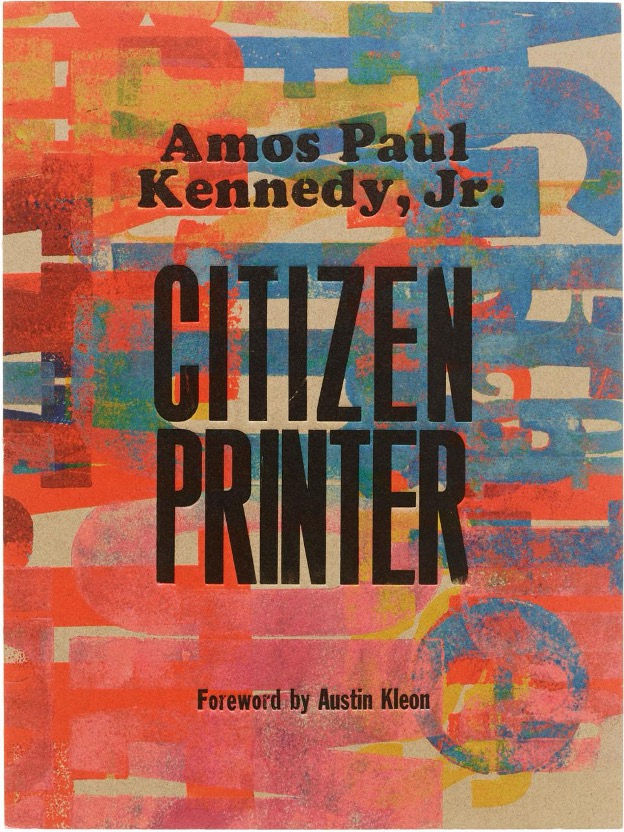
Amos Paul Kennedy, Jr. Amos Paul Kennedy, Jr.: Citizen Printer. San Francisco: Letterform Archive, 2024. 292 pages. ISBN 9781736863381. US $60.00 (hardcover).
Amos Paul Kennedy, Jr. does not call himself an artist. He is, he insists, “just a person with a printing press.” The distinction between artist and printer frames this book, representing Kennedy as Citizen Printer, and it’s central to understanding Kennedy’s career. In his “Manifesto,” Kennedy explains, “I print for the glory of my peoples…. I use letterpress printing…to disrupt the segregated realms of fine printing and artists’ books” (p. 14). For Kennedy, printing is a tool for expression, protest, and community making. In thought and practice, he rejects the exclusivity of fine printing: “Letterpress printing is for humanity…. fine printing is for the bourgeois” (p. 13).
This ethos also shapes Kennedy’s relationship to Black cultural production. “I print Negro,” he emphasizes, a phrase that carries both a declaration of identity and a methodology (p. 12). By this he means that his printing practice is grounded in the expressive traditions of Black culture that have used and transformed the available languages and technologies of American print culture much as the blues transformed American music. He clarifies that his goal is to “make books Negro” by infusing the medium with Black cultural perspectives, rather than “making Negro books” or simply “put[ting] blackface on…so-called fine printing” (p. 12).
Amos Paul Kennedy, Jr.: Citizen Printer is the first book-length treatment and retrospective catalogue of Kennedy’s work. Published in conjunction with the exhibition of the same name at the Letterform Archive in San Francisco, the book provides both a visual and critical engagement with Kennedy’s nearly forty-year-long career. It is more than a record of this exhibition; it is a significant scholarly resource, an archival document, and a visual celebration of Kennedy’s commitment to printing as an act of community engagement and social critique.
The book opens with writing by Kennedy in the aforementioned “Manifesto” as well as “Lessons from the School of Bad Printing,” both of which lay out his philosophy, motivations, and techniques as a printer. These texts clarify his rejection of aesthetic perfectionism and embrace of an intentional, raw, and deeply human printing practice. Alongside these writings, the book includes a foreword and two essays by Austin Kleon, Myron M. Beasly, and Kelly Walters, respectively. They explore Kennedy’s prints and working methods, placing him within the historical frame of Black printing in the United States while also considering the trajectory of his life and career. This critical apparatus, which spans the first 80 or so pages of the book, marks Citizen Printer as the first sustained scholarly engagement with Kennedy’s work, making it an essential volume for research and teaching.
The bulk of the book is devoted to high-quality, full color images of Kennedy’s prints with contextualizing quotations from Kennedy mixed in. These images span different moments, projects, and aesthetics in his career, including rare and ephemeral works that are difficult to access outside of a few institutional collections. The catalogue makes available Kennedy’s early artist books, such as his stunning 1994 Strange Fruit, a meditation on lynching and racial violence, and Mask (2000), an exploration of double consciousness, Paul Laurence Dunbar’s poem “We Wear the Mask,” and figures of African masks similar to those Kennedy used in his earlier African proverbs prints. By reproducing these works, Citizen Printer provides crucial documentation of Kennedy’s creative evolution and the breadth of his artistic output.
The final three sections of the book use the themes “Social Justice,” “Shared Wisdom,” and “Community,” to gather vivid reproductions of Kennedy’s posters, quarter cards, Black church fans, and overprinted maps. Through these pieces, we see Kennedy’s role as a “citizen printer” in action. His work not only documents struggle, resilience, and joy, but also circulates in the world as an active participant in social and political discourse. Photographs of Kennedy at work in his shop are interspersed among the reproductions of his prints, capturing his characteristic style and orientation toward joy in action. In these photos he is almost always laughing and smiling, eyes crinkled at the corners and the whole body engaged in a chuckle. “When I print, I am truly GALLIVANTING,” he writes, “and I hope the joy I experience printing gets infused into the printed matter itself” (p. 37).
As we view Kennedy’s prints, we also encounter an archive of quotations and exclamations that he sets in type and prints onto his work. These include statements from foundational figures in Black history, such as Frederick Douglass—“Power concedes nothing without a demand,” Sojourner Truth—“If women want any rights more than they’s got, why don’t they just take them and not be talking about it,” Rosa Parks—“All I was doing was trying to get home from work,” and Paul Robeson—“The artist must elect to fight for freedom or for slavery. I have made my choice. I had no alternative.” These broadsides broadcast Black history in brief, putting the words of revolutionaries and organizers before the people.
But Kennedy’s prints do not only draw on the words of famous figures, important as that strain of his work is. He also embraces the aphorism, the saying, the phrase, the proverb. Book Lovers Never Go to Bed Alone. I Am as Southern as Pot Licker. Act Like You Got Some Sense. Teachers Touch the Future. I Don’t Want a Job, I Want Money. Start Telling Men to Smile. Choose Courage Over Comfort. The quotation dictionary has long been the printer’s friend—they need “content,” as it were, for their craft—and across Kennedy’s posters, we find an implied quotation dictionary that draws on Black history, Black struggle, Black joy, Black in-jokes, the roots of Black culture in African folklore, a love of books, a love of teaching, the joy of vulgarity, the joy of the body, a love of the uniqueness of places one has lived, whether Alabama or Wisconsin, the effectiveness of sarcasm, a love for the words of oppressed people and their protests, and a sense of the continuities between the struggles of Black, Native, and queer people.
At the heart of Kennedy’s practice is an insistence on the social function of print. His work is not merely an aesthetic exercise but a material engagement with the power of language, particularly the language of oppressed peoples. He explains that he incorporates Frederick Douglass’ imperative to “Agitate, Agitate, Agitate,” into his composing type: “that’s what the letters are doing there—agitating, just like we the people need to do to achieve equality” (p. 26). His love for aphorisms, folk sayings, and everyday wisdom is as central to his work as his typographic compositions, making his posters and prints feel alive with the voices of those who have shaped Black cultural and intellectual life. This catalogue captures not just the visual power of his prints but the philosophical and communal commitments that drive his work.
Kennedy’s principles and practice are deeply rooted in the history of the Black press, particularly the pamphlets and posters printed in the nineteenth century to warn against slave catchers and racist mobs, to circulate political ideas, and to empower communities. His work might be characterized as part of the book arts’ embrace of “democratic multiples,” not in the sense of mid-twentieth-century art world critiques of elitism, but in a tradition that grows directly from the Black struggle for democracy and civil rights. His work makes me wonder if we’ve overemphasized the “multiples” part, and not paid adequate attention to the meaning of “democratic.”
As a physical object, Amos Paul Kennedy, Jr.: Citizen Printer succeeds in translating Kennedy’s work to non-letterpress print while maintaining the vibrancy and materiality that define his practice. The reproductions convey the physicality of his prints: layered ink, textures of chipboard, and the deliberate imperfections that define his aesthetic. The book’s boards are a heavy cardboard reminiscent of Kennedy’s signature chipboard, and the cover is designed to reflect his layered style with bold black foreground copy. Keeping as much as possible to Kennedy’s preference for the broadside or card as opposed to the bound book, the binding is kept as minimal as possible. The exposed smyth-sewn binding is reminiscent of a stack of Kennedy posters ready to be distributed, rather than a commercially bound book.
Ultimately, this volume does what the best exhibition catalogues should: it makes an argument for the importance of its subject while also making that subject more widely available to researchers, educators, and enthusiasts. It is both an archive and an invitation. It offers an opportunity to study Kennedy’s work in depth and an encouragement to seek out his prints in the world, where they continue to, in Kennedy’s words, “put the message in the hands of the people” (p. 14).
Jonathan Senchyne, University of Wisconsin-Madison