
Andy Martrich. Shy of the Squirrel’s Foot: A Peripheral History of the Jargon Society as Told through Its Missing Books.
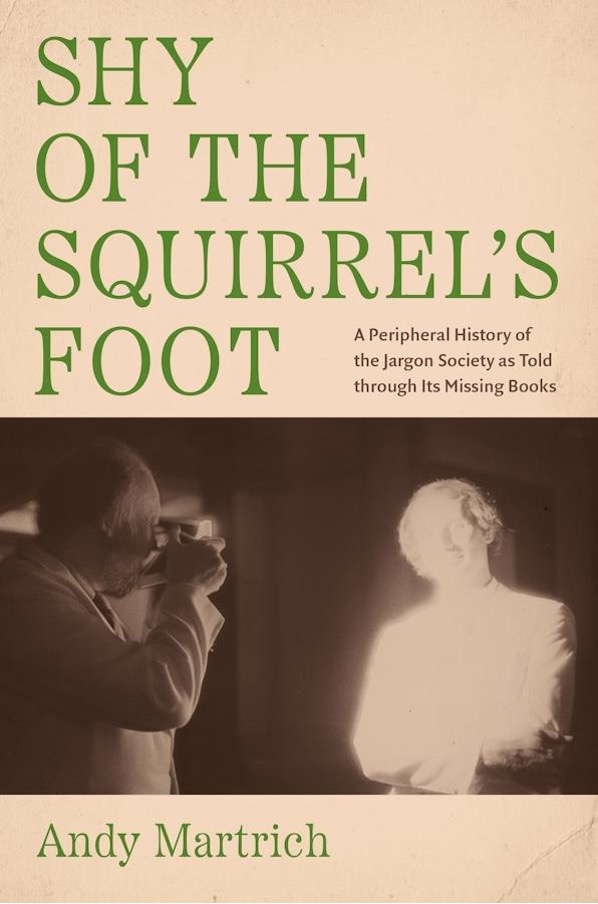
Andy Martrich. Shy of the Squirrel’s Foot: A Peripheral History of the Jargon Society as Told through Its Missing Books. Chapel Hill: University of North Carolina Press, 2024. 196 pages. ISBN 9781469682518. US $24.95 (paperback).
In Shy of the Squirrel’s Foot: A Peripheral History of the Jargon Society as Told through Its Missing Books, Andy Martrich takes on the story of Jonathan Williams, a poet, artist, and primary publisher of the small Jargon Society press in North Carolina during the second half of the twentieth century. The Jargon Society published books and pamphlets featuring writers, poets, and photographers who Williams deemed underrecognized. It is often associated with the Black Mountain poets, including Williams’s mentor Charles Olson. Andy Martrich is himself a poet, archivist, and a co-publisher of H’d’ng Press, a small mixed-genre press in Philadelphia. In this book, he combines bibliography, literary history, and literary criticism with an innovative methodology: he forgoes discussion of the publications actually produced by the Jargon Society. Instead, Martrich argues that Jargon is best understood through projects that, for various reasons, were never completed. The book provides the first comprehensive bibliography of Jargon Society materials, including both completed and unfinished works. With its unique approach, careful bibliography, and clear prose, Shy of the Squirrel’s Foot will be useful to scholars of twentieth-century American poetry, as well as those interested in creative or poetic approaches to bibliography. Martrich leaves his reader with a forceful impression that absence deserves study as a poetic form in itself.
The “missing” Jargon publications that organize Martrich’s chapters are, in most cases, projects that proceeded far enough to receive a number in Jargon’s publication planning but never made it to press. These works were collaborations, making each chapter a history not only of the work in question, but also the artistic relationship that led to its non-publication. Chapter 1 uses “Jammin’ the Greek Scene” to explore Williams’s development as a poet through his complicated relationship with his Black Mountain College mentor, the poet and essayist Charles Olson. Chapter 2 explores Merle Hoyleman’s “Letters to Christopher,” a “maverick” long-form poem that gained contemporary praise but was stifled from publication by Hoyleman’s struggles with paranoia (p. 61). Chapter 3 delves into Richard Craven’s collaboration with Williams, “Notches along the Bible Belt,” a collection of religious ephemera about which Craven and Williams were both enthusiastic, albeit never at the same time. Chapter 4 uses “The Lyrix of Col. Hampton B. Coles (Ret.)” to explore Tom Patterson’s influence on Jargon in the mid-’80s. Chapter 5 is Martrich’s full bibliography of Jargon works, which he compiled using both existing bibliographic checklists and his own archival research.
Throughout, Martrich combines close reading with archival research and interviews. His close readings add depth to his analysis. In chapter 1, Williams’s unpublished “Jammin’ the Greek Scene” poems help Martrich trace the author’s hesitation to publish during a period when he “was coming into his own as a writer and publisher” (p. 36). In chapter 2, Martrich makes use of Merle Hoyleman’s papers, only recently available at the University of Pittsburgh, to offer a more nuanced account of the role of mental illness in her long-form poetry. Martrich also attempts to reconstruct the missing Jargon works as far as possible, often reaching beyond institutional archives. His research is patient, persistent, and creative. In chapter 3, he secures Craven’s personal file of “Notches”-related ephemera by calling every Richard Craven in the phone book.
Martrich carefully locates each major poet in terms of close or analogous contemporaries, making the book accessible to a nonexpert. The book’s tone is academic, with sensibilities verging on the poetic. Often this poetic sensibility is a strength. It lends force to Martrich’s close readings, especially of Hoyleman’s “Letters to Christopher.” Occasionally, however, it leads to a looseness of association. The fourth chapter seems less clearly tied to the book’s organizing principles, given that “The Lyrix of Col. Hampton B. Coles (Ret.)” never received a Jargon number. The book’s main title, a reference to Williams’s poem “May,” also sacrifices some clarity for the sake of poetry.
This study’s greatest strength is its exploration of margins and peripheries in the production of poetry. Martrich’s focus on the peripheral suits his subject matter. Jonathan Williams sustained a reputation as a “custodian of snowflakes” (p. 11), writing that he tried to “protect the margins, because that’s where I live” (p. 88). Williams’s impulse to emphasize the marginal over the known often became, as Martrich narrates, an obstacle to the success of the press. It seems likely, however, that Williams would have approved of Martrich’s approach to a history of the Jargon Society. Indeed, it is possible to read each chapter as an exploration of material at the margins of poetry itself. The missing Jargon books find poetry in (respectively) found sayings, mental illness, newsprint ephemera, and song lyrics. To some extent, each work takes ephemerality as both a subject and a poetic form. In this, the works’ ultimate absence is oddly appropriate to their content. Martrich’s book invites the reader to consider whether missingness might belong in both an archival and a poetic category of its own.
Emma Marie Duke, University of Texas at Austin