
David Pearson, Speaking Volumes & Nicholas Perkins (ed.), Gifts and Books
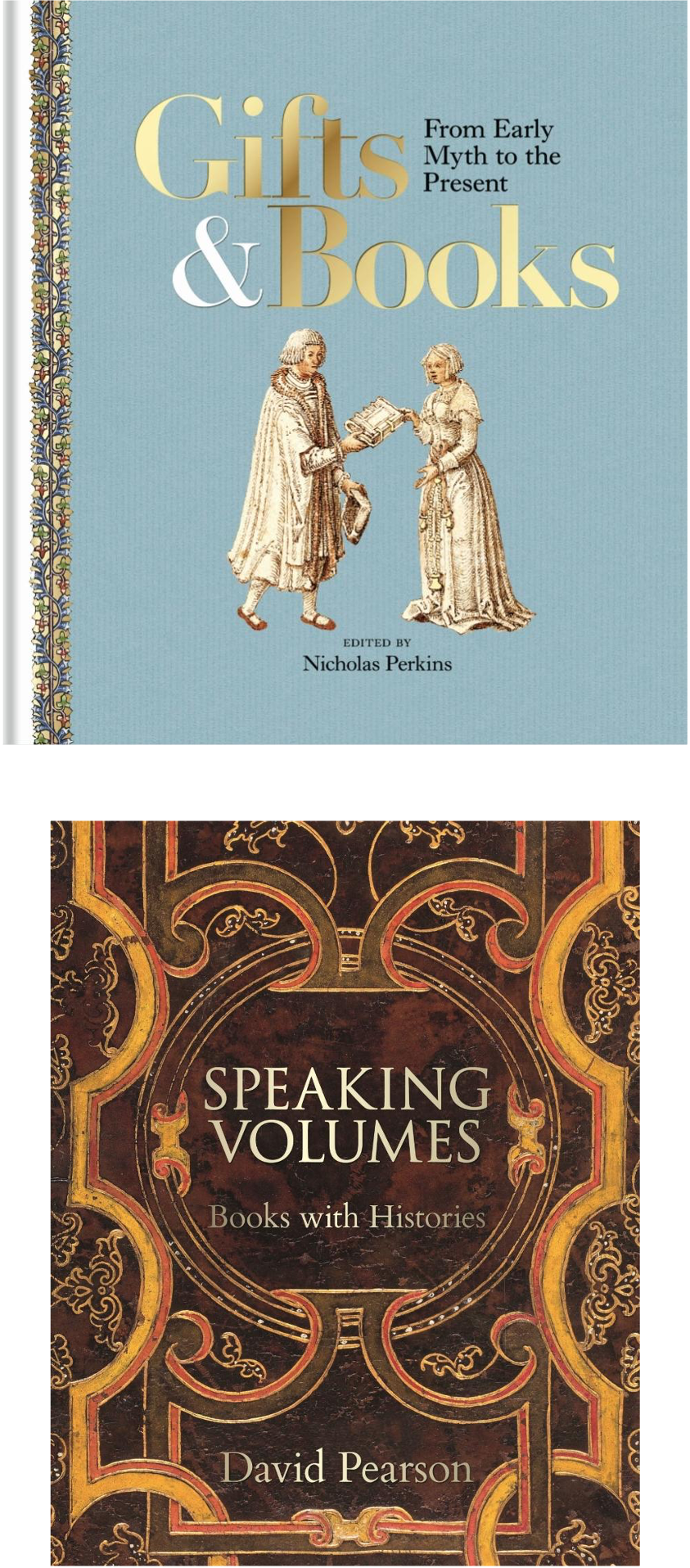
David Pearson. Speaking Volumes: Books With Histories. Oxford: Bodleian Library, 2022. x, 229 pages. 180 color plates. ISBN 9781851245628. ₤40.00 / $65.00 (hardcover).
Nicholas Perkins, ed. Gifts and Books: From Early Myth to the Present. Oxford: Bodleian Library, 2023. x, 171 pages. 75 color plates. ISBN 9781851246106. ₤40.00 / $65.00 (hardcover).
David Pearson’s lavishly illustrated Speaking Volumes describes why books matter as physical objects. In some ways, it is an extension of his earlier Books as History, which also focuses on books whose material qualities make them particularly important. Pearson’s new work opens with a reproduction of an eighteenth-century engraving, “History resisting Time from Destroying a Column of Books” (p. 2), emphasizing that our knowledge of history depends upon protecting books from the ravages of time and circumstance. While texts of course matter, Pearson stresses that variations in the physical book also convey messages—from the ways in which all aspects of production change over edition, time and place, to matters of promotion or suppression, to dedications and associations, to marginalia, insertions and deletions, and to questions of provenance and ownership.
Pearson’s first two chapters deal with ownership. Since many great library collections were founded on private ones, marks of ownership are both common and intriguing. In a case study on a ninth-century Latin grammar, Pearson shows that the historical value of reader marks need not rest upon the celebrity of those who made them: here, we find a schoolboy practising his declensions in the margins, noting how dull the lessons were, and revealing that his grasp of the language was less than fluent. Some things are timeless.
In chapter 3, Pearson turns to annotations and marginalia. Some notes are interesting because they diminish as the book progresses, suggesting that the reader finds it gradually less appealing, important, or understandable—or all three. More revealing are those annotations that appear nonconsecutively or are in some way highlighted by readers. Pearson has a brief discussion of the common appearance of manicules, those little pointing hands drawn in the margins. Some marginalia, he notes, serve to correct or expand upon the printed text, and books offering guidance—cookery books, herbals, almanacs and manuals of all sorts—are especially rich in added commentary. Family bibles also often provided blank pages for recording important people and events. In a case study, Pearson describes an extensive narrative of personal and military fortunes written on the flyleaves of a text promoting charity that had been dedicated to the annotator’s mother. Other marginalia provide cross-referencing, indicate stage directions, provide explanations of difficult or foreign passages, make suggestions for future editions, and so on.
Pearson also emphasizes the usefulness of labels, stampings, and bookplates not only for tracing personal and institutional origins but also for indicating which books have been valued. Yet books that were rarely or never read by their owners, he notes, particularly those acquired for display or investment, also have stories to tell about values, monetary and otherwise. While wealthy collectors may be motivated by impulses other than literary ones, Pearson claims that their activities generally come to enrich scholarship. I think we could broaden the scope of this idea and suggest that, however modest their own contributions may have been, all those who have made literary acquisitions throughout the centuries have served larger purposes.
Pearson devotes chapter 4 to “grangerising”—the once-popular mania for adding pictures and other material to existing books—as well as other book alterations. An extreme example he cites is painter and publisher Robert Bowyer’s early nineteenth-century expansion of a folio bible into 45 volumes, which Bowyer accomplished via the insertion of more than 6,000 prints. More moderate efforts were common and, indeed, publishers produced sets of engravings for readers to insert into unillustrated bibles and prayer books. Deletions were also common: marginalia and marks of previous owners were often erased or excised, as were images believed to be profane or obscene.
Books in which original leaves are missing may be “completed” by taking pages from damaged or less desirable ones; this can be quite legitimate if openly acknowledged but it has also led to thievery. Sometimes, too, thieves simply mutilate books, removing valuable images (frameable maps, for instance). Not mentioned by Pearson are books so seriously damaged or imperfect that it is not unreasonable to disassemble them and retain important pages or sections.
In the fifth chapter, Pearson provides lengthy descriptions of details of book bindings and covers. Before the advent of paperbacks, and before case bindings became common, books were often sold unbound, and buyers then arranged for binding into finished hardback form. Pearson provides images of the same book in five different bindings, ranging from a cheap and undecorated wrapper to an expensive treatment in goatskin with gilt tooling, to demonstrate that binding choices could span a great range of complexity, beauty and luxury. Beyond the details of decorative binding and stamping, books could be bound with embroidered covers, with gold and jewels, or even (if rarely) with human skin. Pearson also notes that older books that have come apart or have been disassembled prior to repair often reveal that the wastepaper used in their bindings was recycled fragments of earlier books or manuscripts—sometimes identifiable and sometimes valuable.
In chapter 6, Pearson examines the value of association copies, inscribed books, those known to have been in the possession of famous people, or scriptural texts of various sorts. Religious books have been considered to possess sacred healing value and, of course, to legitimate oaths. They may also figure in magical operations: bibliomancy, for example, involves opening a book at random for advice or prophecy. The Sortes Virgilianae was a frequent exercise in this regard. Also discussed in this penultimate chapter are the vicissitudes of “accidents and incidents” (p. 170), including tragedies of fire, flood and war.
The final chapter explores the great changes wrought by an electronic world. Encyclopedias and other bulky reference works now need no printed editions, e-books have become prevalent, and the decline of the physical bookshop is notable. Nonetheless, the printed book is more than holding its own, and the cheap paperback is still the most portable medium.
Whether read alone or as an accompaniment to his earlier volume, Pearson’s very satisfying account reminds us that—beyond the obvious textual records so important for social and historical scholarship—virtually all aspects of the physical book can flesh out our understanding of the past. Similarly, physical features are often the reason that books commonly figure as gifts, donations or exchanges. In this respect, Nicholas Perkins’s Gifts and Books, to which David Pearson contributes an introduction, provides an excellent complement to Speaking Volumes. Perkins shows how books have always made important presents to important people, whether on the basis of their physical appeal, because of the significant information they contain, or a combination of aesthetic and textual qualities.
Many religions have seen words as gifts of the gods, and in his chapter on Buddhism, Camillo A. Formigatti points out that spreading these words often led to the donation of books as “pious gifts to acquire merit” (p. 30). This rationale extends to a great many donations, pious or not. In his own chapter, Perkins discusses books dedicated to important people, books written to order, and books meant to foster patronage. He elaborates on the human donors of divine books and goes on to reproduce an image in which God holds a book as he casts Lucifer into hell: the clear implication is that the rebel angel has refused the gift of the divine text. In more secular contexts, from medieval times to our own, the gift of a book represents a pledge of friendship.
In her contribution, Felicity Heal discusses how the exchange of books heightened scholarly fellowship in early modern Europe. Erasmus, for instance, stands as an exemplar of such practices which, as accompaniments to frequent and lengthy correspondence, reinforced academic contacts within and across national borders. He and his fellows drew upon works by Cicero and Seneca that described and encouraged what Heal calls a “gift economy” (p. 73) in which books were important elements in a “culture of giving” (p. 80)—a network of affinities and loyalties. She also notes that the extent and the weight of gift-giving were carefully calculated. Presents had to be scaled to produce amity rather than resentment. This matter is central to the traditional patterns of giving studied by sociologists and, especially, anthropologists, as Inge Daniels reminds us in a later chapter. As these chapters emphasize, gifts of books were central to the foundation of important libraries; see my review of two other Bodleian books.
A chapter by Faith Binckes focuses upon the centrality of books as birthday and holiday presents. Dickens’s Christmas Carol (1843) was one of the first examples of a popular book about the virtues of giving and, at the same time, a book expressly designed to be a gift itself. It also signaled the emergence of the Christmas annual. Annuals of all sorts, from the literary to the comic, became and remained popular.
Maria Sachiko Cecire expands the discussion of children’s annuals, in both Britain and America, pointing particularly to their blend of amusement and instruction. Such a mixture predates the holiday book being a staple of folk and fairy tales. Very few of these were originally meant for children, and modern sensibilities have often necessitated editing. Bowdlerisation apart, one inevitably finds practical or moral lessons being drawn—a feature of works from Aesop’s fables to the Narnia stories of C. S. Lewis to contemporary children’s fiction.
Taken together, these two books provide insightful and illustrative examples of the centrality of books in social history. They remind us that books-as-objects can reveal a great deal about social arrangements, relationships, and hierarchies. In an age of mass production, the importance of compelling physical properties that brought older books to our notice may have declined, but the aesthetics of the book as object have hardly disappeared, even if it is now clearly aimed at maximising sales. Besides, there remain many specialist publishers, private presses, and readers for whom the attractiveness of the book itself remains its chief recommendation. Relatedly, historical and contemporary collections of particular material features (fine bindings, for instance) have made important contributions to our understanding of many facets of social life. It is entirely appropriate that the textual information found in the two books reviewed here should appear in such appealing material form.
John Edwards, St. Francis Xavier University