
Élika Ortega. Binding Media: Hybrid Print-Digital Literature from across the Americas.
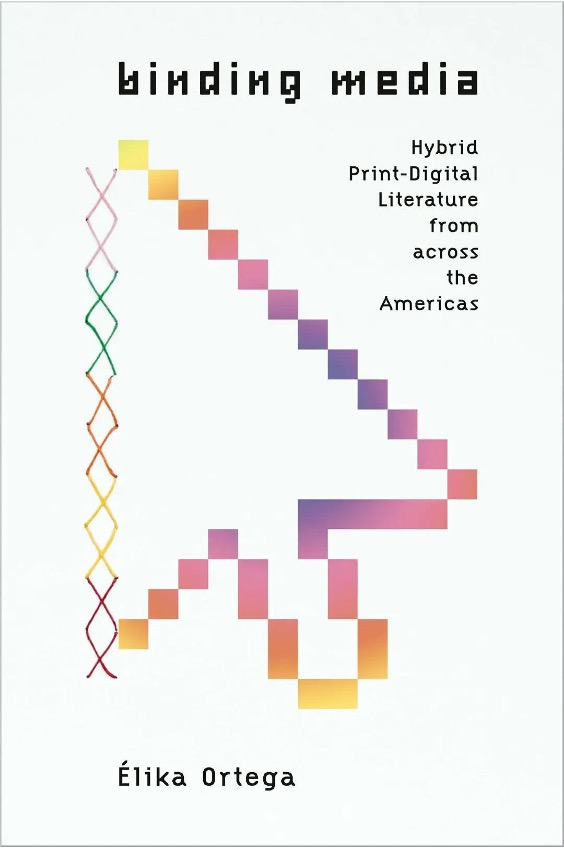
Élika Ortega. Binding Media: Hybrid Print-Digital Literature from across the Americas. Stanford, CA: Stanford University Press, 2025. 340 pages. ISBN: 9781503641785. US $75.00 (hardcover).
In this book, Élika Ortega has a two-fold aim: first, to define “binding media” as a distinct kind of hybrid publishing that “fasten[s] together codex and electronic or digital applications to create a single literary work” (p. 2); and second, to demonstrate that although this proposed category occupies a relatively niche position, binding media works are critical for understanding a publishing landscape—and broader culture—where print and digital technologies are inextricably interconnected. While the study of electronic literature has matured into an established field, Ortega astutely asserts that we lack a satisfying way to talk about literary works that comprise print and digital components, from early examples of the “electronic novel,” like Mindwheel (1984), Robert Pinsky’s collaboration with the software publisher Synapse & Brøderbund, to more recent works that use augmented reality and web technologies to link together the printed page and digital content, like Luis Correa-Díaz’s clickable poem@s (2016). Throughout this work, Ortega develops and refines her definition of binding media with historical analyses that illustrate the bigger picture of how digital technologies have impacted publishing and in-depth explorations of exemplar binding media works. In the process, she strongly supports her second aim to make a case for why “binding media” as a category matters. These works, the products of artists and writers creatively engaging with print and digital media, constitute the “archaeological remains of an elongated present and its recent past produced by the accelerated technocultural changes of the last four decades” (p. 21).
An Assistant Professor in the Department of Spanish and Portuguese at the University of Colorado, Boulder, Ortega brings expertise in comparative literature and a background in digital humanities scholarship well-aligned with the subject of this book. A particular strength of the volume is Ortega’s discussion of binding media as a transcultural phenomenon, with examples from the Global North and South. She grounds the concept of binding media in book history and media studies scholarship, while integrating thinkers from cultural studies to attend to the distinct influences and significance that digital technologies have across and between cultural contexts. In an especially powerful chapter, Ortega applies Mary Louise Pratt’s idea of the “contact zone” as a space of cultural hybridization to analyze a series of binding media works focused on the US/Mexico border. As state and corporate powers use digital technologies to surveil the border region and tightly control the flow of people, Ortega highlights how writers and artists create hybrid media works as forms of overt political resistance, like Electronic Disturbance Theatre 2.0 and b.a.n.g. lab’s Transborder Immigrant Tool (2014), as well as to tell complex stories about the immigrant experience, like Cristina Rivera Garza’s novel Autobiografía del algodón (2020) and accompanying Twitter performance memorializing an historically obscured Mexican peasant revolt. Ortega’s sharp, insightful readings of these works make clear why we need “binding media” as an analytical category for understanding ongoing processes of cultural transformation that cut across old and new technologies.
With this focus on cultural and technological transformation, Binding Media will appeal to more than just the subset of electronic literature scholars and practitioners; this book is highly relevant for anyone interested in the history of the book since the advent of personal computing. As a scholar in the related field of library and information science, I appreciated Ortega’s nuanced consideration of the thorny challenges involved in the long-term collecting and preservation of digital literature. Binding media present intriguing test cases for thinking about cultural preservation because they “manifest two divergent temporalities” (p. 128): the stability of print versus the ephemerality of digital information. For nearly every example discussed in the book, the digital component is no longer accessible, lost to changing file formats or hardware updates, while the print component of the work endures as residual evidence. As Ortega argues, these temporalities are not intrinsic to the media themselves but rather are the result of political and economic forces that push digital technologies into increasingly faster cycles of innovation and obsolescence. This digital presentism has the practical effect of making it difficult to interact with digital culture from just a few years ago but, at a deeper level, also shapes how we assess and assign value to digital cultural works. Digital literature—and, I would argue, other forms of digital culture like video games—are not perceived as having cultural value on the scale of “great works of art” in large part because they simply do not last long enough. Precisely because binding media straddle paradigms of print and digital culture, they can suggest “alternative pathways to perceive the temporalities of digital technologies, identify their destructive effects, and theorize the kinds of literary history and memory we can build over them” (p. 142). Frameworks for understanding the historical and research value of digital culture are sorely needed in libraries and archives, and this book provides excellent starting points and case studies for these ongoing discussions in the field of library and information science.
Overall, Ortega achieves both her aims of defining the category of “binding media” and establishing its significance for the field of book history and beyond. Binding media are indices to the wide array of social, political, and economic changes catalyzed by digital and networked technologies. In addition to the select analyses of examples that Ortega uses to illustrate and support her arguments, the book includes an appendix with an essential listing of binding media works from the 1980s to the present. Equipped with an analytical framework and a catalog of binding media works, readers can pick up Ortega’s work on studying—and preserving—hybrid media. In particular, I hope this book encourages further necessary collaborations between archivists and librarians and literary scholars to develop new methods for articulating and assessing the value of digital culture outside the terms set by the technology industry.
Colin Post, University of North Carolina at Greensboro