
Eike Grossmann, ed. Female Agency in Manuscript Cultures.
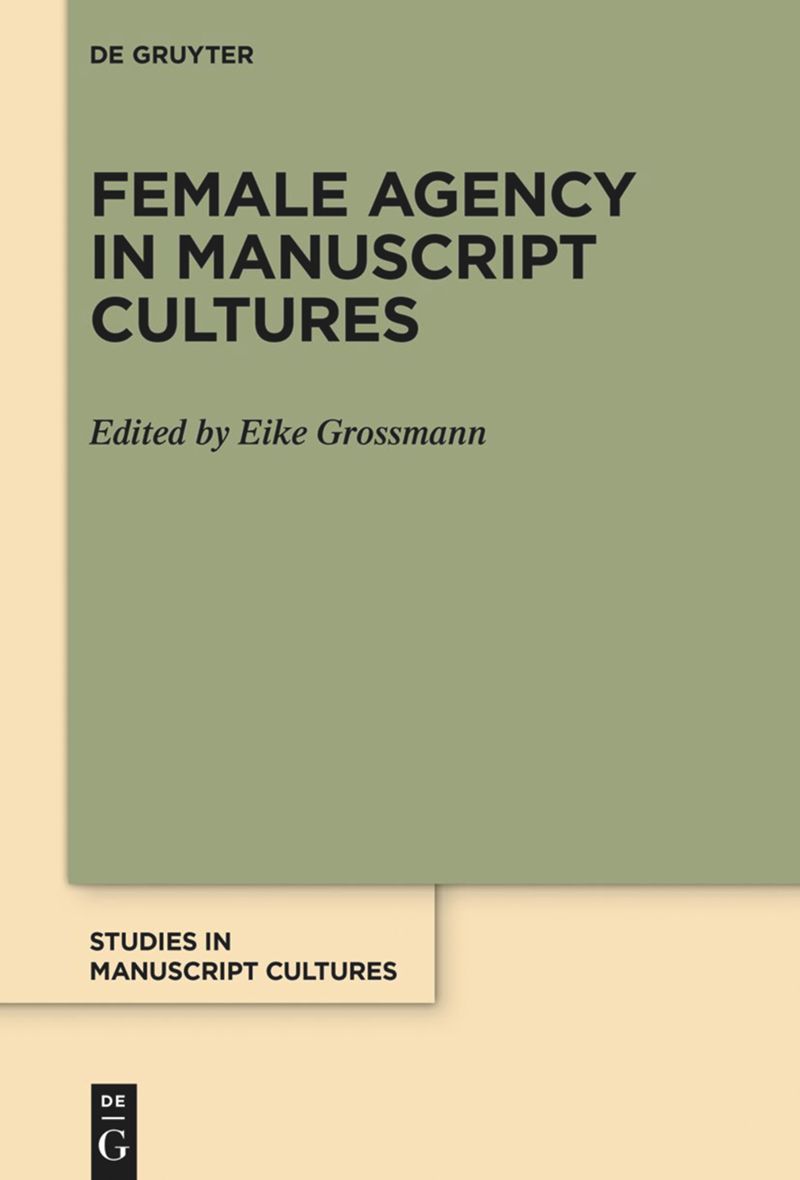
Eike Grossmann, ed. Female Agency in Manuscript Cultures. Berlin/Boston: De Gruyter, 2024. 324 pages. ISBN 9783111382340. US $109.99 (hardcover).
Female Agency in Manuscript Cultures is an ambitious and necessary look into the study of manuscript traditions that addresses the long-overlooked contributions of women across diverse historical and cultural contexts. The volume brings together multiple case studies that challenge traditional androcentric narratives in manuscript production by revealing the multifaceted roles women played not only as authors and scribes, but also as patrons, collectors, illuminators, and curators of textual heritage. In doing so, the book makes a compelling case for expanding our understanding of manuscript culture by acknowledging the breadth and significance of women’s participation—work that has too often been omitted or undervalued in previous scholarship. By integrating methodologies from archival science, gender studies, and literary history, the volume offers a fresh and inclusive perspective on the cultural history of the book.
One of the book’s most significant contributions is its systematic categorization of female agency in manuscript culture. Eike Grossmann introduces a framework that delineates women’s roles into distinct categories, including women as subjects of texts, patrons, owners, scribes, artists, and intellectual contributors. This categorization challenges the assumption that manuscript culture was primarily male-dominated and provides an alternative perspective that emphasizes female participation beyond mere passive readership.
Several chapters explore case studies from different manuscript traditions, reinforcing the book’s global perspective. For example, Bryan D. Lowe’s chapter, “Patrons of Paper and Clay,” examines how women in Nara-period Japan sponsored Buddhist manuscript production as an act of religious devotion and social engagement. Meanwhile, Wendi L. Adamek’s “Inscribing Women at an Archaeological Site in China” investigates female representation in medieval Chinese Buddhist inscriptions, showcasing how epigraphy functioned as a medium for women’s religious expression. These chapters highlight how manuscript culture was not confined to the act of writing but encompassed a broader spectrum of activities that enabled textual transmission and preservation.
A recurring theme in the book is the role of female monastic communities in manuscript production. Leah Mascia’s “Female Monastics and Devotees in Late Antique and Byzantine Egypt” reveals how women in Christian religious settings were involved in copying, commissioning, and distributing religious texts. Similarly, Patricia Stoop’s “Monastic Book Production in the Late Medieval Low Countries” details how the canonesses of the Jericho convent in Brussels created one of the largest surviving manuscript collections in the region. Stoop’s research underscores nuns’ active participation in manuscript culture, not only as scribes but also as intellectuals who engaged in theological discourse and literary compilation. Melissa Moreton’s “Materials, Methods, and Motives” further supports this perspective by illustrating how nun-scribes in late medieval and early modern Italy produced books for both internal and external audiences, often using manuscript production as a means of economic sustainability. The evidence from these studies collectively dismantles the perception that women in monastic settings were merely passive recipients of texts. Instead, they emerge as active agents who shaped religious and intellectual culture through their literacy and craftsmanship.
This collection’s most innovative argument lies in its expansive definition of agency. Traditionally, female involvement in manuscript culture has been limited to discussions of authorship and scribal activity. However, Female Agency in Manuscript Cultures highlights the importance of women as patrons, organizers, and collectors of texts. For example, Cécile Michel’s “Cuneiform Manuscript Culture and Gender Studies” examines women’s roles in Mesopotamian textual traditions, arguing that despite male dominance in scribal professions, women played critical roles in the curation and transmission of cuneiform manuscripts. Michael L. Norton’s “The Invisible Obvious” reinforces this theme by exploring the liturgical contributions of Augustinian canonesses at Klosterneuburg. These women cultivated musical and textual traditions that, though historically underrecognized compared to those of their male counterparts, played a vital role in sustaining and transmitting the spiritual and intellectual life of their monastic community. This chapter, along with others, broadens our understanding of how women facilitated manuscript culture through funding, organization, and intellectual engagement.
Another of the book’s greatest strengths is its interdisciplinary approach. By incorporating insights from literary studies, religious history, and archival science, Female Agency in Manuscript Cultures presents a holistic view of female participation in textual traditions. The case studies are well-researched and draw from a diverse range of sources, including illuminated manuscripts, epigraphic records, and financial documents. This diversity strengthens the book’s central argument that women’s contributions were integral to manuscript cultures across different time periods and regions.
One potential limitation of the volume is its uneven coverage of certain geographical regions. While the book offers excellent discussions on European, East Asian, and Middle Eastern contexts, there is relatively little focus on African and Indigenous manuscript traditions, in which female participation remains an important yet understudied topic. A more balanced representation of global manuscript traditions would further enrich the discourse initiated by this volume. Additionally, while the book makes a strong case for reevaluating female agency, some chapters rely heavily on textual analysis without fully addressing the material aspects of manuscript production. Future research could benefit from a more detailed exploration of the physical processes involved in bookmaking, particularly in relation to the labor conditions of female scribes and illuminators.
Female Agency in Manuscript Cultures is a groundbreaking work that challenges long-standing assumptions about women’s roles in textual traditions. Through meticulous scholarship and interdisciplinary analysis, the book successfully repositions women as central figures in manuscript history, demonstrating their influence as authors, patrons, scribes, and intellectuals. By broadening the definition of agency to include activities beyond direct authorship, Grossmann and the contributing scholars offer a more nuanced and inclusive understanding of manuscript cultures. Despite minor limitations, this volume is an essential contribution to the fields of manuscript studies, gender studies, and archival science. It will be of particular interest to historians, literary scholars, and archivists seeking to uncover the hidden narratives of women in premodern textual traditions. Ultimately, Female Agency in Manuscript Cultures not only recovers lost voices but also redefines the scope of female participation in the intellectual and material history of the written word.
Mercedes Morris, University of Texas