
Meredith Martin. Poetry’s Data: Digital Humanities and the History of Prosody.
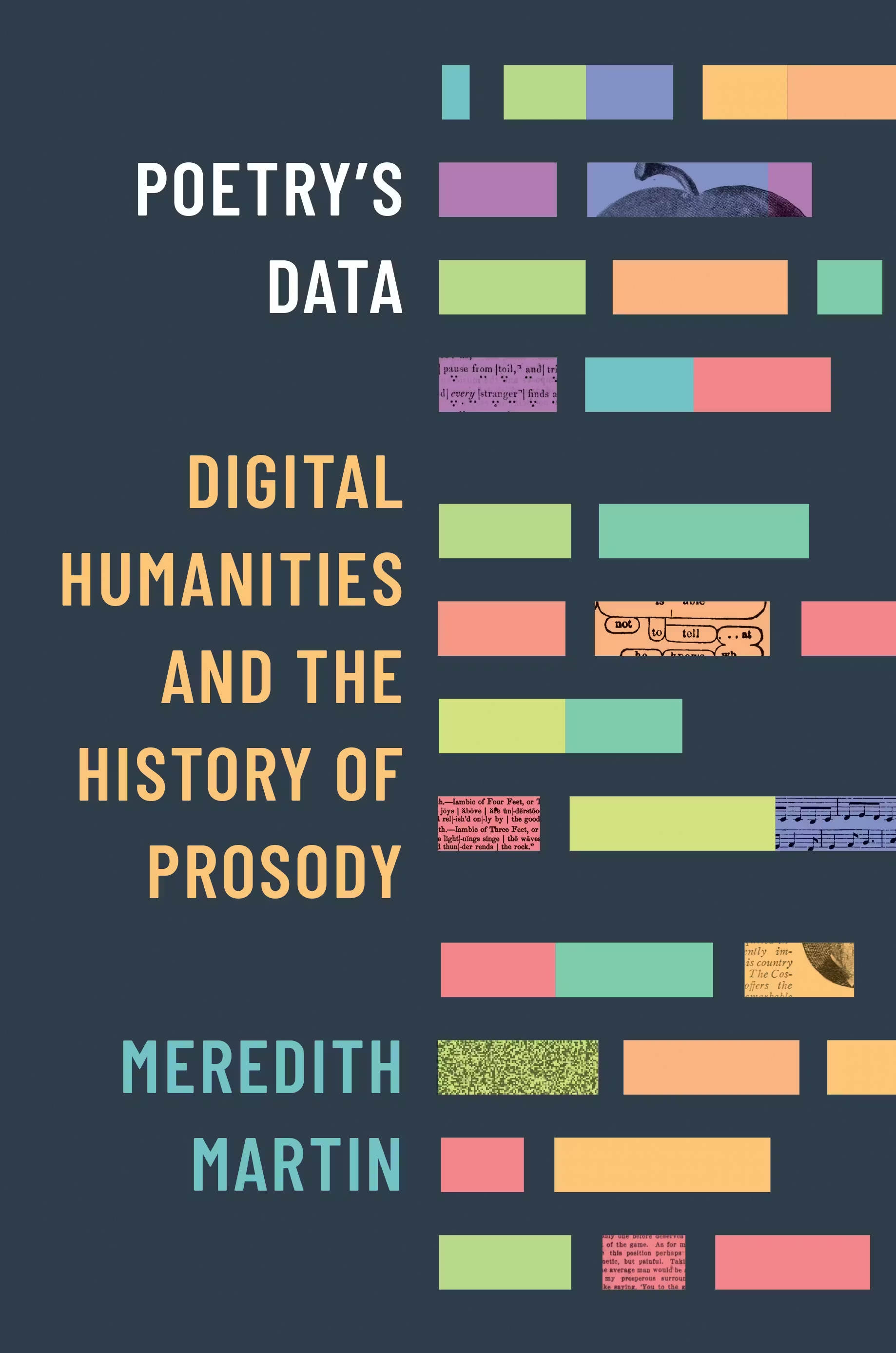
Meredith Martin. Poetry’s Data: Digital Humanities and the History of Prosody. Princeton: Princeton University Press, 2025. 224 pages. 9780691254678. US $35.00 (paperback).
Poetry’s Data by Meredith Martin bridges literary studies, media archaeology, book history, and digital humanities to explore how data can be used to understand the history of poetry. In this volume, Martin, faculty director at the Center for Digital Humanities at Princeton, draws on her experience working with the Princeton Prosody Archive (PPA), a database of digitized books published between 1532 and 1928 intended for the study of language and poetry. Poetry’s Data contains three compelling arguments: (1) poetry’s sonic features (which she refers to as its “data”) are shaped by literary and linguistic histories often overlooked in how poetry is taught and analyzed, (2) scholarly research is mediated by technological infrastructures such as data models and databases, which function as knowledge infrastructures but remain under-theorized, and (3) traditional models of isolated, individual scholarly practice are inadequate in today’s technologically mediated research environment. Each chapter raises questions regarding the embedded interpretations inherent to classification and ends with a case study derived from the PPA that encapsulates the chapter’s primary inquiries.
Chapter 1, “How We Count [Literary],” considers how current models of scholarship fall short in Martin’s exploration of poetic forms and their histories. Through examining the role of poetry in definitions of “literary,” she contends that the history of poetry’s data destabilizes our cultural understanding of the genre. The chapter then considers the material realities informing her scholarship, and the lack of an existing model for engaging with newly digitized historical material. Martin categorizes the initial stage of the history of digitization as the “pre-Google Books” age between 1999-2006, when digitized texts and infrastructures were built by individuals who “relied on their own authority as scholars in the field but did not necessarily involve the expertise of scholars in archival science, information management, or information retrieval” (p. 35). She investigates earlier critics’ scansion and prosodic debates to study how they shaped the boundaries of what counted—or didn’t count—as poetry.
The second chapter, “How We Read [Word Lists and Dictionaries],” grapples with the way in which extracting a poetic text from its historical soundscape and relying on keyword searches risks obscuring the arguments of both early print materials and the databases that digitize them. She highlights word lists and dictionaries to demonstrate that reading poetry has always been mediated by reference structures. Martin identifies a tension between high-culture “right-reading” and more popular reading practices (p. 61). Using the PPA and the arguments built into its infrastructure, including the ways metadata, search design, and digitization shape what we find, Martin contends that “the marginal material history of prosody is what our reading practices and our current technological mediations—our page ranks and character recognitions, our programmatic outputs and agreed-on standards—have discarded” (p. 62).
Chapter 3, “How We Classify [Linguistic],” focuses on poetry’s metadata in the PPA, arguing that the terminology defining data relevant to poetry is interpretive due to the inherently selective nature of classifying information. This metadata thus ultimately reflects the decisions and priorities of the cataloger. Martin demonstrates the value of metadata as a reflection of the argument behind a database. Furthermore, she argues that disciplines beyond literary history—namely music, linguistics, and pedagogy—can help us better understand the ways poetry has been classified and interpreted.
The following chapter, “How We Express [Typographically Unique],” places the sonic dimension of poetry in conversation with the digital landscape and, in particular, considers how what we see on the page and what the computer “reads” underneath do not line up. Martin demonstrates that scansion systems are inherently interpretive and subjective, reflecting biases despite being systems that appear standard and neutral. Rather than letting students believe they simply “do not have an ear” for poetry, she encourages them to reflect on why scansion may come more readily to some than to others, and to recognize arbitrary scansion marks as gateways into the broader history of how poetry has been read (103). Martin notes that we import our own diacritical marks when we read, contending that, because typographically distinctive symbols and diacritical marks in poems can be unfamiliar to contemporary readers, they should prompt us to consider how we read today and the methods and contexts through which readers in the past encountered poetry.
The final chapter, Chapter 5, “How We Argue [Original Bibliography]” reflects on T. V. F. Brogan’s 1981 publication English Versification, 1570-1980: A Reference Guide with a Global Appendix (EVRG), which later became the foundation for The Princeton Encyclopedia of Poetry and Poetics (1993). On the creation and maintenance of this resource, Martin notes: “Both this book and EVRG attempt to critique the largely invisible knowledge structures that uphold modern literary criticism, and the institutional infrastructures on which they are built, by proposing new ways of navigating scholarly materials and imagining different models for scholarship” (p. 135). The PPA, which was inspired by Brogan’s work, thus aims to create a research framework for our understanding of poetry that considers how the digital landscape often mediates our experience of prosody today.
In Poetry’s Data, Martin illuminates the often invisible digital infrastructures that influence our understanding of poetry and its data. This monograph will be of interest to scholars of literature, book history, and digital humanities seeking to understand how infrastructures shape what we count as poetry. Martin’s study is useful because it models how to place historical debates in conversation with the contemporary digital landscape, demonstrating the inherently interpretive nature of classification, error, and mediation.
Laura DeLuca, Carnegie Mellon University