
Andrew Campana. Expanding Verse: Japanese Poetry at the Edge of Media.
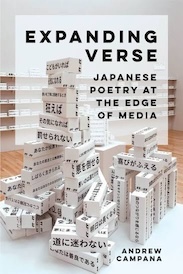
Andrew Campana. Expanding Verse: Japanese Poetry at the Edge of Media. Oakland: University of California Press, 2024. 244 pages. ISBN 9780520399211. US $34.95 (paperback).
Poetry has long been recognized as a major element of Japanese literary culture. From the dawn of modern print media in the late nineteenth century, poetry was a staple in Japanese newspapers, magazines, and books, enjoying enormous reach across geographic regions and readerships. However, because poetry was such serious business—in both the cultural and financial sense—poets who challenged convention inevitably courted controversy. Yet there existed another layer of far less recognized pioneers, innovators who sought to transcend the limits of their medium in thought-provoking or even shocking ways. In Expanding Verse, Andrew Campana takes us on a tour through modern Japanese poetry operating at the extreme margins of media.
Campana argues, accurately, that most histories of modern Japanese poetry encompass only a limited range of works, namely poems published in influential literary magazines and anthologies. Yet Expanding Verse is not just an alternative history focusing on minor or forgotten poets. Alongside largely unknown figures one also finds well-studied poets like Takenaka Iku (1904-1982), Kawaji Ryūkō (1888-1959), and Itō Hiromi (b. 1955), the latter recognized as “one of the most written-about contemporary poets in Japan” (p. 108). Neither is Campana merely examining poets who embraced new technologies in transcribing and disseminating their work.
Rather, Campana sets out to “[explore] the role of experimental poetic practice in Japan from the 1920s to the present, focusing on key moments of media transition” (p. 1). He draws attention to poets, (in)famous or not, who employed poetry as a means of challenging established limits and conceptual frameworks. Each strove in some way to push against convention—whether social, ideological, technological, or all three—in the pursuit of crafting new approaches to seeing and experiencing the world. Through examining poetic experiments that eluded, overturned, or transcended conventional discourses on poetry, Campana seeks to rethink the relationship between poetry and media, to “foreground poetry’s intense engagement with media and mediation writ large: the complex and often fraught relationship it has always had to embodiment, orality, visuality, and technology” (p. 6). He is particularly concerned with the body, and the ways that poetry can reflect, engage with, and transcend embodied experience, especially when perspectives and approaches such as those born of disabled or feminist lived experiences challenge conventional portrayals of, and discourses on, the body. In exploring these poetic experiments, Campana draws on a wide range of scholarship and effectively weaves together strands from such areas as literary studies, disability studies, and media theory.
Each chapter of Expanding Verse takes up a form of experimental poetic practice in a certain era. Chapter 1 covers poets that fused the poetic and the cinematic in the 1920s and 1930s, such as Osaki Midori (1896-1971) and Ōi Sachiko (1904-?), who portrayed their embodied experience as film viewers; the creators of cinepoems resembling short lists or scripts for idealized, unfilmable films; and finally poets like Kawaji Ryūkō who turned a cinematic lens on reality itself. Chapter 2 focuses on a 1953 tape recorder poem by Akiyama Kuniharu (1929-1996) that incorporated innovative recording and playback techniques while challenging audiences used to associating recordings and live performances not with poetry but with wartime propaganda. Chapter 3 examines poet and disability activist Yokota Hiroshi (1933-2013), who through his works, both printed and performed, angrily confronted tropes of the disabled “overcoming challenges” that reduced them to feel-good props for the abled majority responsible for inaccessible infrastructure. Chapter 4 covers two feminist poets in the 1980s, Itō Hiromi and Togawa Jun (1961- ), who employed cross-media poetic practices to challenge contemporary portrayals of women in mass media. In articles, photobooks, music, and video, they upended the conventions of popular media and the discourses that informed them, often through performances using their own bodies, covering topics like sexuality and childbirth in especially frank ways. Finally, chapter 5 examines ni_ka, a poet of augmented reality poems, and Tanada Shigeru, a Japanese Sign Language poet, both of whom embraced the multimedia potential of the internet against the widespread expectation that online poetry merely resemble print poetry.
Campana’s study fills an important gap in Japanese literary studies: there is little this comprehensive on experimental modern poetry in Japanese scholarship, and nothing else like it in English. The work will appeal to scholars of media and Japanese cultural history, because it excels at putting each era’s innovators in context and tracing the background of technological and social trends that informed their work. Despite drawing on a range of perspectives, Campana clearly deploys his critical tools with precision and remains focused on his case studies, making the work suitable for a wide audience. This is all the more impressive considering the inherent difficulty of writing about multimedia works or ones that push against the boundaries of media altogether. Illustrations, such as the pages of the script for the tape recorder poem, are helpful and significantly contribute to the clarity of the analysis. The work manages to be rigorous and thought-provoking while also accessible and enjoyable to read.
In terms of drawbacks, there are a few minor typographical errors (e.g., “one Itō’s” rather than “one of Itō’s” on p. 118). The absence of Japanese characters for names and key terms, and lack of original text alongside the translation of the works being studied, is unfortunate and puzzling in light of how a small seemingly random number of titles is rendered in Japanese in the endnotes, suggesting this was a stylistic choice rather than a technical limitation. Finally, given the nature of the works being analyzed, from a teaching perspective a digital companion resource would be a welcome addition. These are, ultimately, mere quibbles. Expanding Verse is an excellent and thought-provoking work that deserves to be widely read.
Andrew T. Kamei-Dyche, Aoyama Gakuin University