
David Faflik. The Literary Gift in Early America.
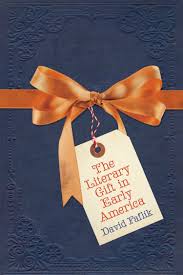
David Faflik. The Literary Gift in Early America. Stanford, CA: Stanford University Press, 2025. xi, 314 pages. ISBN 9781503639676. US $75.00 (cloth).
David Faflik’s book is a study, not of gift books per se, but of the “book as gift.” Faflik, an English Professor at the University of Rhode Island, departs from earlier attempts to define the “gift book,” or “literary annual,” such as Michael Felmingham’s The Illustrated Gift Book, 1880–1930 (Scolar Press 1989) and Katherine D. Harris’s Forget Me Not: The Rise of the British Literary Annual, 1823–1835 (Ohio University Press 2015), to focus on the gift book as a carrier of exchange—between giver and receiver, publisher and author, and author and reader.
Faflik presents his argument in the form of five “reception histories” (p. 2), with a mix of political figures (Roger Williams, Benjamin Franklin), poets (Walt Whitman, Emily Dickinson), and a successful antebellum writer (Catharine Maria Sedgwick) who was eagerly read by the audiences of that day. He uses these five authors to establish his thesis: that we can only understand the development of a truly American literature by examining these writers’ circulation of gift books as a method of literary (and financial) exchange. Gift books are important, Faflik states, not because they are material representations of thoughtfulness or advice-giving, but because, in the end, they circulate.
In chapter 1, Faflik examines Roger Williams’s A Key into the Language of America (1643). Now, A Key is not what most readers would call a typical gift book, with that genre’s literary content and ornamental features, that would develop in the late eighteenth century in England and in early nineteenth-century America. Williams’s book, instead, is a key to the language and customs of Native Americans. It was also, for Williams, a means of religious conversion and “an Implicite Dialogue” (p. 31) between the Old World and the New, between Christian and Native American readers. Faflik traces the transmission of The Key from its first edition printed in London to later American editions published in 1827, 1866, and 1936. The Key’s circulation across continents, between Native Americans and settlers, within a gentlemen’s bibliophilic society, and between libraries and historical societies makes it one of the earliest instances of the “giftedness” (p. 48) of all books in early America.
The chapter on Benjamin Franklin, politician, diplomat, and printer, tells the story of Franklin’s Poor Richard (1733), along with The Way to Wealth, an essay in Poor Richard that advises readers on the surest way to success. It became “a worldwide phenomenon” (p. 95) and was translated into numerous languages. Faflik’s examination of The Way is preceded by two perhaps overly long narratives on Franklin’s civic gifts to his country: his experimentation with electricity and his gift giving as a diplomat in France, where gift giving became so ingrained in diplomacy that an exchange between heads of state is now a requirement. It is here that Faflik cites Robert Darnton, arguing that not only was the book a part of the communications circuit, but it became its “engine” and a place “of perpetual motion of continuous exchange” (p. 70).
Faflik’s chapter on Catharine Maria Sedgwick, a contributor to what we now think of as the gift book, describes her as a literarily shrewd and successful author who had conflicting feelings about her own authorship and the material and financial exchange of gift books. While she profited from her published works, she expressed reservations about the entire business of gift book publication. Perhaps because she succeeded so well financially, she felt the need to present the moral argument for selfless gift giving in two of her novels, where the female protagonist personifies the ideal gift giver—the woman who not only gives material gifts, but provides a loving home for her family. This chapter also contains a useful description of the business history of literary annuals, from their marketing, sale, and critical reception to their arrival at the home of the recipient, who exhibited them, coffee-table style, to display her (and it was mostly “her”) learning and refinement.
In chapter 4, Walt Whitman’s Leaves of Grass, first published in 1855, takes center stage. Faflik explores the ambivalence with which Whitman offered his self-published book to the public. With its nontraditional self-portrait as the frontispiece to the personal and sexual openness of the text itself, Leaves might be seen as a gift from one common man to another. However, while he gave away numerous copies of the first edition, it was clear that Whitman, who had a background in printing and publishing, knew he had to sell his work to readers who might be reluctant to pay for Whitman’s experiment in free verse in a market flooded by cheap print. Revised four more times by the author, it was not until the edition of 1881–1882 (the first published by a mainstream publisher) that the poems appeared in diverse fonts, with distinctive ornamentation, paper, and bindings. For Faflik, this edition was the “epitome of Leaves’ movement toward the more obvious commercial manifestations of the American gift book” (p. 167). Whitman even offered an 1889 edition of his poems to the public as a holiday gift book entitled Gems from Walt Whitman.
The final chapter of Faflik’s book deals with the “contradictions” (p. 201) of American literary gift culture in the person of Emily Dickinson. Well known for her habit of “gifting” her manuscript poems to others, Dickinson was not above experiencing “a reception deficit” (p. 221) in both her poetry giving and letter writing. As a student, she kept count of letters received, a habit that continued with both her poetry and her letters for the rest of her life. Her “gift-poems” exhibit both her desire to disseminate her poetry and to withstand the “painful exchanges” (p. 220) resulting from unequal exchange between giver and receiver.
A brief conclusion and a substantial bibliography of primary and secondary sources round out the volume. Both scholars of book history and American literature will find Faflik’s unique approach—using a popular genre, the gift book, to describe a nascent American literature that was adventurous, changeable, and formally experimental—compelling and will want to read this book. Perhaps they, too, will want to participate in their own cultural (and perhaps resisting) exchange with this author.
Cecile M. Jagodzinski, independent scholar