
Evanghelia Stead. Goethe’s Faust I Outlined: Moritz Retzsch’s Prints in Circulation.
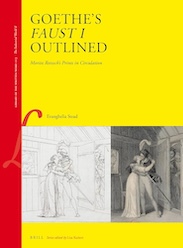
Evanghelia Stead. Goethe’s Faust I Outlined: Moritz Retzsch’s Prints in Circulation. Library of the Written Word—The Industrial World, vol. 113. Leiden, Boston: Brill, 2023. 480 pages. ISBN 9789004518551. US $209 (hardcover). ISBN 9789004543010 (Open Access e-book).
Even among the bibliographically sophisticated readers of SHARP News, few will recognize the name of German artist Moritz Retzsch (1779-1857). Yet many may find that they do know the work of this onetime “borderline celebrity” (p. 25). His etchings of scenes from Goethe’s Faust in the then fashionable “outline” form, coupled with many resultant imitations, appropriations, and remediations, played a significant and hitherto unacknowledged role in turning a demanding literary treatment of a German myth into part of the Western patrimony. In the process, these images gave us the Faust we (think we) know: the scenes of the flower oracle and kiss in the garden, the stage setting for Margaret’s chamber, and the figures of the three protagonists, Faust, Margaret, and above all, the sinuously sinister Mephistopheles. How that came to pass is the subject of this book.
The volume is divided into two broad sections. Chapters 1-7 deal with Retzsch’s images from their birth as drawings to their maturity and offspring in the world of print: original German editions (26 plates in 1816, three more in 1834) and reissues by Johann Friedrich Cotta of Stuttgart, domestic bootleg copies, and foreign adaptations. Chapters 8-12, meanwhile, trace the afterlives of these images across a wide range of material culture. This book is no mere checklist and gazetteer, however. Deep cross-cultural comparison is central to Stead’s task.
Retzsch’s etchings actually drove the reception of Faust abroad, foremost in Britain. The play, like the rest of Goethe’s oeuvre, was culturally as well as literally foreign, and it was the German images, first in their original form and then as local adaptations—Henry Moses re-engraved them to conform to British notions of religious and sexual propriety—that made the text culturally accessible. The iconography in turn inspired accompanying translations. Ironically, Retzsch’s images were a greater success in Britain than at home. Things unfolded differently in France, where translation preceded the arrival of Retzsch’s images, which were disseminated in a wider range of forms to a broader and more diverse readership.
Chapter 7 functions as a sort of hinge or pivot, resolutely empirical in its analysis of evolving imagery but also introducing a robust conceptual framework. In analogy to the history of reading, Stead asks us to see iconography, too, as divided between intensive and extensive: the latter here exemplified by the “veritable flood of [Faust] images” arising from a new culture of “multiple re-workings, reception, and aftermath” enabled by “novel techniques of multiplication and reproduction” (p. 242), the former by the way that Retzsch’s images fed “the re-imaginative process of different communities” (p. 253-254).
The volume’s latter half treats the fate of Retzsch’s “outlines ‘beyond outlines’” (p. 254) in forms as varied as parodies, theater sets, romantic gifts, or objects ranging from Prussian royal porcelain to such bourgeois consumer goods as pipe bowls, tin figurines, and lithopanes. Stead persuasively conveys the creativity inherent in imitation and even commodification. That Retzsch’s set of Faust images “was the broadest, cheapest, and easiest to copy” (p. 554) was a net positive, for “genuine interpretations may occur within repetition” (p. 212). And far from being “trivial” bastardizations, the seemingly kitschy objects offer “riddles or clues as to how Goethe’s Faust entered people’s lives through Retzsch” (p. 333). Two meticulous appendices provide a census of original and copied editions of Retzsch’s images (1816-1987) and derivative objects (1818-1979).
Stead’s book proposes to “combin[e] art history, book history, print culture, comparative literature, semiotics, and aesthetics” in a way that treats “books and prints as objects, media, and symbols” (p. 5). The key lies in the subtitle, “Prints in Circulation,” and the titles of the introduction and the conclusion: “Air View and Ant Perspective” and “Grains of Sands as Cities.” Although intent on refuting twentieth-century dismissals of Retzsch’s etchings as unimaginative and variously, cold or marred by sentimentality, Stead aims not merely to rehabilitate. Rather, moving constantly between microcosm and macrocosm, she challenges reductive binaries. For too long, critics have judged literary images based on aesthetic criteria alone or treated them as subordinate to the texts they supposedly represent (mere “illustration”), failing to see them, as in Retzsch’s case, as “inter-semiotic tools, making numerous claims on a text they borrowed from but also changed, all the while contributing to understanding, appreciating, and establishing it as canon” (p. 3). Retzsch, she demonstrates, read Faust “in extenso” (p. 80) and thanks to his “subtlety of line and veiled imaginative brio” (p. 62), “cleverly added numerous details . . . further opening up storyline vistas, as yet without words” (p. 2). Retzsch’s outline images created a partnership, inviting readers to become creative agents who filled in the details of the story using their own imaginations.
Finally, Stead also consistently and insistently asks us to consider the materiality of the printed image, including the “kinetic” (p. 81) experience of the reader: to contemplate the difference between “manhandling” (p. 49) a monumental double folio of Peter Cornelius’s Faust prints versus browsing the loose leaves of a Cotta portfolio or leafing through a bound English quarto and having to toggle between vertical text and landscape images.
Evanghelia Stead is the perfect person to have written this book; indeed, the only one who could have done so. A scholar of comparative literature and print culture, she has written extensively not only on Faust, but also on modern texts, theory, and iconography. “Originally a brief study,” Stead explains, “this book’s scope kept growing” (p. 356). (One thinks of Faust’s demonic poodle.) Based on manuscripts from a dozen archives and hundreds of primary and secondary print sources, it is weighty in all senses of the word: 480 pages comprising over 240,000 words and weighing in at 1.8 kg.
In this prodigious labor of love as well as research, the author has left no stone unturned. Some of the rich detail could perhaps have been trimmed to make room for discussion of larger questions, e.g. the place of Retzsch’s book in the literary-artistic program of the Cotta publishing house and its “Monopoly on the [German] Classics” under the great Johann Friedrich (“The Bonaparte of the Bookdealers”) and his more mercenary and less imaginative son Georg. Fortunately, the chapter introductions and subdivisions, along with the robust index, will allow all readers, from expert to amateur, to find their way.
The high production values, reflected in the hundreds of superb color images, make the book as beautiful as it is informative. Reading Stead’s book with my treasured copies of the Cotta originals and the Moses derivations at hand for reference, I not only came to see Retzsch’s images in a new light but also came away with a richer understanding of Faust itself. I can offer no higher praise. Stead’s book—a sort of scholarly Gesamtkunstwerk—now stands as the definitive treatment of its topic, and what is more, blazes new methodological and interpretive paths in interdisciplinary publishing history, iconography, and reception studies.
James Wald, Hampshire College