
Vanessa Warne. By Touch Alone: Blindness and Reading in Nineteenth-Century Culture.
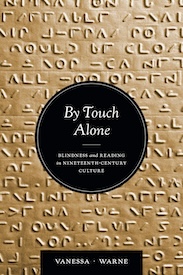
Vanessa Warne. By Touch Alone: Blindness and Reading in Nineteenth-Century Culture. Ann Arbor: University of Michigan Press, 2025. 208 pages. ISBN 9780472077519. US $85 (hardcover).
Vanessa Warne’s new book, By Touch Alone: Blindness and Reading in Nineteenth-Century Culture, is a much-needed addition to the small, but growing, intersection of book history, reading studies, and disability studies. This volume explores blindness and culture in the nineteenth century predominantly in English-speaking contexts through the reading and writing habits of blind authors and literary characters. Warne’s primary claim is “that the ability and opportunity to read by touch changed the lived experience of blindness, in part by changing perceptions of blindness and blind people” (p. 152). Throughout the book, Warne describes how being able to read—and, in some cases, write—improved the lives of blind and visually impaired people in the nineteenth century.
By Touch Alone focuses on the experiences of blind authors and fictional characters to describe the cultural effects—and the effects on culture—of improved access to reading through tactile books. Warne argues that “reading by touch transformed many people’s experiences of education, faith, social inclusion, and privacy,” although “the experience of reading raised-print books was shaped by class status and by gender, as well as by differences in readers’ experiences of disability” (p. 2–3). By examining essays, letters, and testimonials by blind readers, essays about blind readers by sighted people, and nineteenth-century fiction and poetry, Warne’s mixed methods and sources allow her to tell a holistic story of the growth and dissemination of tactile reading and writing.
The introduction is a fascinating overview of the history of disabled literacy, which includes brief descriptions of how some tactile codes—including raised print, moon, and braille—work and the timeframes in which they were invented and used, as well as some literary context from the Victorian era. Warne also uses this chapter to describe sighted people’s reactions to the rise of tactile reading for blind people, which adds important cultural and social context. This section would be an excellent introduction to disabled reading for a History of Reading or History of the Book course.
The next four chapters cover two topics: Chapters 1 and 2 primarily discuss reading, and chapters 3 and 4 primarily discuss writing. Chapter 1 considers public reading and the performance of reading, mainly from a context of the desire and need of blind people to earn income. Chapter 2 then discusses private reading “in more privileged contexts”—that is, reading for leisure and for study, in direct contrast to those reading as performance for money in the previous chapter (p. 31). Warne engages with the concept of “blindness gain” (rather than sight loss), which “challenges the ableist and ocularcentric values” of nondisabled experiences and allows for disability joy, celebration, and acceptance (p. 20). Within this context, Warne also explores how tactile reading allowed for and encouraged blind scholars.
Turning her attention to writing in chapter 3, Warne discusses dictation and the partnerships between blind writers and sighted amanuenses, which were sometimes problematic. Chapter 4 will be particularly compelling to readers interested in epistolary contexts, writing, and privacy. Warne explores how people with visual impairments were affected not only by the ability to read, but also the ability to write on their own. This chapter discusses some technology—including a printing frame, stamps, and guides—that allowed blind people to write independently, but often with spelling and grammatical errors or producing writing that was messy and difficult to read.
Warne’s focus on the nineteenth century is also particularly valuable. Raised type had been invented in the eighteenth century, but other systems such as Charles Barbier’s dot-based code, Louis Braille’s namesake code that is still used in over one hundred languages today, and William Moon’s eponymous code based loosely on the shapes of the Roman alphabet were all invented in the nineteenth century. Warne argues that “by 1862, the development and expansion of a canon of raised-print books for English-speaking blind readers was well underway but it was still a work in progress” (p. 158). The context throughout the book shows shifting preferences and the problematic prioritization of raised type by sighted people, even though raised type was more difficult to read than braille or moon and it did not allow blind people the freedom and privacy to write on their own.
Warne’s book will be valuable to scholars interested in print disabilities, nineteenth-century reading and culture, and adaptive writing and printing techniques. By Touch Alone begins to fill a large lacuna in book history by focusing on the perspectives of blind readers and how they are affected by, and in turn affect, technological improvements in ink writing, embossing, and reading tactilely. This book effectively prioritizes the perspectives of people with visual impairments, but it also explains the reactions to tactile reading by sighted people of the time and how that, in turn, affected blind readers. The cultural history, literary context, and mixed methods approach is an extremely valuable contribution to both book history and disability studies.
Ellen Forget, University of Alberta