
Alexis Easley, ed. British Writers, Popular Literature, and New Media Innovation, 1820-45.
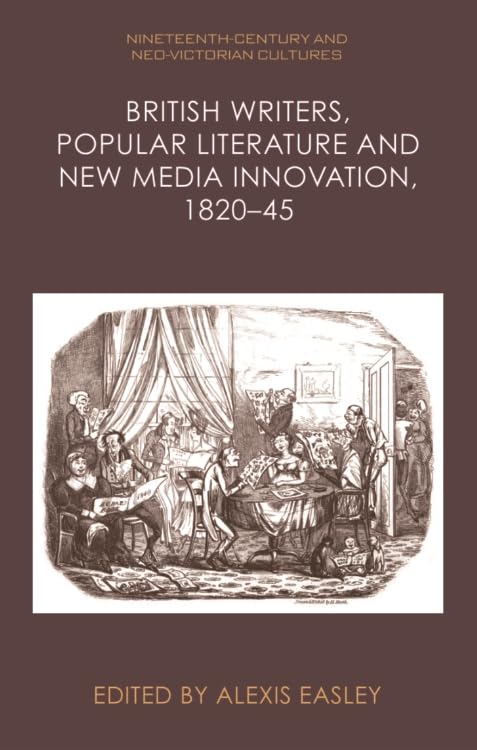
Alexis Easley, ed. British Writers, Popular Literature, and New Media Innovation, 1820-45. Edinburgh: Edinburgh University Press, 2024. xv + 320 pages. ISBN 9781399514002. US $125 (hardcover).
In his essential new monograph Digital Victorians (Stanford University Press, 2024; reviewed in this issue of SHARP News), Paul Fyfe convincingly argues that the digital age—the age of self-reflective mass consumption of new media—began not in the twentieth century, but in the 1840s. Just as convincingly and significantly, British Writers, Popular Literature, and New Media Innovation, 1820-45, edited by Alexis Easley, backdates the new media revolution to the 1820s. Easley and company argue that the Age of Reform, often dismissed as a gap between Romantic and Victorian eras, was in fact an exciting time that saw “the emergence of the first ‘mass media’”: popular periodicals and newspapers (p. 5). These media cultures in turn created new kinds of authors or categories of authorship, including corporate authorship, an explosion of anonymous and pseudonymous publications, and new kinds of literary celebrity, such as the posthumously famous woman poet. They also gave rise to recognizable features of modern publishing, such as a systematized advertising industry, women’s magazines, and a culture of celebrity that included portraiture, celebrity evasion of publicity, and public bereavement for deceased celebrities.
The twelve essays in this volume explore early nineteenth-century Britain’s new media, modes of production, and types of authors, editors, illustrators, publishers, and readers. Some essays reveal that the features of media culture we tend to take for granted today had definite origins in 1820-40. Mark Turner’s essay “‘Collect and Simplify’: Serial Miscellaneity and Extraction in the Early Nineteenth Century,” is one example. Although it can seem that the media has always practiced “extractive miscellaneity,” or creation of new narratives by remixing cut-and-paste contents from other periodicals, this practice began in that era, and by the late 1800s had begun to “align with the extractive” (in the economic sense) “forces in colonialism” (p. 19). In 1832, the year of the Great Reform, a journalist called the extracted contents of a periodical miscellany “stolen goods” (p. 24). Chris Haffenden concurs, and in “William Hazlitt and Celebrity Culture: Periodical Portraits in an Age of Public Intimacy” notes the normalization of such intellectual property theft. Serialization of extracted contents, organized into series such as Charles Knight’s “National Library” (1826-7), normalized intellectual property theft long before generative AI tech bros did.
Apolitical humor writing found in the British pictorial comic book annuals such as Beano and the like also seems to have always existed, but as Regency comic publishing expert Brian Maidment shows, this too was an 1830s media innovation. The rise of wood engraving (“woodcuts were not so much cutting as amusing or diverting”), proliferation of women readers, and formatting that precluded complex textual explanation of images produced comic annuals in which humor was not literate, politically-charged wit, but supposedly apolitical, not very clever “fun” (p. 82). Reacting to this development, 1830s annuals also cultivated what Maidment terms “mirth,” or a retro infusion of cleverness into humor, a coping device often prescribed by comic authors as an antidote to “melancholy” (p. 89). By the mid-1830s, the two modes converged, with leading comic authors such as Thomas Hood “rethinking mirth as fun” (p. 94), while the caricaturist Robert Seymour, “the most prolific and experienced practitioner of the new small-scale humorous wood engravings that gave commercial impetus to a whole new range of comic print forms,” developed mirth’s potential, preparing the way for the metacritical cartooning of the Victorian era and beyond (p. 103).
In 2024, it is obvious that the media shapes political realities. That, too, has precedents in the 1830s. Sofia Prado Huggins demonstrates that The Anti-Slavery Reporter, the newspaper of the Anti-Slavery Society, played a crucial role in the 1834 abolition of slavery in Britain’s Caribbean colonies. Its trans-imperial reach, “cross-class readership,” “direct political impact,” and incorporation of Black voices (albeit mediated by white ones) made The Anti-Slavery Reporter “a striking example of the social force of nineteenth-century new media” (p. 223). Readers experienced it in their own (metropolitan or colonial) local spaces and also “as a space” for progressive political discourse (p. 224). Cultivating “a degree of respect” for its colonial sources (p. 237), The Anti-Slavery Reporter embraced “island Britons” and “white colonials” as long as they agreed to remove “the barrier of slavery” (p. 227). This quality made the periodical a “thirdspace,” or “alternative to the binary of real versus imagined space” (p. 224)—like, well, the internet.
The media technologies that British Writers, Popular Literature, and New Media Innovation, 1820-45 tours are not limited to print. As Sara L. Maurer shows, oral communication is an extremely ephemeral information technology, specifically in the context of charitable visiting. In “The Media System of Charitable Visiting,” Maurer unpacks how this practice solidified into a discrete medium that supported an organized system of visitors and beneficiaries who created an information culture with complex rules and real consequences, with “the visitor…a vessel that might carry multiple types of content between the clergy and the people,” not unlike “a newspaper” (p. 249). Maurer’s chapter reveals that often the most sophisticated information format is speech and that some aspects of lost speech networks, such as the composition of oral communities, are, in fact, recoverable today.
Fyfe’s Digital Victorians proposes the notion of a new media-focused nineteenth century, but called upon other writers to reveal its scope. In British Writers, Popular Literature, and New Media Innovation, editor Alexis Easley accomplishes this goal by curating a broad range of essays from field luminaries and relatively new voices. Few edited volumes support a central idea as clearly as this one does. Read together, the twelve chapters flesh out the surprising modernity of the Age of Reform. Any SHARP members interested in the history of publishing, the development of the modern digital age, or the problems inherent in periodicity as a scholarly organizing function must read this volume.
Rebecca Nesvet, University of Wisconsin, Green Bay