
Sarah Peters Kernan and Helga Müllneritsch, eds. Culinary Texts in Context, 1500-1800: Manuscript Recipe Books in Early Modern Europe.
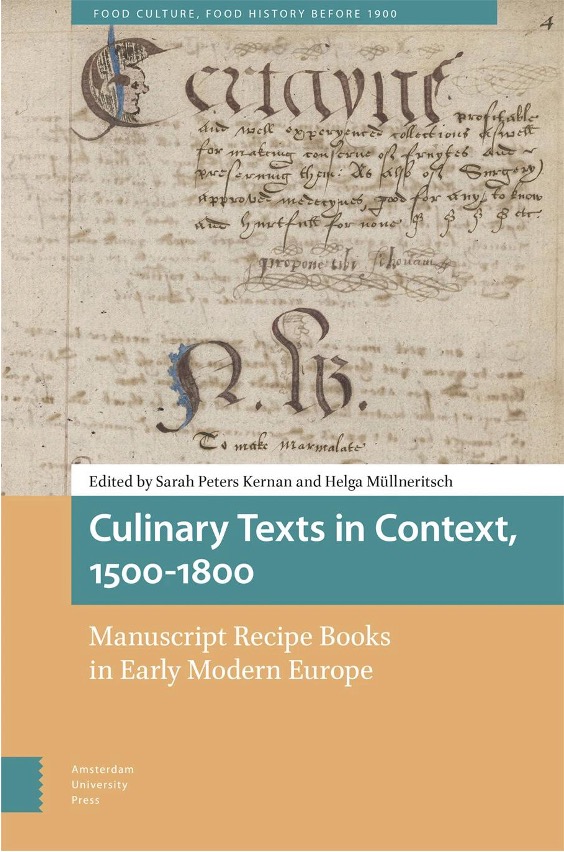
Sarah Peters Kernan and Helga Müllneritsch, eds. Culinary Texts in Context, 1500-1800: Manuscript Recipe Books in Early Modern Europe. Amsterdam: Amsterdam University Press, 2024. 286 pages. ISBN 9789463727792. €129.00 (hardcover).
This book contains nine chapter-length studies of recipe collections transmitted in early modern manuscripts produced in western Europe. Editors Sarah Peters Kernan and Helga Müllneritsch group these studies into four sections and bookend them with an uncommonly insightful introduction and brief concluding remarks. Twenty-seven sharp black-and-white images of manuscripts support five of the chapters. The editors deserve praise for a collection in which all the contributions achieve a high standard for sound scholarship, participation in ongoing conversations in the history of cookbooks, and the ability to engage readers.
The opening section on “Collecting Recipes” considers the act of collecting on two scales: the assembly of recipes into individual manuscripts, and the assembly of manuscripts into libraries. Lucy J Havard examines fifteen recipe collections initiated in seventeenth- and eighteenth-century England and attributable to families or individual women from the middle and upper classes. Havard scrutinizes user-added paratexts and codicological features, exploring why, how, and for whom the knowledge of cooking, medicine, and household labor was recorded in writing. Next, Barbara Denicolò provides an account of the cookery books that became part of the Herzog August Library in Wolfenbüttel during Duke August the Younger’s lifetime (1759–1666), contextualizing them within the Duke’s biography and his correspondence with brokers in the book trade.
The second section, “International Transmission,” focuses on recipes that travel across political and cultural borders. The section opens with Annamaria Valent’s study of a manuscript belonging to the Granville family, in which numerous Iberian recipes were transmitted back to England through the mediation of Sir Martin Westcombe, an English consul at Cadiz in the late seventeenth century. Valent points out distinctive recipes and rare ingredients, and she explains how Westcombe gathered recipes from his contacts in Iberia. Maren Jonasson and Märtha Norrback analyze six Swedish-language recipe collections originating in Finland during the period ca. 1720–1850, when Finland was under Swedish and then Russian rule. Building on descriptions of each manuscript, the authors establish broader observations about culinary taste, conspicuous consumption, and family networking among Swedish and Finnish elites.
Both of the chapters in the third section, “Professional and Trade Ownership,” focus on cookbooks written by men. Marta Manzanares Mileo’s chapter discusses recipe collections compiled by men of the Barcelona confectioners’ guild during the seventeenth and eighteenth centuries. Some of these manuscripts incorporate pedagogical materials, such as dialogues about confectionery theory and practice, that helped young confectioners study for their qualifying exams. Isabel Drumond Braga offers a richly descriptive account of the Portuguese-language recipe collection ascribed to the cook Francisco Borges Henriques and written in the 1710s and 1720s. This study calls attention to confectionery and preserving techniques, international ingredients such as tomatoes and couscous, specialized cooking equipment, and the distinction between recipes that are genuinely collected abroad and those that merely imitate the culinary styles of foreign regions.
The final section on “Women’s Manuscript Culture” includes three chapters that intervene in ongoing scholarly conversations concerning the intersection of gender, authorship, and domestic labor. Naomi Preston analyzes selected French medicinal recipes that Anne de Croy, Princess of Chimay, collected in a manuscript dated 1533. Preston posits that the presence of extraordinarily expensive ingredients in well-born women’s recipes may have signified more than conspicuous consumption in the usual sense: in the context of a handwritten recipe collection, such ostentation represents subtle resistance to the socioeconomic levelling associated with the emerging culture of printed books. Marlene Ernst’s chapter foregrounds how recipe manuscripts can be used to trace interpersonal networks, then takes as a case study the recipe collection, dated 1654, of Maria Clara Dückher, the wife of an Austrian Pfleger (provincial administrator). Lastly, Elizabeth Ridolfo considers the recipe manuscript written by Mary Leadbeater, a middle-class Irish Quaker (1758–1826). Whereas most female authors and compilers of recipes in early modern Europe are scarcely attested outside their recipe collections, Leadbeater left a vast legacy of published writings, personal journals, and correspondence, which Ridolfo deftly uses to flesh out her portrayal of Leadbeater as a reader, author, healer, and socially conscious Quaker.
The linguistic and socioeconomic variety of primary sources represented in this volume is the fruit of intentional cultivation by the editors Kernan and Müllneritsch. As they explain in their introduction, they selected contributions that would enlarge readers’ understanding of trends that connect recipe manuscripts across western Europe and also represent the critical methods that currently predominate in western European scholarship on this topic.
The book’s methods and materials cater to several distinct audiences at once. Seasoned specialists in the study of handwritten recipe collections will appreciate the wealth of fresh primary-source data and analysis. Readers who specialize in cookbooks but have not been trained in the discipline of manuscript studies will benefit from the chapters that model how to analyze manuscript artifacts. In particular, Havard’s chapter illustrates how to ask productive questions about material, codicological features, and user-added paratexts, while Denicolò’s chapter shows how to navigate an early modern book collection by studying its founders, their correspondence, and early modern library catalogs. Readers who are already steeped in early modern literary and social history, meanwhile, will find an accessible, efficient introduction to the prominent scholars and conversations in the fields of early modern European culinary history and cookbook studies. The essays complement one another by returning to key topics such as the relationship among culinary, medical, and household recipes; the role of the cookbook as a rare forum in which women could assert their creativity and domestic expertise in writing; the exchange of recipes or of entire books as a means of strengthening social bonds; the material culture of the kitchen and the food marketplace; the arrival of exotic foods from Asia and the Western Hemisphere; culinary fashions and tastes at different socioeconomic strata; and the idea that recipes, unless modified by written affirmations that the recipe has proved efficacious, represent ideals and aspirations rather than a record of foods that were actually prepared and served.
Finally, Kernan and Müllneritsch’s volume expressly encourages readers to continue the conversations they encounter here. Nearly every chapter either identifies potential next steps in the investigation of the primary sources under consideration, introduces readers to repositories of digitized recipe manuscripts that are accessible without travel, or familiarizes readers with the numerous thriving online collaboratives for the study of recipe collections in manuscript. And though the volume promotes the use of digital resources, it also reflects on what is lost when researchers consult only digital proxies, advocating for readers to value and pursue in-person study.
Leslie Lockett, The Ohio State University